
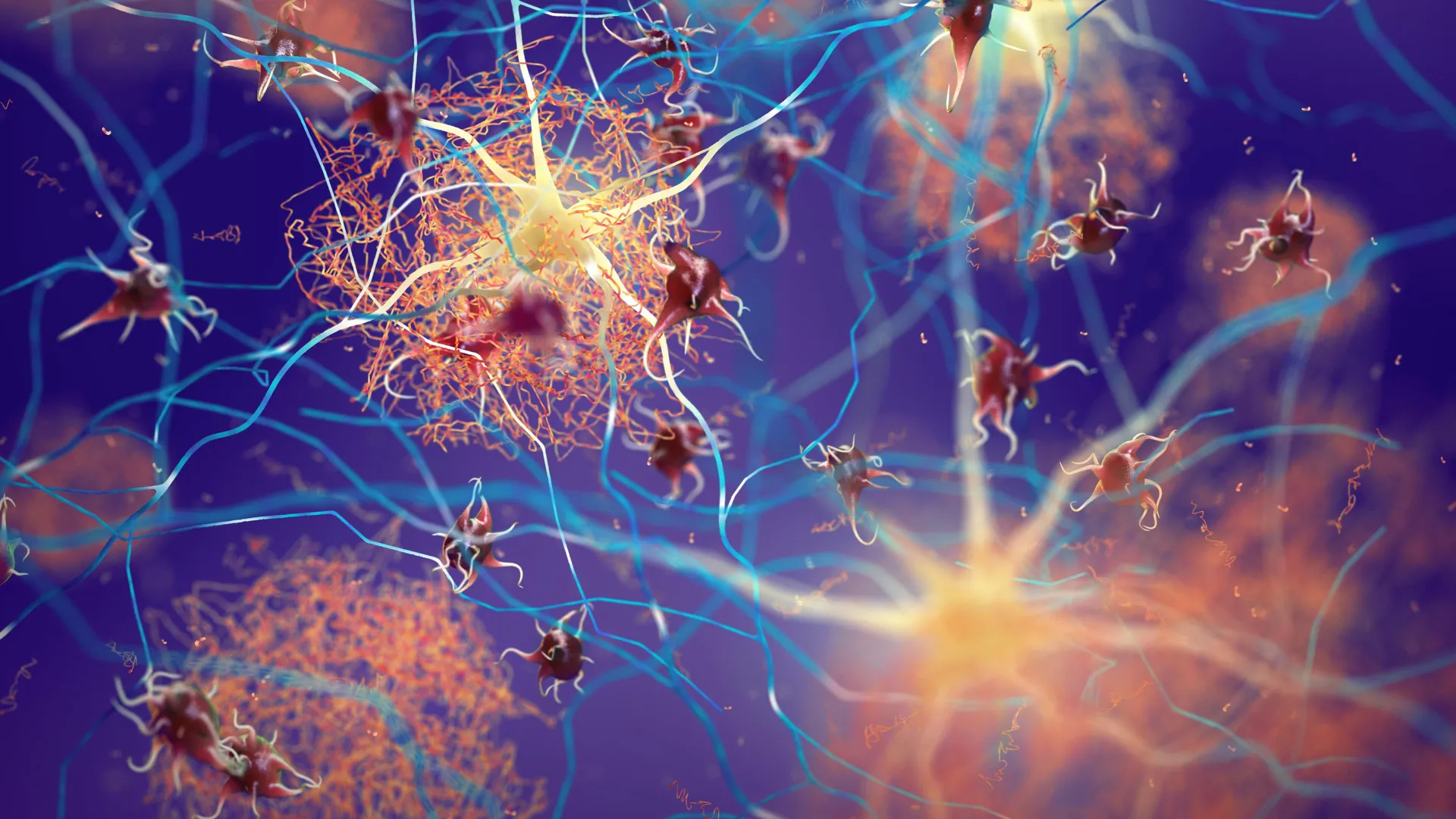
Scientists at Karolinska Institutet in Sweden and the RIKEN Center for Brain Science in Japan have identified two brain receptors that help regulate the breakdown of amyloid beta, the protein that builds up in Alzheimer’s disease. Their findings suggest it may be possible to develop future medications that are both safer and more affordable than today’s antibody based treatments.
Alzheimer’s disease is the leading cause of dementia and is marked by sticky clumps of amyloid beta (Aβ) forming plaques in the brain. Normally, an enzyme called neprilysin helps clear away Aβ. However, neprilysin activity declines with aging and during the progression of the disease. The research team discovered that two somatostatin receptors, SST1 and SST4, work together to control neprilysin levels in the hippocampus, a region essential for memory. The findings were published in the Journal of Alzheimer’s Disease.
Boosting the Brain’s Natural Defense System
The researchers conducted experiments using genetically modified mice and laboratory grown cells. When both SST1 and SST4 receptors were missing, neprilysin levels dropped. As a result, amyloid beta accumulated and the mice showed memory problems.
The team also tested a compound designed to activate these two receptors. In mice with Alzheimer’s-like brain changes, stimulating SST1 and SST4 increased neprilysin levels, reduced amyloid beta buildup, and improved behavior. Importantly, the treatment did not cause serious side effects.
“Our findings show that the brain’s own defence against amyloid beta can be strengthened by stimulating these receptors,” says Per Nilsson, docent at the Department of Neurobiology, Care Sciences and Society, Karolinska Institutet.
Toward Safer and More Affordable Alzheimer’s Drugs
Many of the most advanced Alzheimer’s therapies currently rely on antibodies. While these treatments can target amyloid, they are extremely expensive and may trigger significant side effects in some patients.
“If we can instead develop small molecules that pass the blood-brain barrier, our hope is that we will be able to treat the disease at a significantly lower cost and without serious side effects,” says Per Nilsson.
SST1 and SST4 belong to a large family of proteins known as G protein-coupled receptors. These receptors are common drug targets because they are well understood and often respond to medications that can be produced at lower cost and taken in pill form.
The project brought together researchers from Karolinska Institutet in Sweden, RIKEN Center for Brain Science in Japan, and several other international universities. Funding was provided by organizations including the Swedish Research Council, the Hållsten Research Foundation, the Alzheimer’s Foundation and the private initiative Innovative ways to fight Alzheimer´s disease — Leif Lundblad Family and others and RIKEN. The researchers report no conflicts of interest.