
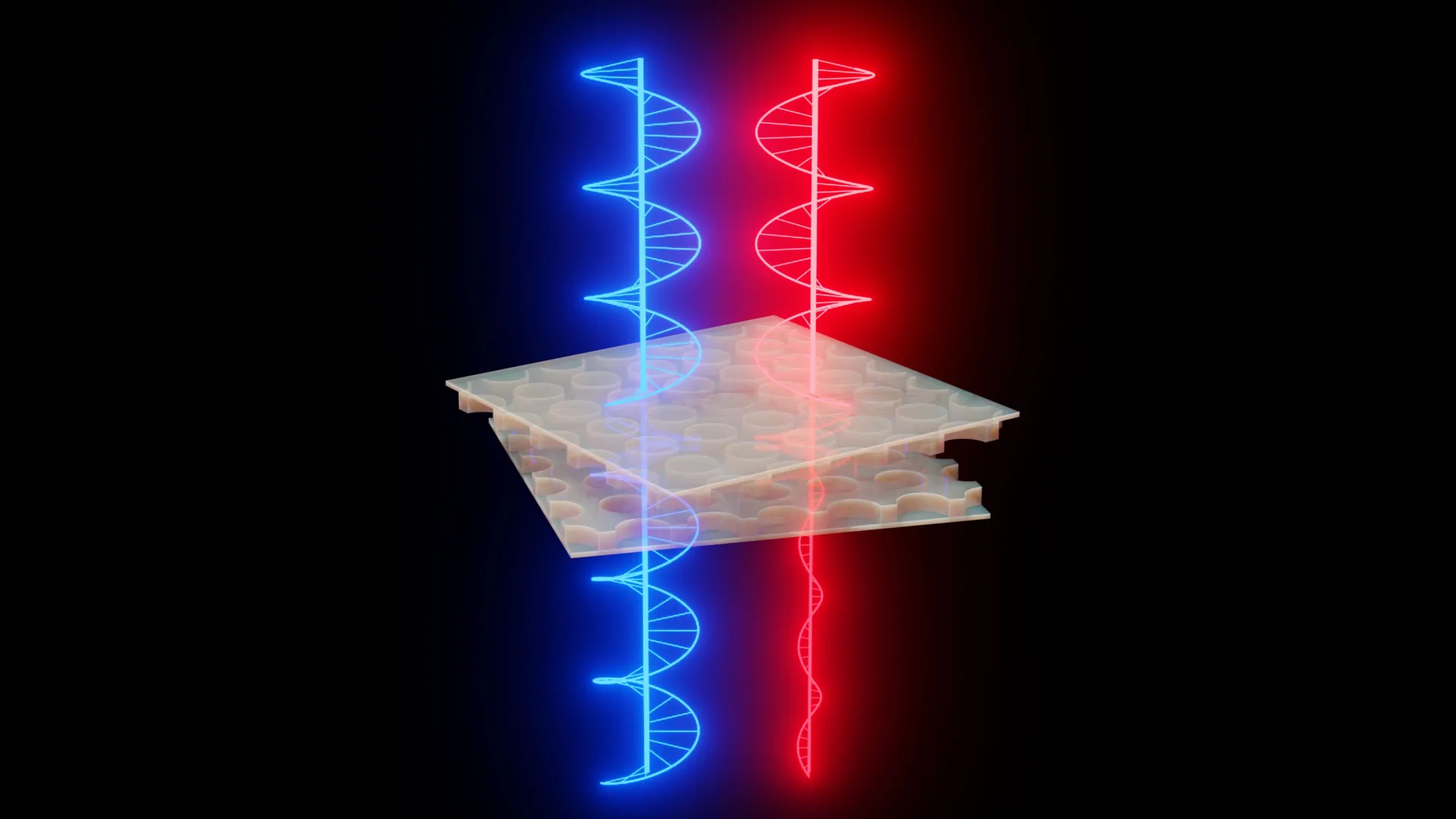
Researchers at the Harvard John A. Paulson School of Engineering and Applied Sciences (SEAS) have created a compact device that can actively control the “handedness” of light as it passes through it, also known as optical chirality. This is achieved by slightly rotating two specially engineered photonic crystal layers.
The project was led by graduate student Fan Du in the lab of Eric Mazur, the Balkanski Professor of Physics and Applied Physics. The team designed a reconfigurable twisted bilayer photonic crystal that can be adjusted in real time using an integrated micro-electromechanical system (MEMS). This advance could enable new capabilities in chiral sensing, optical communication, and quantum photonics.
“Chirality is very important in many fields of science — from pharma to chemistry, biology, and of course, physics and photonics,” Mazur said. “By integrating twisted photonic crystals with MEMS, we have a platform that is not only powerful from a physics standpoint but also compatible with the way modern photonics are manufactured.”
Twisted Photonic Crystals and Light Manipulation
Photonic crystals are nanoscale materials designed to control how light behaves. These structures, small enough to fit on the tip of a pin, are already used in technologies for computing, sensing, and high-speed data transmission.
Mazur’s group has expanded this field by applying ideas from twistronics, a concept that gained attention through research on twisted bilayer graphene. By stacking two patterned silicon nitride layers and rotating them relative to each other, the researchers can create new optical properties that do not exist in a single layer.
In their study published in Optica, the team demonstrates that this twisted bilayer structure naturally introduces asymmetry between left and right, making it highly effective for controlling light chirality. Chirality refers to objects that cannot be superimposed on their mirror images, like left and right hands. In optics, this concept applies both to materials and to light itself, which can travel in a helical pattern.
Light can rotate clockwise, known as right-circular polarization, or counter-clockwise, known as left-circular polarization. While these differences are subtle, they play a critical role in many scientific applications.
Why Chirality Matters in Science
Small differences in chirality can have major consequences. In chemistry and medicine, molecules that are mirror images of each other can behave very differently in the body. A well-known example is thalidomide, a drug from the 1950s. One version of the molecule helped treat morning sickness in pregnant women, while its mirror image caused serious birth defects.
Scientists often use chiral light to study such molecules. Traditional tools, including wave plates and linear polarizers, can detect polarization but are fixed in their capabilities and limited in range.
Tunable Photonic Device With MEMS Control
The new Harvard device overcomes these limitations by being fully tunable. Instead of relying on static components, its response to different types of chiral light can be adjusted continuously without replacing any parts.
This flexibility comes from its bilayer design. When the two photonic crystal layers are brought close together and rotated, the structure becomes geometrically chiral and capable of detecting the handedness of incoming light. Strong interactions between the layers lead to very different transmission behaviors for left- and right-circularly polarized light under “normal incidence,” or polarized light that hits perpendicular to the surface.
By using the MEMS system to precisely control both the twist angle and the spacing between layers, the researchers demonstrated that the device can be tuned to near-perfect selectivity when distinguishing light’s handedness.
Future Applications in Sensing and Communications
The study also outlines a broader design strategy for creating twisted bilayer photonic crystals with controllable optical chirality. Although the current device serves as a proof of concept, it points toward practical applications.
Future systems could be used in chiral sensing, where devices are tuned to detect specific molecules at different wavelengths. They could also function as dynamic light modulators in optical communication systems, allowing precise control of light directly on a chip.
The paper, “Dynamic Control of Intrinsic Optical Chirality via MEMS-Integrated Photonic Crystals,” was co-authored by Haoning Tang, Yifan Liu, Mingjie Zhang, Beicheng Lou, Guangqi Gao, Xuyang Li, Alsyl Enriquez, and Shanhui Fan.