
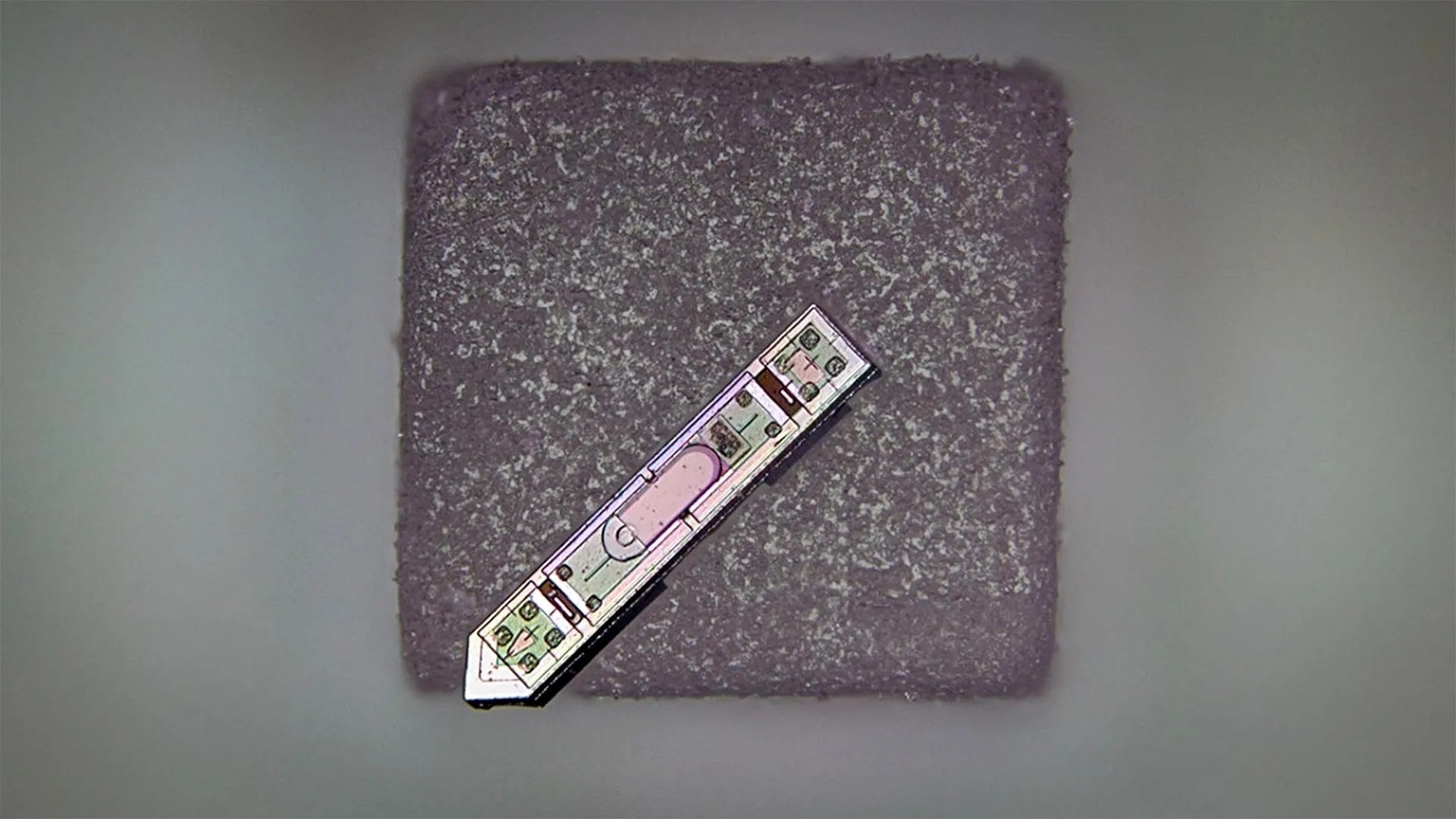
Researchers at Cornell University, working with collaborators, have created an extremely small neural implant that can sit on a grain of salt. Despite its size, the device can wirelessly transmit brain activity data from a living animal for more than a year.
The advance, reported in Nature Electronics, shows that microelectronic systems can operate at a remarkably small scale. This could open the door to new approaches in brain monitoring, bio-integrated sensors, and other medical and technological uses.
What Is the MOTE Device
The device is known as a microscale optoelectronic tetherless electrode, or MOTE. Its development was led by Alyosha Molnar, a professor in the School of Electrical and Computer Engineering at Cornell, along with Sunwoo Lee, an assistant professor at Nanyang Technological University. Lee began working on the technology earlier as a postdoctoral researcher in Molnar’s lab.
How the Implant Uses Light to Transmit Brain Signals
The MOTE operates using red and infrared laser beams that safely pass through brain tissue. It sends data back by emitting tiny pulses of infrared light that encode electrical signals from the brain.
At the core of the device is a semiconductor diode made from aluminum gallium arsenide. This component captures incoming light to power the system and also emits light to transmit data. The implant also includes a low-noise amplifier and an optical encoder, both built with the same type of semiconductor technology used in everyday microchips.
The device measures about 300 microns in length and 70 microns in width.
“As far as we know, this is the smallest neural implant that will measure electrical activity in the brain and then report it out wirelessly,” Molnar said. “By using pulse position modulation for the code — the same code used in optical communications for satellites, for example — we can use very, very little power to communicate and still successfully get the data back out optically.”
Future Applications for Brain and Body Monitoring
According to Molnar, the materials used in the MOTE could allow researchers to record brain activity during MRI scans, something that is largely not possible with current implants. The technology may also be adapted for other parts of the body, including the spinal cord, and could eventually be combined with future innovations such as opto-electronics embedded in artificial skull plates.