
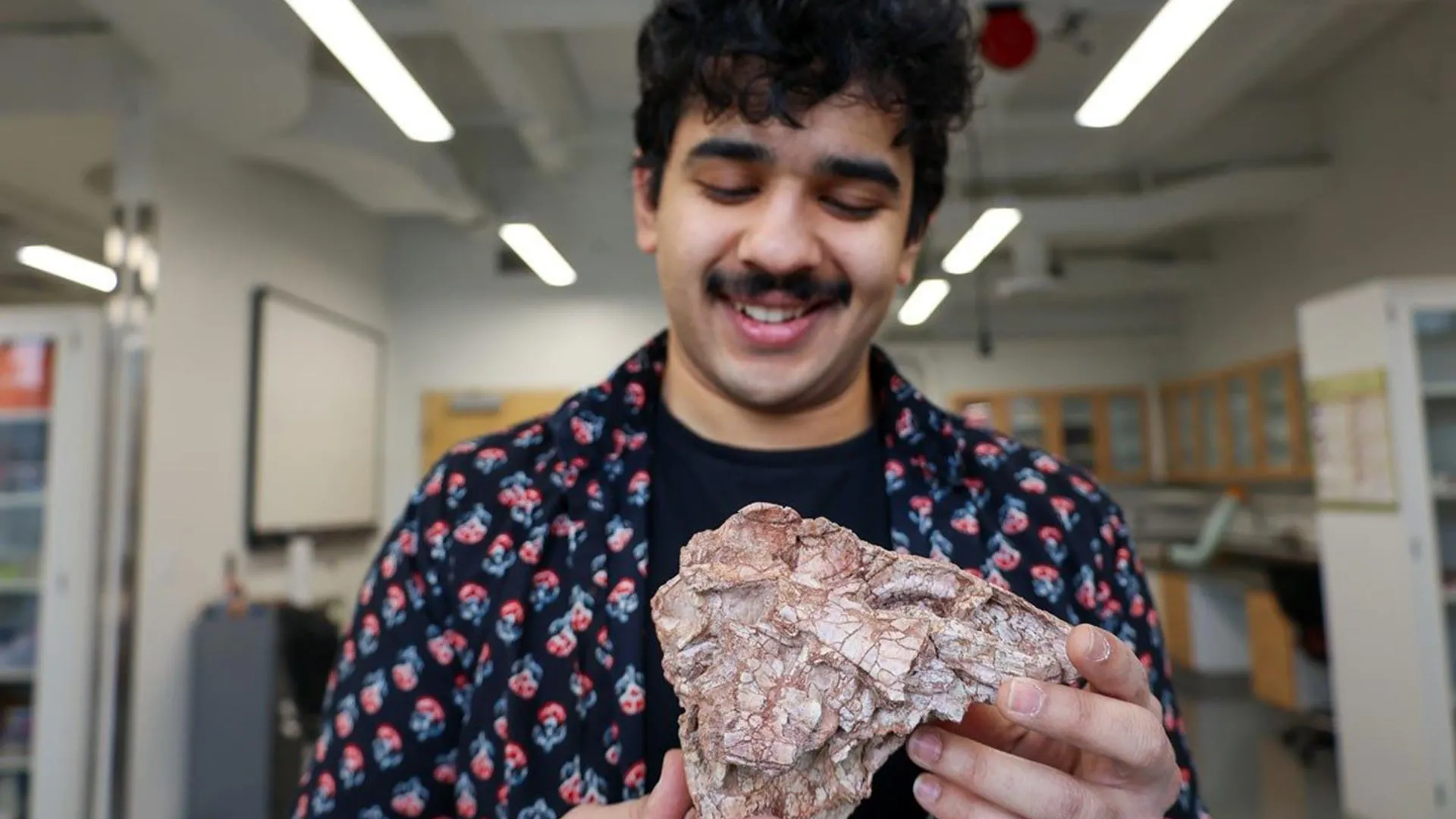
“You want to stick your finger in a dinosaur brain?” asked Simba Srivastava.
Inside a paleobiology lab lined with cabinets of ancient fossils, the Virginia Tech undergraduate held up a rough, pitted skull.
“This is a uniquely sucky specimen,” said Srivastava. “It’s so bad. Like, if you saw a human skull in this way, you’d throw up.”
Despite its poor condition, the senior geosciences major spent two years carefully reconstructing the fossil and figuring out where it fits in the evolutionary history of dinosaurs. His work, published in Papers in Palaeontology, offers new insight into how dinosaurs rose to dominance during the Jurassic period.
Although this kind of research is typically handled by experienced scientists, geobiologists Sterling Nesbitt and Michelle Stocker brought Srivastava onto the project as a first-year student.
“We want undergraduate researchers to experience the whole paleontological research process at Virginia Tech,” said Nesbitt. “Simba grabbed the project by the reins.”
Reconstructing a Rare Dinosaur Skull
The fossil had an unusual history. It was first discovered in 1982 by a team from the Carnegie Museum of Natural History at Ghost Ranch in New Mexico. More than 30 years later, Nesbitt rediscovered it in a drawer and brought it to Virginia Tech for further study.
Using computed tomography scanning data, Srivastava digitally separated the crushed bones and created a 3D printed reconstruction of the skull.
The fossil belonged to a carnivorous dinosaur species that lived more than three times earlier than Tyrannosaurus Rex.
These animals lived near the end of the Triassic period, which lasted from about 252 million to 201 million years ago. At that time, dinosaurs were not yet the dominant predators often seen in movies. They competed with early relatives of crocodiles and mammals for survival.
How Dinosaurs Rose to Power
That balance changed dramatically after a mass extinction event eliminated much of the competition. As the Triassic period ended, dinosaurs quickly became the dominant land animals.
“Dinosaurs go from being co-stars to the headliner,” Srivastava said.
Fossils from this critical transition are rare, especially well-preserved ones from the end of the Triassic. That makes this damaged skull especially valuable.
In fact, no other specimen like it has been found.
Even in its distorted state, the fossil revealed important details. The dinosaur had large cheekbones, a broad braincase, and likely a short, deep snout. These features had not been seen before in early dinosaurs, suggesting they were evolving in more complex ways than previously understood.
A New Species With a Strange Look
Srivastava named the new species based on its unusual appearance.
“We landed on Ptychotherates bucculentus, which means ‘folded hunter with full cheeks’ in Latin,” said Srivastava. “One paleo-artist said that it looked like a murder muppet.”
After years of analysis, the team determined that this dinosaur belonged to Herrerasauria, one of the earliest groups of carnivorous dinosaurs. It appears to have been among the last surviving members of this lineage.
Rethinking the End-Triassic Extinction
The fossil led to another unexpected conclusion.
Ptychotherates was found in rock layers that may date to just before the mass extinction at the end of the Triassic period, and no other members of its group have been found after that time, possibly suggesting that this dinosaur group went extinct as a result of that mass extinction.
“This forces us to reconsider the impact of the end-Triassic extinction as something that wiped out not just the competitors to dinosaurs, but some long-standing dinosaur lineages themselves,” Srivastava said.
Because no herrerasaurians have been discovered elsewhere from such a late point in the Triassic, scientists think the region that is now the American Southwest may have been their final refuge.
One Fossil, an Entire Lost Lineage
Srivastava’s “folded hunter” may be the only remaining evidence of this group’s final chapter.
“This specimen, it fits in my hands, but it is the only proof that any of these dinosaurs lived this long, lived in these latitudes, the only proof that they evolved to have this skull shape,” said Srivastava. “All these billions of individuals that existed through time are spoken for by this one specimen.”