
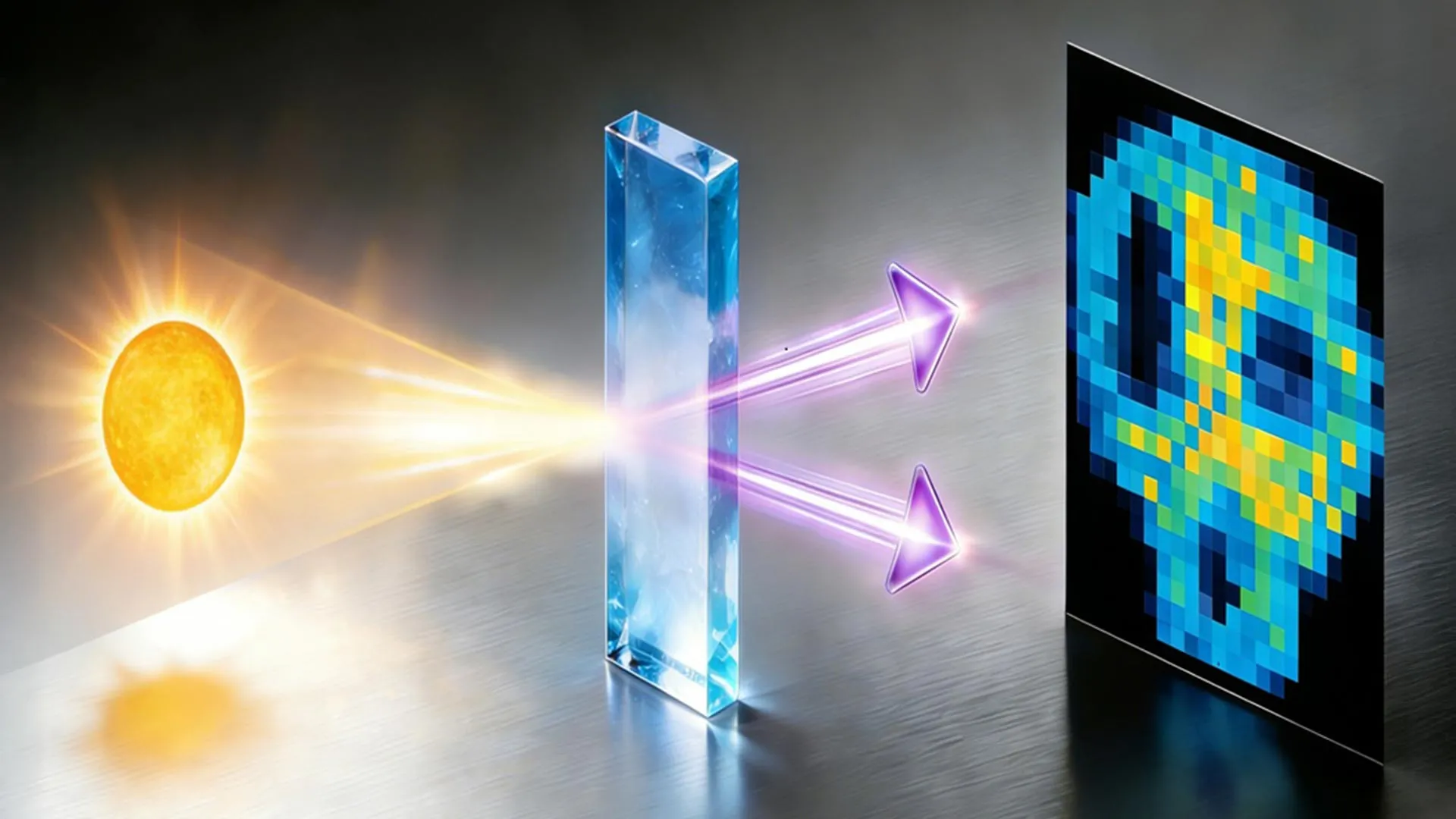
Correlated and entangled photon pairs are essential tools in quantum optics. Scientists usually create these photon pairs through a process called spontaneous parametric down-conversion (SPDC), in which a powerful, highly stable laser shines into a nonlinear crystal. Because SPDC depends so heavily on coherent laser light, researchers have long considered the technique impractical outside carefully controlled laboratory environments.
More recently, studies have shown that perfectly coherent light is not actually required for SPDC to work. Even partially coherent light sources can produce correlated photon pairs, while also transferring some of their own coherence properties to the generated photons. That discovery led researchers to ask an intriguing question: could sunlight itself be used to generate correlated photon pairs?
Using Sunlight for Quantum Optics
Turning sunlight into a usable SPDC source comes with major obstacles. Sunlight reaching Earth constantly fluctuates in brightness, direction, and position, making it difficult to maintain the precise alignment needed for SPDC experiments and photon detection.
At the same time, sunlight offers a major advantage. Unlike lasers, it does not require electrical power or complex laboratory equipment. A sunlight-based system could potentially operate in remote locations or even in space where traditional laser systems may be impractical.
A research team led by Wuhong Zhang and Lixiang Chen at Xiamen University has now demonstrated a working solution. Writing in Advanced Photonics, the scientists described an experimental setup that uses sunlight as the only pump source for SPDC.
Their system includes an automatic sun-tracking device similar to an equatorial telescope mount. The tracker continuously follows the Sun throughout the day and directs sunlight into a 20 m plastic multimode optical fiber. The fiber transports the light into a dark indoor laboratory, where it pumps a periodically poled potassium titanyl phosphate (PPKTP) nonlinear crystal.
Sunlight Successfully Produces Correlated Photon Pairs
Despite the instability of natural sunlight, the setup successfully generated photon pairs with strong position correlations. To test the system, the researchers used the photon pairs for ghost imaging, a quantum imaging technique in which images are reconstructed using correlated photons instead of direct spatial detection.
The sunlight-driven system achieved a ghost-imaging visibility of 90.7%, close to the 95.5 percent visibility produced by a standard 405 nm laser operating at the same pump power.
Beyond simple double-slit imaging, the researchers also reconstructed a more detailed two-dimensional image described as a “ghost face.” The result demonstrated that the sunlight-powered system could handle more complex spatial patterns.
According to the researchers, sunlight’s broad spectrum helps support quasi-phase matching inside the nonlinear crystal, allowing the production of large numbers of position-correlated photon pairs. By collecting data over extended periods, the team improved both the signal-to-noise and contrast-to-noise ratios, showing that the system could maintain stable performance despite natural fluctuations in sunlight.
A Fully Passive Quantum Imaging System
The experiment marks the first successful demonstration of sunlight-pumped SPDC combined with ghost imaging. By removing the need for lasers and external electrical power, the system creates a fully passive source of correlated photon pairs.
The researchers believe the technology could prove especially useful for future quantum imaging and quantum information systems used in remote environments or space-based applications.
They also noted that advances in sunlight collection, crystal engineering, and image reconstruction methods, including compressed sensing and machine learning, could further improve image quality and imaging speed while helping move the technology closer to practical real-world use.