
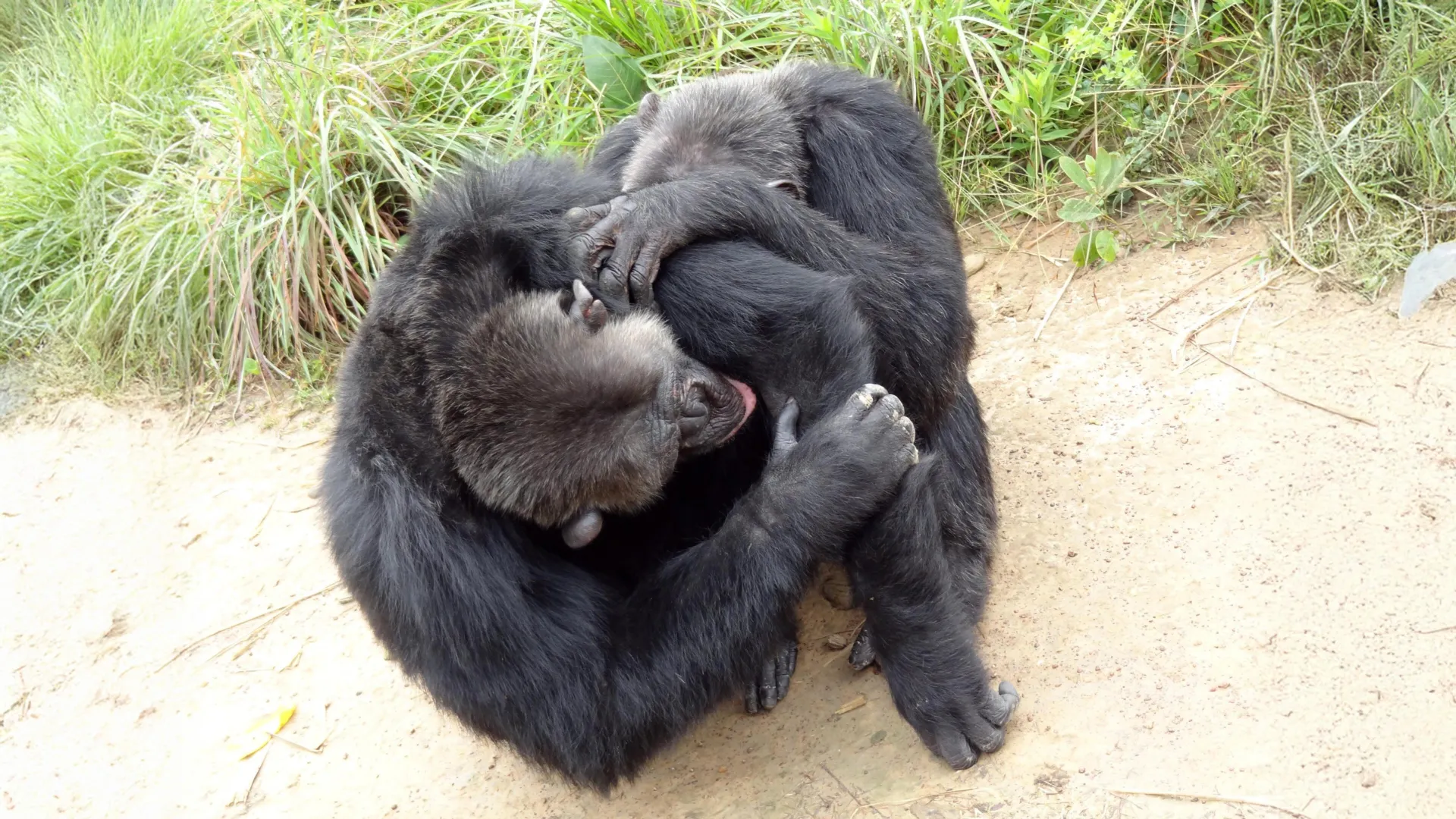
Humans often organize their relationships into layers, spending the most time with a small group of close friends and family while maintaining weaker connections with a larger number of acquaintances. A new international study suggests that this pattern is not unique to people.
Researchers from Utrecht University and Universidad Carlos III de Madrid found that chimpanzees and bonobos, our closest living relatives, also form social networks that resemble human friendship circles. The findings provide new insight into how complex social relationships may have evolved.
Great Apes Build Human-Like Social Networks
To investigate how great apes manage their social lives, researchers examined social grooming behavior in 24 groups of chimpanzees and bonobos. Grooming is one of the most important social activities among apes, helping to strengthen bonds and maintain relationships.
Using a mathematical model, the team analyzed how individuals distributed their limited time and social effort among other members of their group.
The results revealed a familiar pattern. Most apes devoted a large share of their grooming time to a small number of preferred partners while maintaining less intensive relationships with many others. This layered structure closely resembles the way human social circles are organized.
The study also found that apes living in larger groups tended to be more selective about where they invested their social attention, a trend that has also been observed in human social networks.
Chimpanzees and Bonobos Take Different Approaches
Although both species showed human-like social structures, they did not manage their relationships in exactly the same way.
Bonobos distributed their grooming time more evenly among group members, creating a more egalitarian social network. Chimpanzees, by contrast, concentrated more of their effort on a smaller number of favored companions.
These differences reflect broader distinctions in the social behavior of the two species.
Aging Changes Chimpanzee Friendships
People often become more selective about their relationships as they grow older, focusing more attention on a smaller inner circle of close connections. The researchers found a similar pattern among chimpanzees.
As chimpanzees age, they increasingly invest in fewer social partners. Bonobos, however, did not show the same narrowing of their social circles over time.
“Possibly, this is due to their more egalitarian social systems. Bonobos appear to live together in more fluid relationships, with social bonds that transcend group boundaries, something we rarely see in chimpanzees,” explains Van Leeuwen.
Clues to the Evolution of Friendship
According to lead author Edwin van Leeuwen, the results suggest that similar principles govern how social relationships are formed and maintained across multiple species.
“Our findings suggest that the fundamental rules that guide how individuals allocate social effort apply across multiple species,” says Van Leeuwen. “This reveals deep evolutionary continuity in how complex societies are organized.”
At the same time, the differences between chimpanzees and bonobos indicate that there is more than one evolutionary strategy for managing social connections.
Van Leeuwen notes that understanding these patterns could improve scientists’ understanding of cooperation, social learning, and emotional well-being in both humans and other animals.
“Understanding these patterns may reveal crucial insights for studying cooperation, social learning, and emotional well-being in both humans and other animals.”