
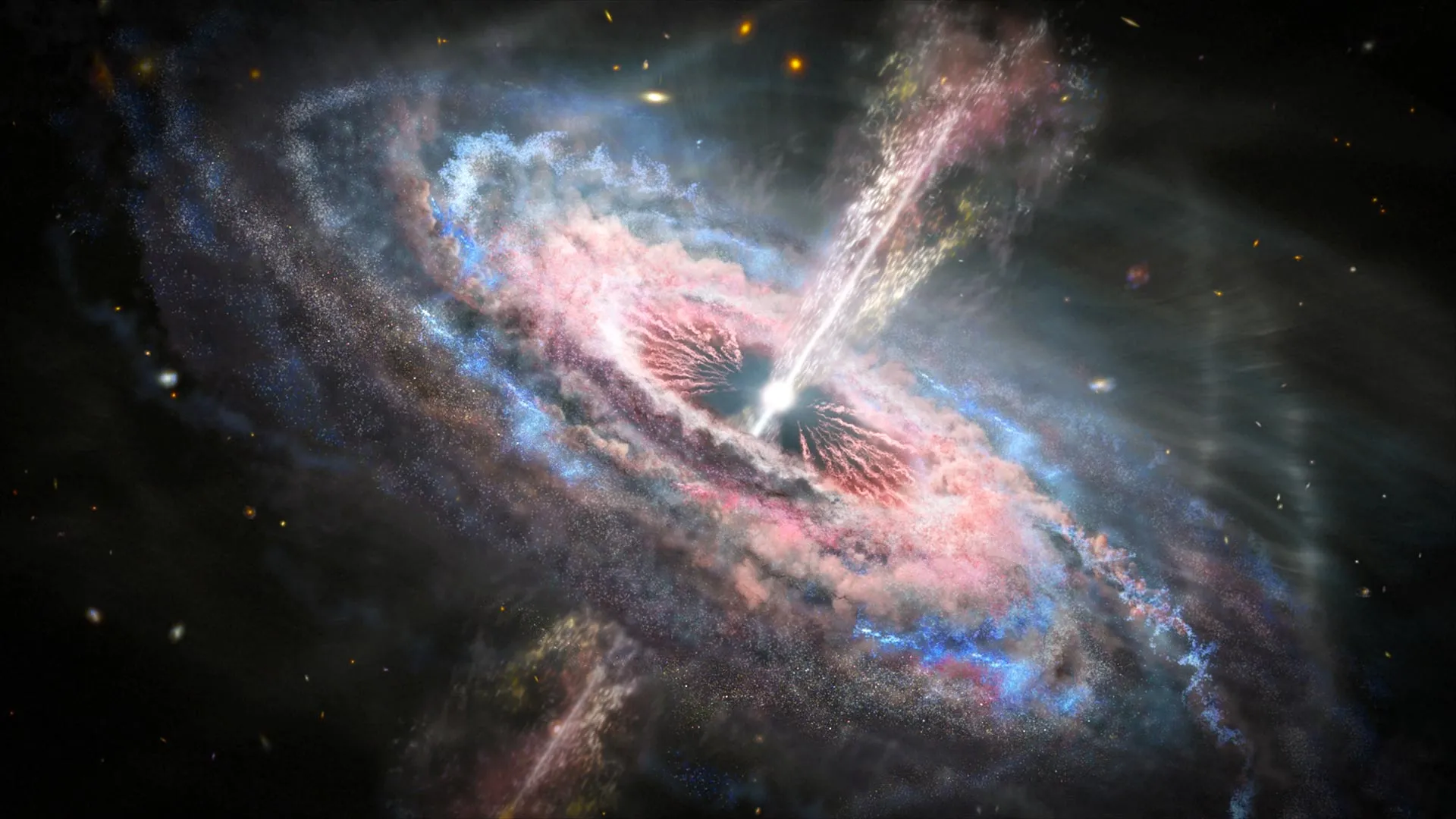
Quasars rank among the brightest and most powerful objects in the universe. They are fueled by supermassive black holes that consume surrounding material at the centers of galaxies, producing so much energy that they can be seen across billions of light years.
Now, an international team of researchers has identified 31 of the oldest quasars ever discovered, including the two earliest known examples. These extraordinary objects were already shining with the light of roughly a trillion suns when the universe was only about 670 million years old. The discovery, published in Astronomy & Astrophysics, offers an unprecedented glimpse into one of the earliest chapters of cosmic history.
“These objects provide the best clues for understanding how supermassive black holes form,” said co-author Joseph Hennawi, a physics professor with joint appointments at UC Santa Barbara and Leiden University. “These monsters — weighing billions of times the mass of our sun — somehow already existed when the universe was in its infancy. We don’t yet have a good understanding of how they grew so massive, so fast.”
Why Ancient Quasars Are So Difficult to Find
For decades, astronomers have searched for the universe’s earliest quasars because they preserve valuable information about how the first galaxies and supermassive black holes came into existence.
Finding them, however, is exceptionally challenging. Quasars that formed less than about 770 million years after the Big Bang are extremely uncommon because only a small number of galaxies had grown large enough to host them. Their faint light is also easily confused with that of much closer stars in our own galaxy.
Another obstacle comes from the expansion of the universe. As space stretches over billions of years, the light from these distant quasars shifts from ultraviolet into the near infrared. Earth’s atmosphere naturally glows in these wavelengths, making it much harder for ground based telescopes to detect such faint objects.
Astronomers use this effect, known as redshift, to estimate both distance and age. The greater the redshift, the farther away and earlier in cosmic history an object appears. “A redshift of 7 takes us to when the universe was just 750 million years old, less than 6% of its current age,” Hennawi said.
“These two things make finding quasars at these distances incredibly difficult,” said lead author Daming Yang, a doctoral student in Hennawi’s group at Leiden University. “For every one of them there are thousands of stars in our Milky Way and nearby galaxies that look almost identical in the imaging surveys. And since their light is stretched to the infrared at such distances, we need a survey that is both wide enough to capture these rare objects and deep enough to detect their faint light.”
Because of these limitations, searching from Earth’s surface is nearly impossible. Observing from space provides a much clearer view.
Euclid Space Telescope Finds 31 Ancient Quasars
The European Space Agency launched the Euclid space telescope in 2023 to investigate the universe during this pivotal era. Operating above Earth’s atmosphere, Euclid avoids the infrared glow that limits ground based observations while surveying enormous portions of the sky at remarkable depth.
Using data from the Euclid Wide Survey, researchers identified an unprecedented 31 new quasars from the early universe. Once completed, the survey will map more than one third of the entire sky. Some of these newly discovered quasars date to a time when the universe was only about 5% of its current age.
Until now, astronomers had mostly detected only the brightest and rarest ancient quasars, leaving too few examples to study the early quasar population as a whole.
“Euclid is a true game-changer,” Daming said. “Before, we could only find a handful of the very brightest ancient quasars, but Euclid lets us search far more efficiently across huge areas of sky to capture much fainter light. It’s a unique tool for quasar hunting.”
A Window Into the Universe’s First Billion Years
Researchers recently examined the second oldest quasar in the new collection in greater detail. They found it resides inside a dusty, gas rich galaxy undergoing an intense burst of star formation, providing new clues about the environments where the earliest supermassive black holes grew.
These newly discovered quasars come from a critical period known as the epoch of reionization, when the first stars and galaxies transformed the early universe by ionizing the neutral hydrogen gas that once filled space. This era shaped the evolution of the cosmos that followed.
Among the 31 newly discovered quasars, 14 have redshifts of 7 or greater. The two oldest have redshifts of 7.69 and 7.77, making them the earliest quasars ever identified. Located just over 13 billion light years away, they are seen as they existed within the universe’s first 670 million years. They also surpass the previous record established by Hennawi’s research group in 2021.
“Every step further back in time makes the puzzle more perplexing: How did the Universe produce supermassive black holes so quickly?” Hennawi said. “We’re finding black holes with hundreds of millions of times the mass of our sun at a time when the universe was barely getting started.”
Looking Even Deeper Into Cosmic History
Astronomers have steadily pushed farther back into cosmic history through a combination of improved telescopes and more sophisticated search techniques. It took more than a decade to discover roughly the first 10 quasars with redshifts of 7 or higher. Euclid has already found more than that in a single year, more than doubling the known population of these extremely ancient objects.
Machine learning has also become an essential part of the search. According to Hennawi, advanced algorithms can now examine tens of millions of astronomical sources and separate the few genuine quasars from the overwhelming number of lookalike stars and galaxies.
Hennawi’s team spent years developing many of the algorithms used in these discoveries. He also leads development of PypeIt, the software astronomers across the University of California use to process observations collected by the Keck telescopes. Through the University of California’s observing access, Keck confirmed two thirds of the newly discovered quasars, including the three most distant examples.
The researchers are now aiming to discover the first known quasar beyond a redshift of 8, which would reveal an object that existed within the universe’s first 630 million years.
James Webb and ALMA Will Study These Ancient Giants
Finding these quasars is only the beginning. The team has already secured observing time with the James Webb Space Telescope to investigate many of them in detail. Future observations will measure the masses of their black holes, analyze the chemistry of the surrounding gas, and use their light to trace how reionization unfolded across the young universe.
Meanwhile, the Atacama Large Millimeter Array will study the dust, gas, and star formation inside the galaxies hosting these ancient quasars, providing an even clearer picture of how the earliest massive galaxies evolved.
“The bigger vision is to stitch all of this together into a coherent timeline,” Hennawi said: “a quasar chronicle of the first billion years.”
Daming Yang, Antoine Basset, and Jean-Charles Cuillandre of the Euclid Consortium contributed to this story.