
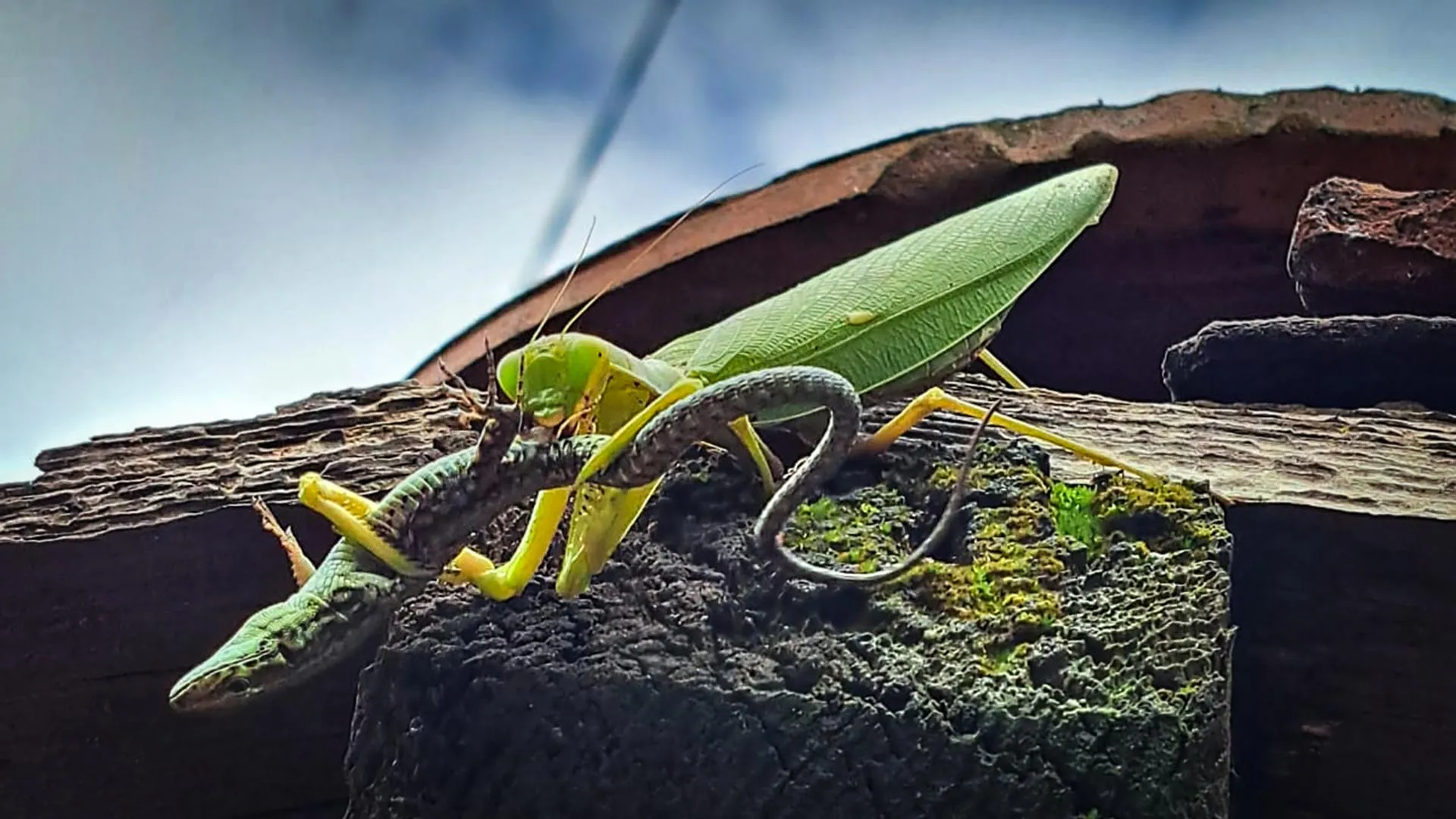
Praying mantises have fascinated people for centuries. Across different cultures, they have been viewed as everything from mystical guides that help lost travelers find their way home to ominous creatures associated with bad luck. Beyond the legends, native mantises also play an important ecological role by serving as indicators of healthy, biodiverse ecosystems.
Now, however, scientists say two Asian mantis species are becoming a growing threat to Europe’s native wildlife.
Giant Asian Mantises Officially Classified as Invasive
A new study published in the open access Journal of Orthoptera Research has formally designated two mantis species found in Europe, Hierodula tenuidentata and Hierodula patellifera, as Invasive Alien Species (IAS). The decision follows research led by Roberto Battiston of the Museum of Archaeology and Natural Sciences “G. Zannato,” which examined how these Asian native species are affecting European ecosystems, an issue that had previously received little scientific attention.
According to Battiston, the insects have been present in Europe for roughly a decade, but their populations have increased dramatically in recent years throughout Mediterranean and continental regions.
“They are pushing increasingly further north, thanks to climate change,” Battiston explains, adding that established populations are now regularly being reported by members of the public in parks and gardens. Because these mantises are large and visually impressive, many people see them as a welcome sight rather than a possible ecological problem.
“This study was born to give people those answers and to develop strategies to contain them.”
Why These Mantises Spread So Quickly
Both Hierodula tenuidentata and Hierodula patellifera are large, adaptable predators that spend much of their time in trees and shrubs. They also reproduce at an exceptional rate. Each egg case can produce an average of about 200 young, nearly twice as many as the native European mantis (Mantis religiosa). Since young nymphs are also less likely to eat one another, their populations can grow rapidly.
Their success creates serious challenges for native wildlife. The invasive females attract native male mantises, which attempt to mate but are ultimately eaten, reducing local populations. They also feed on a broad range of native animals, including important pollinators such as honeybees as well as protected small vertebrates like tree frogs and lizards.
Researchers say these impacts make it especially important to assess the risks on Mediterranean islands, where many unique invertebrate and vertebrate species are found nowhere else.
Cats, Cities, and Climate Change
One surprising finding is that domestic cats are the leading vertebrate predator of these invasive mantises, accounting for 45% of recorded positive predation events.
Battiston notes that although cats can help reduce invasive mantis numbers, they cannot distinguish between invasive and native species. Free roaming cats also prey on European mantises, which are already under pressure from competition with the invasive newcomers and are declining in many peri urban environments.
Human development is also helping the insects expand. Urban and suburban landscapes provide ideal conditions, allowing Hierodula mantises to use structures such as insect hotels as productive hunting sites. Urban heat islands also help them remain active later into the colder seasons, extending both their survival and their geographic range beyond what would normally be possible.
Citizen Science Can Help Slow the Spread
To better understand and limit the expansion of these invasive mantises, researchers have turned to the public.
“My colleagues William di Pietro and Antonio Fasano (GRIO) have managed to set up a huge citizen science project and collect over 2,300 reports from enthusiasts and citizens. Citizen science is a fundamental tool not only for monitoring but also for raising awareness and informing people in an active and participatory way about these issues.”
Scientists say people can do more than simply report sightings. During winter, when trees and shrubs have lost their leaves, the insects’ oothecae, brown, spongy egg cases measuring about 2 to 3 cm, become easy to spot on branches. Although the egg cases can be removed without causing pain, Battiston stresses that people should first consult a specialist to avoid accidentally removing the eggs of native mantis species.
Protecting Europe’s Native Biodiversity
The spread of these Asian mantises highlights how human activity and climate change can alter the natural boundaries that once limited invasive species. As these adaptable predators continue expanding across Europe, researchers say public awareness, citizen science, and carefully targeted conservation efforts will be essential for protecting the continent’s native biodiversity.