
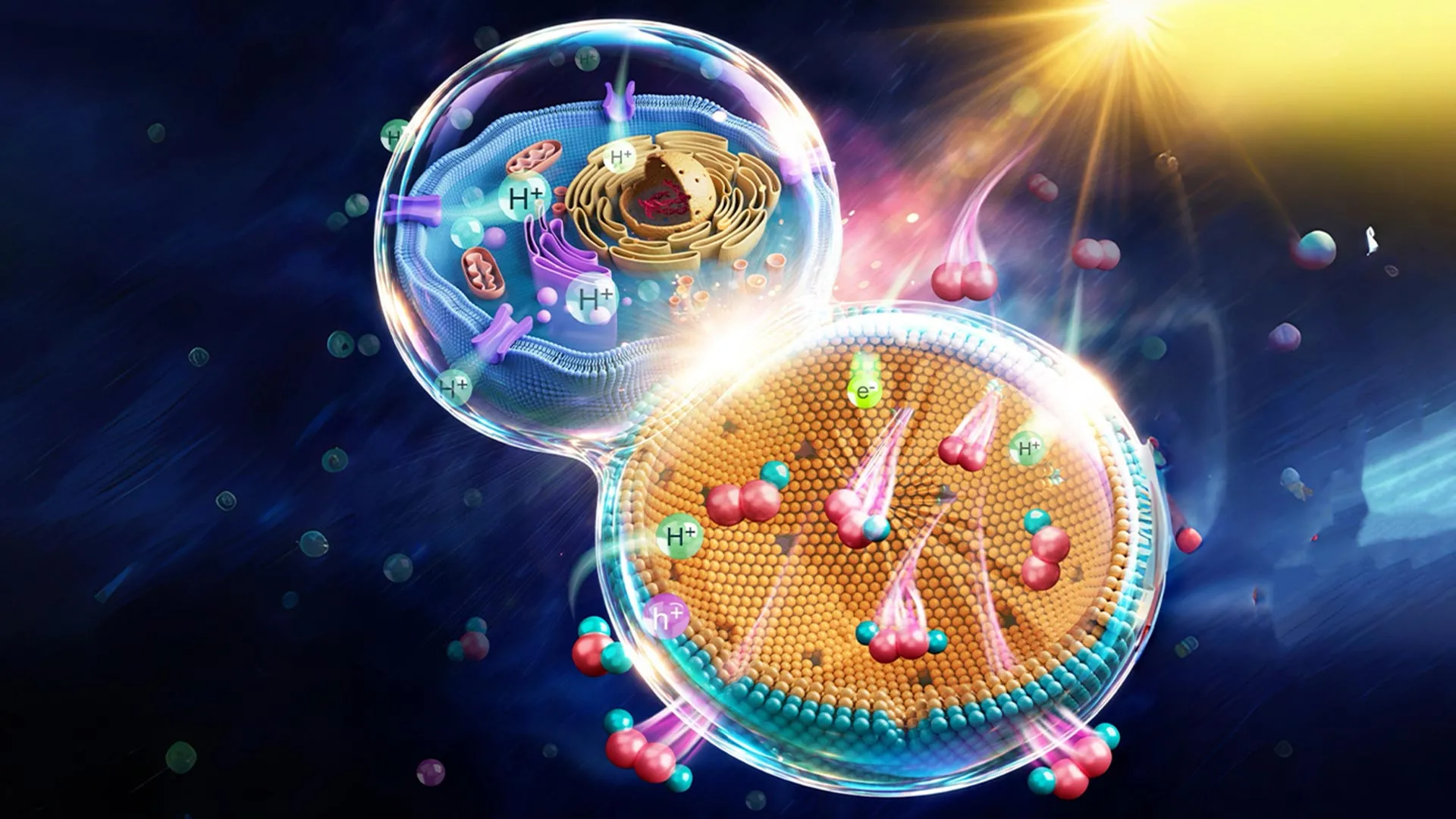
Researchers have created a hollow CdS@polydopamine nanoreactor that imitates two important features of living cells. The design offers a new way to reproduce some of the highly organized chemical functions of cells inside synthetic nanomaterials.
The findings were published in the Journal of the American Chemical Society. The research was led by Prof. LI Can at the Dalian Institute of Chemical Physics (DICP) of the Chinese Academy of Sciences (CAS), in collaboration with Prof. Jian Liu’s team at Inner Mongolia University.
Recreating Cellular Chemistry at the Nanoscale
Living cells carry out complex biochemical reactions with exceptional efficiency and precision. They achieve this by arranging different components within tightly controlled spaces, where molecules can move, interact, and react under carefully regulated conditions.
Scientists are now attempting to apply these same principles to engineered nanomaterials. This field, known as nanocell engineering, seeks to create cell-like structures with specialized surfaces and internal pores or cavities. These synthetic systems, often called nanoreactors, bring together ideas from cell biology and nanotechnology.
Two Cell-Inspired Features
The new nanoreactor contains two main biomimetic elements.
The first is a dynamic catechol/o-benzoquinone redox pair located in the polydopamine shell. Instead of operating as an active proton pump, this chemical pair serves as a proton relay. By repeatedly accepting and releasing protons, it speeds up proton-coupled electron transfer (PCET), a process in which proton and electron movement are closely linked.
The second feature is the nanoreactor’s compartmentalized structure. A nanoscale hollow cavity is surrounded by a porous shell, forming a confined environment where reactants can accumulate. This architecture also supports molecular diffusion and traps incoming photons, helping the light-driven reactions proceed more effectively.
Improving Hydrogen Peroxide Photosynthesis
Together, these features help balance the different reaction speeds of oxygen reduction and water oxidation, two half-reactions that must work together during hydrogen peroxide production.
Under visible-light illumination in an aqueous solution, the nanoreactor achieved an H2O2 photosynthesis rate of 3.24 mmol gcat.-1 h-1. It also reached a solar-to-chemical conversion efficiency of 1.2%.
To determine how the system worked, the researchers combined in situ spectroscopy, photochemical analysis, finite element simulations, and theoretical calculations. These methods allowed them to observe the cell-inspired processes and clarify the Z-scheme heterojunction-based photocatalytic mechanism responsible for the reaction.
A Recyclable System Powered by Sunlight
The researchers also embedded the nanoreactors in an environmentally benign sodium alginate hydrogel matrix. This produced solid, recyclable photocatalysts that could continuously synthesize H2O2 under natural sunlight while maintaining stable performance.
“Our study provides a new strategy for engineering biomimetic nanoreactors that increasingly replicate the sophisticated functions of living cells, opening new opportunities in artificial photosynthesis, energy catalysis, and synthetic chemistry,” said Prof. Li.