
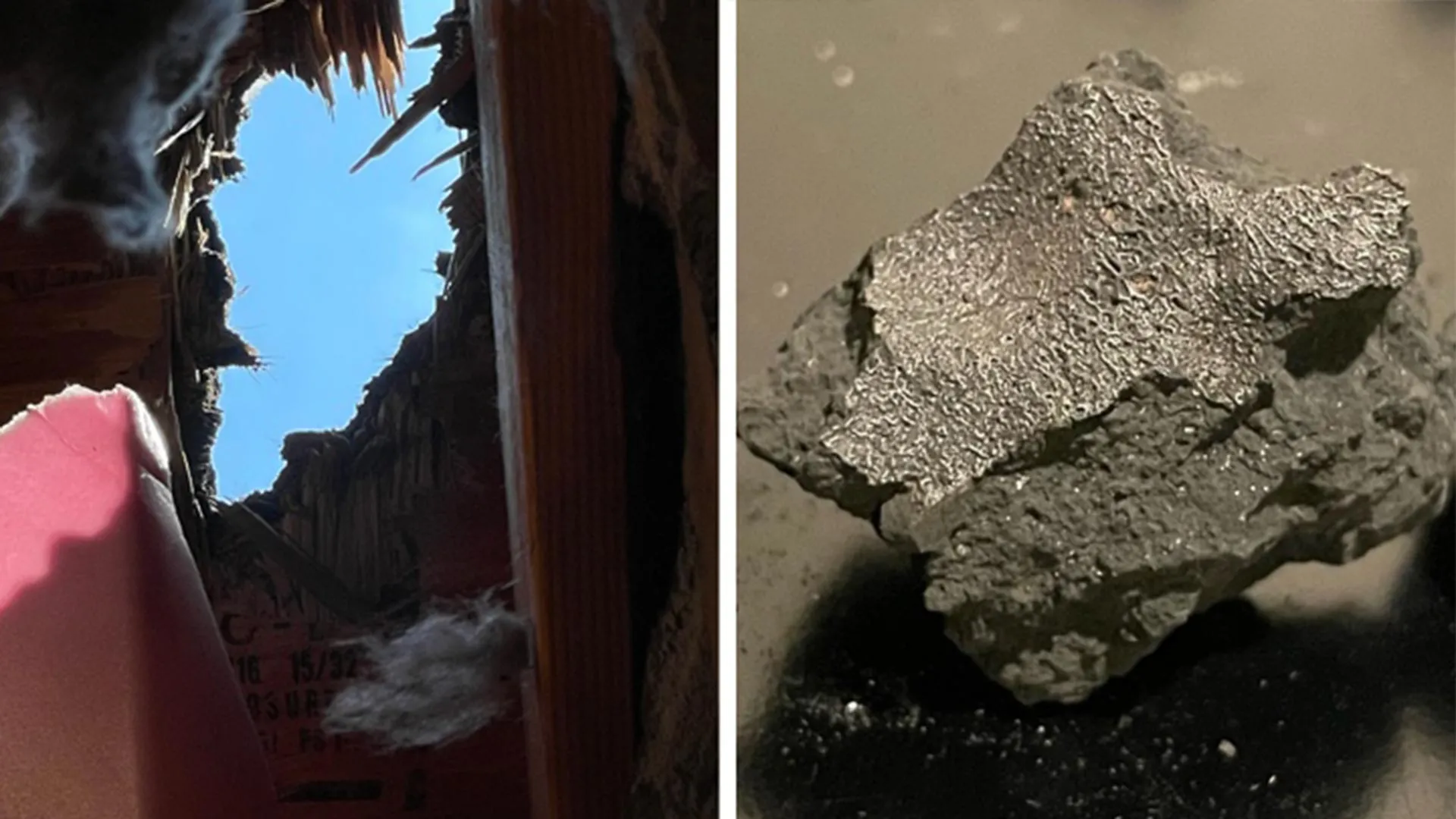
A meteor streaked across the New York City area in broad daylight on July 16, 2024, producing a sonic boom as it passed just south of the Statue of Liberty. Not long afterward, a meteorite weighing more than two pounds punched through the roof of a home in Hillsborough, New Jersey. An international research team has now analyzed the recovered material and reported its findings in Science Advances.
“A forensic study of the fragments revealed that they contained preserved bits from near the surface of a primitive asteroid where it experienced concentrated salty fluids — a process not previously known from this type of proto-planet world,” said lead author and meteor astronomer Peter Jenniskens of the SETI Institute and NASA’s Ames Research Center in California’s Silicon Valley.
A Meteor Tracked Across the Northeast
The object that entered Earth’s atmosphere that day was roughly the size of a heavy airline bag and was traveling at 32,000 miles/h (14.4 kilometers per second). Sixty people across New York, New Jersey, Connecticut, Rhode Island and Pennsylvania reported seeing the meteor to the American Meteor Society. Sixteen people in New York and New Jersey also reported feeling the shockwave.
“Our cameras in Northford, Connecticut, and Douglassville, Pennsylvania, as well as a doorbell camera in Wayne, New Jersey, captured the meteor, and from that we measured its trajectory,” said American Meteor Society operations manager Mike Hankey. “The path traced back to low in the asteroid belt.”
The incoming rock was fragile and broke apart quickly as it traveled through the atmosphere. It disappeared from view at an altitude of 22 miles (35 kilometers). Soon afterward, Doppler weather radar at Newark Airport briefly detected an elongated cloud of falling pebbles extending from Staten Island into New Jersey.
Hillsborough sat near the far end of that debris path, where the largest pieces were expected to reach the ground. Only one meteorite was recovered, largely because it made its presence impossible to miss by striking a house.
The homeowner recalled what happened: “I was at home at the time, heard a loud crash and found a hole in the ceiling of the master bedroom. I smelled a strong sulfur-like odor and saw many black fragments along with debris and black dust that covered my bed, carpet and surrounding areas.”
He quickly documented the scene and protected the material from contamination. Wearing disposable gloves, he used aluminum foil to collect the meteorite fragments and placed them in glass jars.
An Exceptionally Rare Primitive Meteorite
Laboratory analysis showed that the recovered rock belonged to a primitive meteorite family known as CM-type carbonaceous chondrites. The “M” refers to the Mighei meteorite, which fell in Ukraine in 1889.
Paper coauthor Mike Zolensky, a meteoriticist at NASA’s Johnson Space Center in Houston, found that some parts of the Hillsborough meteorite had experienced more extensive alteration by water on its parent asteroid than scientists usually observe in CM2 carbonaceous chondrites.
The meteorite was classified as a CM1/2 carbonaceous chondrite, placing it between the petrographic CM1 and CM2 categories.
The Hillsborough event is only the 22nd observed fall involving a CM-type meteorite. More remarkably, it is just the second witnessed fall of a CM1/2 carbonaceous chondrite. The first was the Kolang meteorite, which fell in North Sumatra, Indonesia, in 2020. Every other witnessed CM fall has involved CM2 material, and no CM1 meteorite fall has ever been observed.
“Thanks to the homeowner’s quick reaction, these are the most pristine CM1/2 meteorites we know of,” said Jenniskens.
Evidence of Ancient Asteroid Brines
Scientists are particularly interested in how water influenced the chemistry of primitive asteroids. Another major group of primitive carbonaceous chondrites is known as CI, with the “I” referring to the Ivuna meteorite that fell in Tanzania in 1938.
Pristine samples related to this type have also been returned directly from space. JAXA’s Hayabusa 2 mission brought material back from asteroid Ryugu, while NASA’s OSIRIS-REx mission returned samples from asteroid Bennu. Those samples contain substantial evidence that briny fluids once existed just beneath the surfaces of their parent asteroids.
Zolensky and colleague JangMi Han discovered small CM1 fragments rich in salt inside the Hillsborough meteorite. Their findings suggest that the material came from a region near the surface of its parent asteroid, where liquid water evaporated and left behind increasingly concentrated salts.
The researchers are now identifying the specific salt minerals in the meteorite so they can compare them with similar materials found in samples returned from Ryugu and Bennu.
This salty chemistry could have important implications for understanding the chemical conditions that helped produce molecules relevant to life. Highly concentrated brines can keep phosphate dissolved in solution and can promote chemical reactions involving organic compounds and minerals that precipitate from solution.
Organic Molecules and Ingredients for Life
“Isotope studies of carbon and nitrogen suggest that primitive carbonaceous chondrites, including CM-types, delivered organic matter to the early Earth,” said cosmochemist Queenie Chan of Royal Holloway University of London, England, and biogeochemist Nana Ogawa of the Biogeochemistry Research Center at the Japan Agency for Marine-Earth Science and Technology. “The Hillsborough meteorite contained 1.8% by weight of carbon and 0.07% of nitrogen, and had carbon and nitrogen isotopes typical for CM-type meteorites.”
Researchers also detected a broad range of soluble organic compounds in the meteorite. The diversity of those compounds provides further evidence that the Hillsborough material experienced more extensive alteration by water than most other CM-type meteorites.
“A high fraction of compounds were the product of organic chemistry with minerals,” said organic mass spectrometry specialist Phil Schmitt-Kopplin of Technical University Munich. “We do not know if these magnesium organic compounds were contributed by brine chemistry or were simply left over from earlier impact shock processes.”
Organometallic compounds also play important roles in living systems, including in blood and photosynthesis. Scientists found numerous amino acids among the soluble organic compounds in the Hillsborough meteorite as well. They were similar to amino acids previously detected in CM2 chondrites that experienced more moderate water alteration.
Astrobiologist Danny Glavin of NASA’s Goddard Space Flight Center in Greenbelt, Maryland, and researchers in Goddard’s Astrobiology Analytical Lab concluded that CM-type bodies could have supplied the early Earth with amino acids, carboxylic acids and other soluble organic molecules. That delivery may have contributed to the collection of prebiotic organic material that existed before life emerged.
Their analysis also indicates that the meteorite’s complex assortment of amino acids formed inside its parent body. Briny fluids likely helped drive at least some of that chemistry.
A Rare Asteroid Sample Preserved for Science
Some fragments of the Hillsborough meteorite will eventually be curated by the American Museum of Natural History in New York City, preserving the unusual material for future research.
“We are thrilled that nature delivered such a precious asteroid sample on our doorstep,” said curator Denton Ebel.