
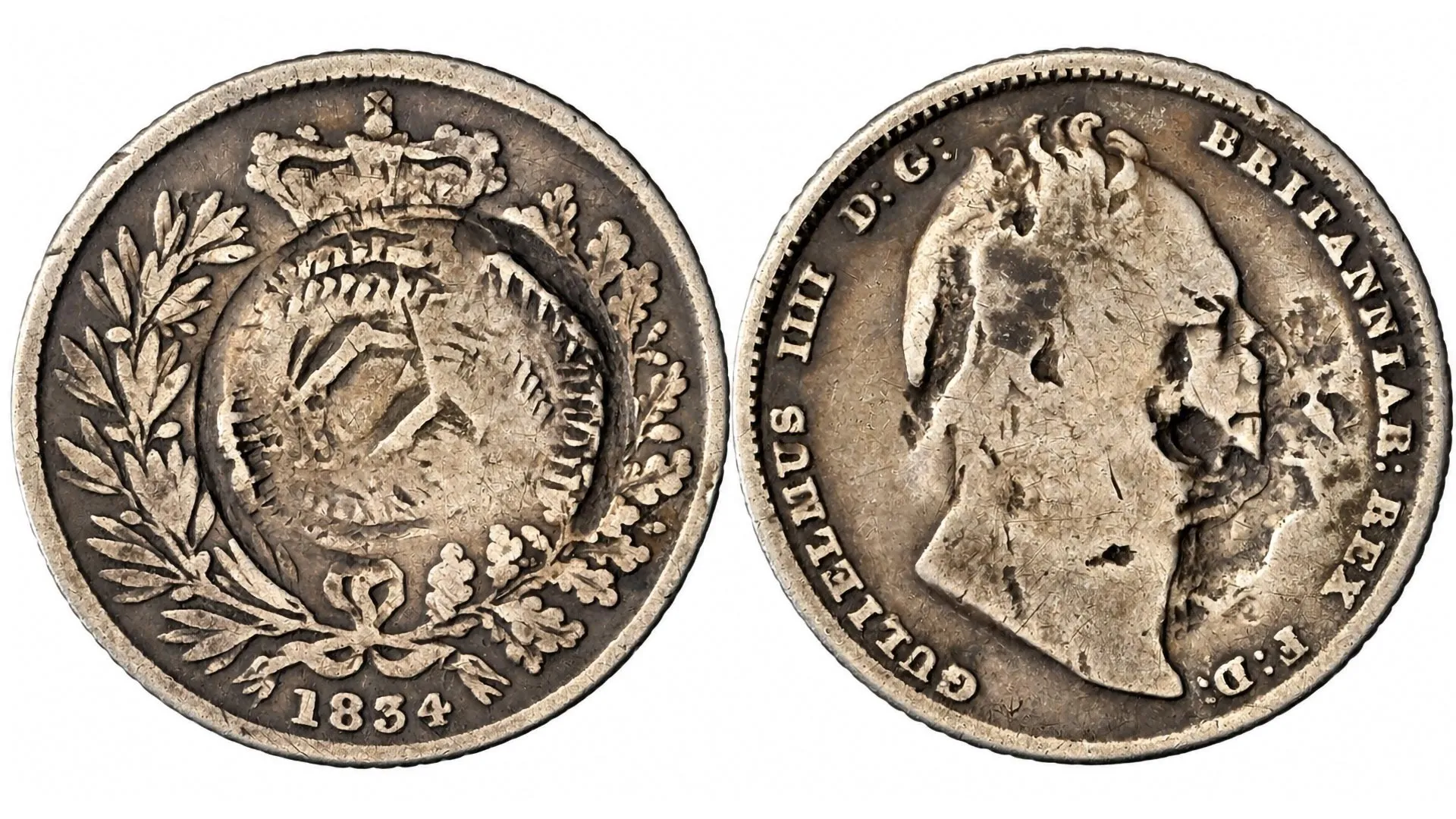
A badly distorted British silver coin dating to 1834 may hold evidence of an unusual accident during the minting process nearly 200 years ago. New scientific analysis suggests that the remarkable damage to the coin was more likely caused by a manufacturing problem than by ordinary wear, corrosion, or a later impact.
The findings, reported by IA STUDIO in the journal npj Heritage Science, center on a silver sixpence issued during the reign of King William IV. The coin was found in an album containing various coins at a car boot sale in Greater Manchester, England. Although the sixpence had an individual price tag of £8, the entire album was subsequently purchased as a single lot rather than the coin being bought separately.
What makes this particular sixpence remarkable is the extent and unusual pattern of its damage. Its central surface appears severely crushed and distorted, yet much of the outer rim and the small grooves along its edge remain relatively intact. The contrast raised an intriguing question about what could have happened to the coin.
To investigate, researchers examined the silver piece using powerful microscopes, chemical testing, and detailed three-dimensional surface measurements. The results point toward an unusual sequence of intense compression, potentially while the coin was being struck at the mint.
A Crushed Silver Coin Reveals Unusual Clues
The most striking evidence came from the coin’s severely distorted central regions. Detailed measurements revealed deep, sharply defined depressions, elevated ridges, stepped surfaces, and areas where the metal appeared to have been pushed and displaced in overlapping patterns.
These features were particularly pronounced on the front of the coin, known as the obverse, which bears the portrait of William IV. Across the damaged central portrait area, the difference between the highest and lowest measured points reached approximately 0.75 millimeters.
That may sound small, but it represents a substantial distortion on the surface of a thin silver coin.
The investigators found that the overall damage was most consistent with repeated applications of high pressure concentrated in a limited area. The metal also appears to have been at least partly prevented from spreading outward as the force was applied.
This combination of heavy central damage and relatively well-preserved edges is difficult to reconcile with the gradual effects of circulation or simple corrosion. It also makes a single later impact, with the metal free to move outward, a less convincing explanation.
Instead, the findings favor an unusual problem during the original striking process, although the available evidence does not establish the exact sequence of events with certainty.
Microscopic Analysis Reveals Damage Beneath the Surface
To better understand the unusual deformation, the investigation combined scanning electron microscopy with energy-dispersive X-ray spectroscopy (SEM-EDX) and optical surface profilometry.
The microscopic and chemical examinations provided information about the coin’s metal composition and the changes affecting its surface.
In areas that had escaped the worst damage, testing identified an underlying silver and copper alloy. The more severely distorted regions contained lower measured concentrations of silver, higher levels of copper, and additional chemical evidence associated with corrosion and contamination.
These substances were especially concentrated inside the depressions formed by the damaged metal.
However, the chemical results largely reflected changes at the surface. Although corrosion and contamination had affected the coin, they could not adequately account for the depth, shape, and distribution of its unusual distortions.
The team also used optical surface profilometry, a technique that maps the height and shape of a surface in three dimensions. This made it possible to examine the coin’s damaged areas in much greater detail than ordinary photographs could provide.
The resulting maps showed steep depressions, raised shoulders, abrupt changes in surface height, and multiple layers of metal displacement.
Using height measurements supplied by the Oxford Materials Characterisation Service, the study’s author determined that the damaged central portrait region varied in height by approximately 750 micrometers, equivalent to 0.75 millimeters.
Taken together, the findings suggest that the coin underwent repeated compression while its sideways movement was at least partly restricted. This explanation fits the evidence better than ordinary wear, which generally smooths a coin’s surface over time, or corrosion, which tends to remove or chemically alter material.
A Rare Glimpse Into 19th-Century Coin Production
The sixpence was produced in 1834, when Britain was already using steam-powered presses to manufacture coins.
During this period, coins with serious striking defects were typically identified through mint inspections and melted down so the metal could be reused. This was especially important for coins made from precious metals such as silver.
If the unusual deformation occurred during the original minting process, the sixpence may therefore represent a rare surviving example of a manufacturing failure that would ordinarily have been removed from circulation before it ever reached the public.
Such a coin could provide a physical record of a brief mechanical problem during the early era of mechanized coin production.
Determining whether the damage actually occurred at the mint is challenging, however. Historic metal objects can undergo many changes over decades or centuries, and severe deformation may obscure the physical clues needed to identify its origin.
To address this uncertainty, the study examined several kinds of evidence independently. The researchers considered the composition of the underlying metal, chemical changes at the surface, and the three-dimensional geometry of the deformation before comparing the results with different possible explanations.
The findings also demonstrate how non-destructive scientific techniques can be used to investigate other historic metal objects. By combining chemical and structural evidence, researchers may be able to distinguish manufacturing defects from later damage even when visual inspection alone provides no clear answer.
How AI Helped Investigate the Coin Mystery
The investigation also explored how computational tools, including artificial intelligence, could assist in evaluating a historical mystery without replacing physical scientific evidence.
Before any laboratory results were available, the author began by studying high-resolution photographs of the sixpence and systematically reviewing its unusual surface features.
This early examination helped identify several possible causes of the damage and establish what kinds of physical measurements would be needed to test them.
Human-supervised computational tools, including large language models (LLMs), helped organize the observations, develop alternative explanations, compare competing ideas, and formulate questions that could later be investigated through laboratory testing.
Importantly, the initial hypotheses and analytical notes were recorded before the independently produced laboratory measurements became available.
The possible explanations included ordinary circulation wear and corrosion, mechanical damage occurring after minting, later compression under restricted conditions, and deformation during the original manufacturing process.
To investigate these possibilities, independent measurements were commissioned from the Experimental Techniques Centre at Brunel University of London and the Oxford Materials Characterisation Service within the Department of Materials at the University of Oxford.
Once the testing was completed, computational tools were used again to help organize the resulting data and compare the physical findings with the earlier explanations.
“The important sequence was hypothesis first, independent laboratory measurement second,” said A. Ikraam, founder of IA STUDIO and author of the study.
“We used the models to ask what features mattered and what evidence could distinguish one explanation from another. Then the laboratory measurements gave us something physical to test those ideas against. The models could support the reasoning process, but they could not decide what happened to the coin.”
Scientific Evidence Points to a Possible Minting Error
Although artificial intelligence played a supporting role in organizing observations and evaluating competing possibilities, it did not produce the laboratory measurements or determine the final findings.
The study’s conclusions were based on independently generated scientific data, with the author retaining responsibility for interpreting the evidence and deciding which explanation was best supported.
The results favor a rare minting anomaly involving repeated, highly concentrated pressure, rather than damage caused by ordinary circulation, corrosion, or a single unrestricted impact after production. Nevertheless, the research does not conclusively establish every detail of what happened to the sixpence.
Beyond shedding light on the possible origins of a strangely mangled 1834 coin, the investigation illustrates how modern imaging, chemical analysis, and carefully evaluated computational tools can work together to uncover clues hidden in historic objects.
What initially appeared to be little more than a badly damaged silver coin may instead preserve an unusual record of how something went wrong during the early days of mechanized coin manufacturing.