
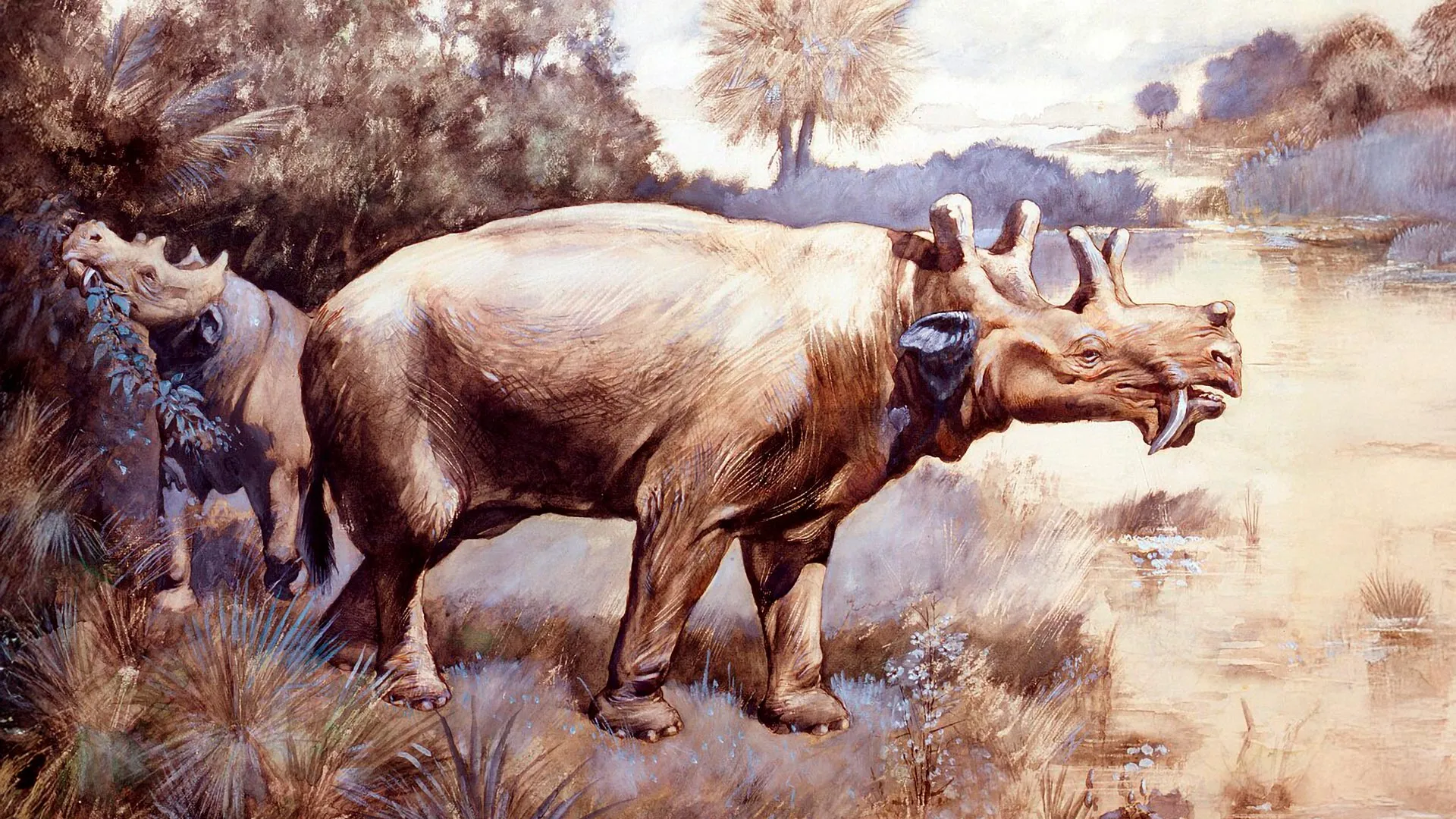
For generations, paleontologists have regarded an extinct group of giant mammals known as uintatheres as a textbook example of sexual dimorphism, the physical differences between males and females of the same species.
Recognizable by their enormous bodies, prominent horns, and oversized canine teeth, uintatheres first appeared approximately 58 million years ago, less than 10 million years after an asteroid wiped out the dinosaurs. These unusual mammals persisted for roughly 20 million years.
However, new research from the University of Kansas published in PLOS One suggests that the physical differences between male and female uintatheres may have been considerably less pronounced than scientists have long assumed.
“Males have been interpreted as being much larger and possessing far more dramatic cranial features than females,” said study author Kevin Mulcahy, doctoral student at the KU Biodiversity Institute & Natural History Museum.
A Broken Fossil Tooth Leads to an Unexpected Discovery
The investigation began when Mulcahy and his doctoral adviser, K. Christopher Beard, senior curator at the institute, attempted to identify a broken upper molar recovered during fieldwork in Montana. The researchers suspected the tooth belonged to a uintathere but needed additional fossil specimens to confirm its identity.
“We had a research visit at the American Museum of Natural History in New York, where our main goal was just to compare that tooth to teeth from other uintatheres and figure out what type of animal we had,” Mulcahy said. “They have this big collection — entire shelves occupied with these skulls, and each one of them is almost a meter long. These are famous specimens that are in the literature, and I was originally just looking at them to compare their teeth, and I noticed a ton of variation in a way that didn’t appear binary.”
Intrigued by the unexpected range of physical characteristics, Mulcahy began measuring the skulls in the museum’s collection.
“I just, really hastily, with a ruler, gathered a bunch of measurements of the skulls while we were there,” Mulcahy said. “I started playing around with statistics, and there are ways you can look at different measurements to see if they’re best fit by a classic unimodal distribution, or if you were to think you’re dealing with something that exhibits strong sexual dimorphism, you’d see something with a bimodal distribution — that there are two means, one for males and one for females.”
Ancient Skulls Challenge a Classic Example of Sexual Dimorphism
If males and females differed as dramatically as paleontologists had suggested, the skull measurements would be expected to cluster into two relatively distinct groups. Instead, Mulcahy’s initial analysis failed to reveal such a clear separation.
“It wasn’t like there’s one group of specimens that look bigger than another, and then there’s another group that are smaller with smaller horns and canines,” he said. “So I was kind of interested — are these really good examples of sexual dimorphism after all? Is there actual evidence in the morphology of these skulls, in the distribution in particular of the ranges of morphology we’re seeing, that that’s what’s going on?”
To investigate further, Mulcahy collected additional measurements from fossils housed at other institutions and expanded his analysis using new statistical methods. His final dataset encompassed approximately 30 skulls belonging to a single extinct species, Uintatherium anceps.
Although the results offered some hints of physical differences between the sexes, the evidence was far less convincing than expected. One major challenge in studying extinct animals is that researchers generally cannot independently determine the sex of individual fossil specimens.
“Maybe there were some little signals of dimorphism here and there, but nothing really concrete,” he said. “I had an idea: Maybe it’s just that the techniques I’m using aren’t robust enough to actually measure sexual dimorphism. With fossil animals, you don’t actually know which specimens are males and which are females. You can guess and then test whether or not the ones you guess are males differ from the ones you guess are females, but that’s super circular, because you could just be picking the most extreme ones to be one sex and the least extreme to be the other. Of course they’re going to differ.”
Modern Bison Provide an Important Comparison
To determine whether his statistical methods could reliably detect sexual dimorphism, Mulcahy turned to a living mammal: the bison. Unlike fossil uintatheres, modern bison specimens could be classified by sex with confidence.
Bison also offered a useful comparison because they are large, horned herbivores whose ecology shares similarities with what researchers have proposed for uintatheres.
“When you’re dealing with living animals, you can just take the males, take the females and compare them,” he said. “Bison are another really big herbivore, with a similar sort of ecology that’s been proposed for uintatheres, and they also have big horns. What I noticed is that the signals of dimorphism I was picking up in bison were a lot clearer. When I was looking at the bison, it was almost perfect that all of the females were most similar to the females, and all the males were most similar to the males.”
The contrast suggests that the relatively weak evidence for sexual dimorphism in uintatheres cannot be attributed solely to limitations of the statistical techniques. The same methods successfully identified much clearer physical differences between male and female bison.
Victorian-Era Bias May Have Shaped Paleontology
Mulcahy believes that historical cultural attitudes may help explain why paleontologists came to accept such pronounced differences between male and female uintatheres. Many extinct species were first identified and described during the late 19th and early 20th centuries, when prevailing views about the sexes may have influenced scientific interpretations.
“Back then, this is right when evolutionary theory, sexual selection, natural selection, all of that is kind of coming into play,” he said. “I think it’s really important to remember that these things were first discovered in the late 1800s by a bunch of male paleontologists working in a very Victorian-era mindset. The idea is basically assumed at that point that males are going to be bigger and scarier than females. It’s really interesting: When you step back and actually test that hypothesis, it doesn’t really hold up.”
Because uintatheres have long been regarded as one of the clearest examples of sexual dimorphism in the fossil record, the new findings could have implications beyond these unusual prehistoric giants. Other extinct species may also have exhibited less pronounced physical differences between males and females than scientists have traditionally believed.
Rethinking the Evolution of Sex Differences in Mammals
The research also adds to a growing body of evidence challenging the widespread assumption that male mammals are typically larger than females. Dramatic differences in body size and physical appearance may have evolved independently in multiple mammalian lineages rather than being a characteristic inherited from their earliest common ancestors.
Research on living mammals has similarly challenged conventional thinking, suggesting that pronounced differences favoring larger males are less widespread than historically assumed.
“Strong, big male-style sexual dimorphism was probably not ancestral at the root of the mammalian tree, and among the mammals where we do see this pattern today, it’s almost certainly shown up independently several times,” Mulcahy said. “It had long been assumed that sexual dimorphism is the norm, that most species show that males are bigger than females. But just a couple years ago, a paper came out showing that among living mammals, most species either don’t show any dimorphism or actually have larger females. The idea that males are always bigger than females is really just a choice of what animals were people looking at, what are the things that biologists in the past were interested in.”