
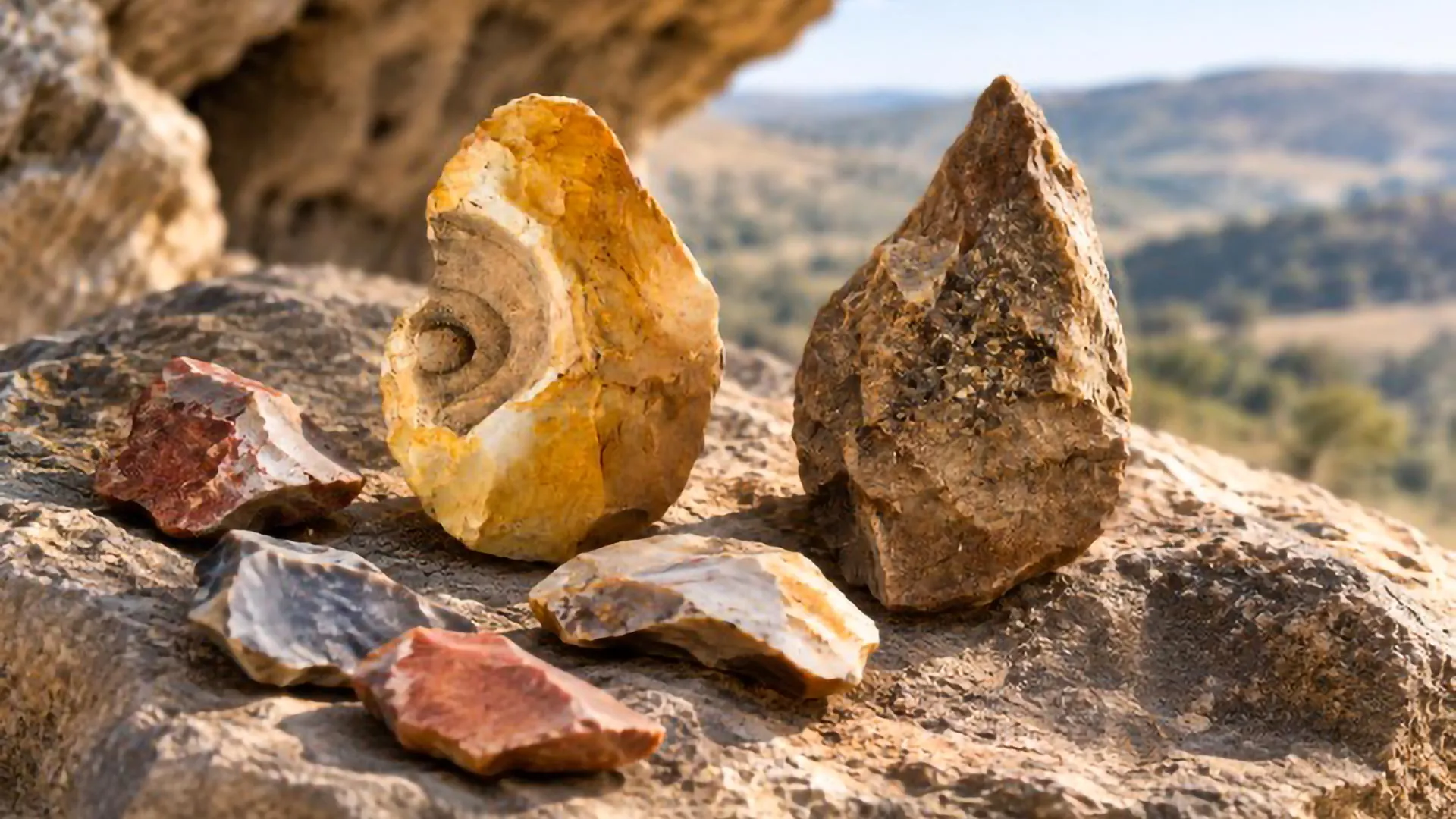
Unusual stones, fossils, and ancient flint tools unearthed at prehistoric sites in Israel may hold clues to the evolution of the human mind. Researchers propose that early humans collected these objects as personal keepsakes, using them to recall meaningful experiences and potentially influencing the development of personal memory and our sense of identity.
Picking up a colorful seashell during a trip to the beach or bringing home an unusual stone from a hike is a familiar human impulse. Although such objects may have little practical or monetary value, they can evoke vivid memories of people, places, and experiences. But how far back does this behavior stretch in human history? New research from Tel Aviv University suggests that humans may have been collecting souvenirs as early as 500,000 years ago, and that this habit could have played an important role in the evolution of memory.
The research was led by Dr. Yoav Ram of the School of Zoology, Wise Faculty of Life Science, Prof. Ran Barkai, and Dr. Ella Assaf of the Department of Archaeology, Entin Faculty of Humanities, at Tel Aviv University. They collaborated with Prof. Liad Mudrik of the School of Psychological Sciences, Gordon Faculty of Social Sciences, and Dr. Bar Efrati of Oxford University. Their findings were published in the journal Evolutionary Anthropology.
Ancient Stones With No Obvious Practical Purpose
Drawing on evidence from archaeology, evolutionary theory, psychology, and neuroscience, the researchers examined a curious aspect of prehistoric human behavior. Early humans sometimes went to the trouble of gathering, transporting, and retaining objects that appeared to serve no practical function. The team suggests that these items may instead have held personal significance, acting as tangible reminders of past experiences or places their owners had visited.
Evidence for this behavior comes from several archaeological sites across Israel that date back hundreds of thousands of years. At Qesem Cave, archaeologists uncovered small, colorful pebbles that had been brought there from different locations, despite having no identifiable practical use.
Discoveries in the Sakhnin Valley offer another intriguing example. Early humans crafted handaxes from flint containing fossils or distinctive geological features. In some instances, the tools were shaped in ways that left these unusual features intact at their center, allowing them to remain visible and accessible to touch.
Archaeologists also found much older flint tools at Revadim, Jaljulia, and Qesem Cave that prehistoric humans had retrieved after their surfaces had already been altered by age. Although some of the tools had been sharpened again, much of their original surface and evidence of earlier craftsmanship remained intact. The researchers propose that these signs of age may have been part of what made the objects valuable to their collectors. Their appearance effectively preserved a record of their past.
How Keepsakes May Have Shaped Human Memory
The researchers suggest that bringing an object home from a particular location could have provided early humans with a physical cue for recalling a personal experience. Sensory details, such as the object’s color, shape, and texture, might also have helped people recognize whether a memory came from something they had personally experienced, something another person had told them, or something they had imagined.
Unlike many everyday objects, a keepsake can hold meaning that is unique to its owner. It is also portable and can be shared with others. Showing someone an object associated with a past experience may have lent additional credibility to the owner’s account of what happened.
The ability to accurately recall personal experiences has considerable social value. Remembering previous encounters, alliances, exchanges of gifts, shared responsibilities, and rights to particular locations can help people navigate complex social relationships. Dependable personal memories can also promote cooperation, sustain relationships, and build trust among members of a community.
Across many generations, the researchers propose, the practice of collecting and using keepsakes may have created evolutionary pressures favoring brain mechanisms that help people identify where their memories came from and assess how reliable they are.
This interaction between the physical objects humans collected and the biological processes occurring in their brains may have contributed to the development of autobiographical memory. This form of memory allows us to recall events from our own lives and connect them into an ongoing personal narrative. It is a fundamental part of how we understand who we are and how our identities develop over time.
A Changing Prehistoric World
Why might humans have begun collecting meaningful objects during this particular period? Prof. Barkai suggests that the behavior could have developed in response to major environmental changes that forced early humans to adapt their hunting strategies and explore different landscapes.
“The disappearance of large animals, particularly elephants, required early humans to develop new hunting methods and become familiar with hunting grounds inhabited by animals such as fallow deer and wild cattle. Objects taken from these places may have helped them maintain a personal connection with the places that would henceforth provide their livelihood.”
Under this hypothesis, objects gathered from important hunting locations may have helped early humans preserve memories of places that were increasingly essential to their survival.
The Earliest Human Memory Aids?
The authors caution that their proposed explanation remains a hypothesis. The archaeological discoveries do not establish that every unusual pebble, fossil, or ancient tool was deliberately kept as a souvenir. However, the archaeological record points to a remarkably long history of humans collecting and retaining objects that may have been associated with personal memories, extending from roughly half a million years ago to the present day.
Given the persistence of this behavior, the researchers argue that collecting meaningful objects may have been more than a simple pastime. It could have played a part in shaping human cognition over the course of our evolution.
Dr. Ram concludes: “When early humans brought a colorful stone or an old tool they had found in the landscape back to their cave, that object may have helped them remember a significant event or encounter for the rest of their lives. In this way, keepsakes may have become a kind of ‘external memory device,’ supporting the evolution of brain mechanisms responsible for autobiographical memory, which is so characteristic of us as humans and so important in shaping our identity.”