
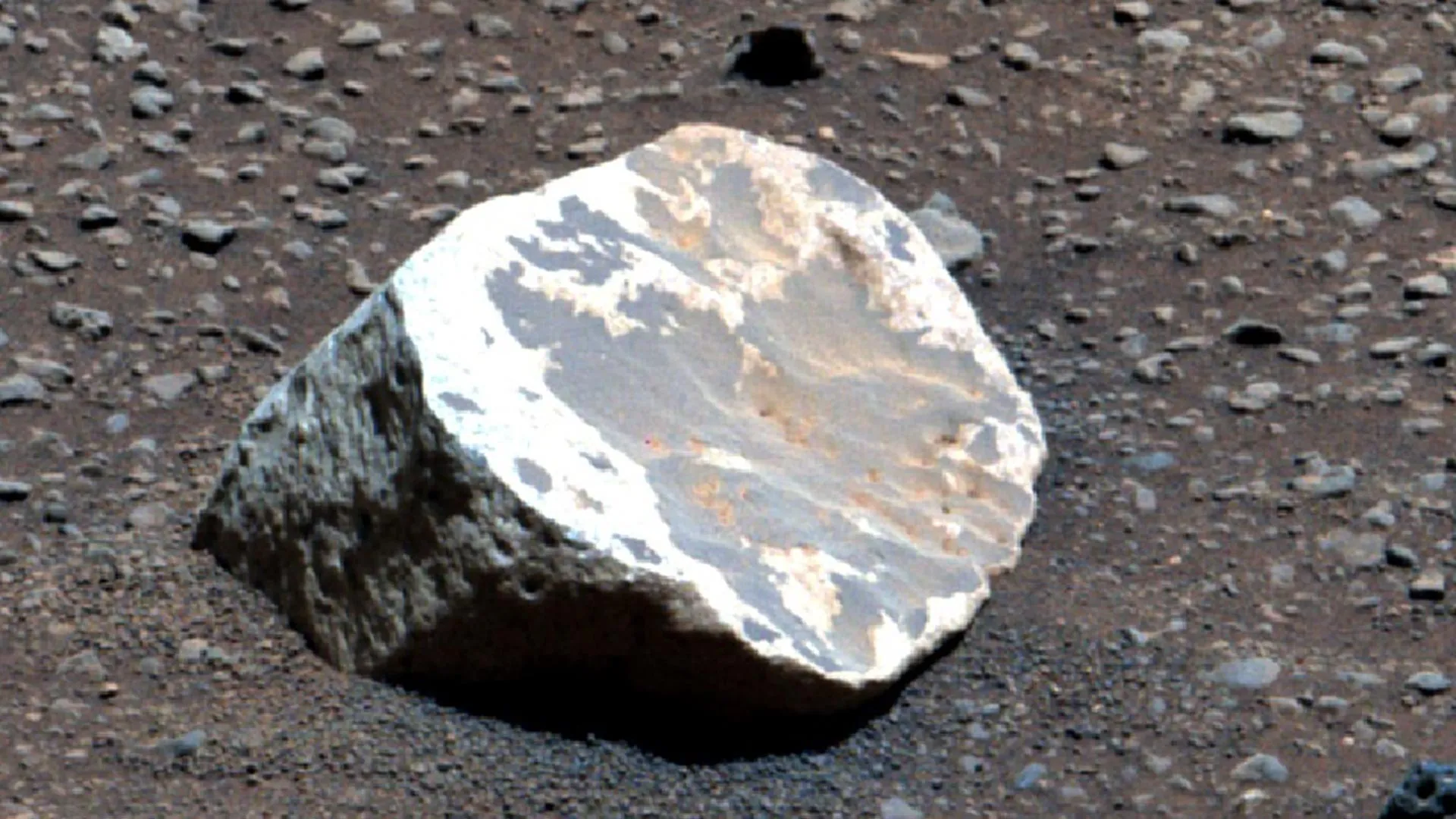
Small, pale rocks scattered across Mars’ reddish surface are offering fresh clues that parts of the planet may once have been far wetter than they are today. These light-colored spots stand out sharply against the surrounding terrain and suggest that some regions of Mars once hosted humid environments with frequent rainfall, similar to tropical areas on Earth.
NASA’s Perseverance rover identified the rocks as kaolinite clay, a white, aluminum-rich material. On Earth, kaolinite forms only after rocks and sediments are stripped of most other minerals through prolonged exposure to water. This process typically requires millions of years of persistent rainfall in warm, wet climates.
Study Links Rare Clay to Long-Term Rainfall
The research was published in the peer-reviewed journal Communications Earth & Environment. The study was led by Adrian Broz, a postdoctoral research associate at Purdue University working in the lab of Briony Horgan. Horgan serves as a long-term planner on NASA’s Perseverance rover mission and is a professor of planetary science in Purdue’s Department of Earth, Atmospheric, and Planetary Sciences.
“Elsewhere on Mars, rocks like these are probably some of the most important outcrops we’ve seen from orbit because they are just so hard to form,” Horgan said. “You need so much water that we think these could be evidence of an ancient warmer and wetter climate where there was rain falling for millions of years.”
Broz explained that on Earth, kaolinite is most commonly found in tropical environments such as rainforests, where heavy rainfall drives intense chemical weathering.
“So when you see kaolinite on a place like Mars, where it’s barren, cold and with certainly no liquid water at the surface, it tells us that there was once a lot more water than there is today,” said Broz, a postdoctoral collaborator on the Perseverance rover.
Rover Instruments Reveal Clues to Mars’ Climate History
The kaolinite pieces observed by Perseverance range in size from small pebbles to large boulders. While modest in scale, they contribute important evidence to the ongoing debate over what Mars was like billions of years ago. The rover’s SuperCam and Mastcam-Z instruments were used to analyze the rocks and compare them with similar materials found on Earth.
These Martian samples could help scientists better understand the environmental changes Mars experienced over time and how the planet transitioned from a wetter world to the dry landscape seen today.
A Geological Mystery in Jezero Crater
Despite their importance, the origin of these light-colored rocks remains unclear. Horgan noted that there is no obvious nearby source where the kaolinite could have formed, even though the fragments appear scattered along the rover’s path since it landed in Jezero crater in February 2021. Scientists believe the crater once held a lake roughly twice the size of Lake Tahoe.
“They’re clearly recording an incredible water event, but where did they come from?” Horgan said. “Maybe they were washed into Jezero’s lake by the river that formed the delta, or maybe they were thrown into Jezero by an impact and they’re just scattered there. We’re not totally sure.”
Satellite data has revealed large kaolinite deposits elsewhere on Mars, but Perseverance has not yet reached those locations.
“But until we can actually get to these large outcroppings with the rover, these small rocks are our only on-the-ground evidence for how these rocks could have formed,” Horgan said. “And right now the evidence in these rocks really points toward these kinds of ancient warmer and wetter environments.”
Earth Comparisons Strengthen the Case
To better understand how the Martian kaolinite formed, Broz compared the rover data with rock samples collected near San Diego, California, and in South Africa. The chemical signatures of the Earth and Mars samples closely matched.
Broz noted that kaolinite can also form through hydrothermal processes on Earth, where hot water alters rock underground. However, this method leaves behind a distinct chemical pattern that differs from the signature created by long-term exposure to rain at cooler temperatures. Data from three separate sites were used to evaluate whether hydrothermal activity could explain the Martian samples, and the results favored rainfall as the most likely cause.
A Time Capsule for Habitability
Kaolinite and similar rocks on Mars act as geological records, preserving information about environmental conditions from billions of years ago. These materials offer rare insight into whether Mars once had settings capable of supporting life.
“All life uses water,” Broz said. “So when we think about the possibility of these rocks on Mars representing a rainfall-driven environment, that is a really incredible, habitable place where life could have thrived if it were ever on Mars.”