
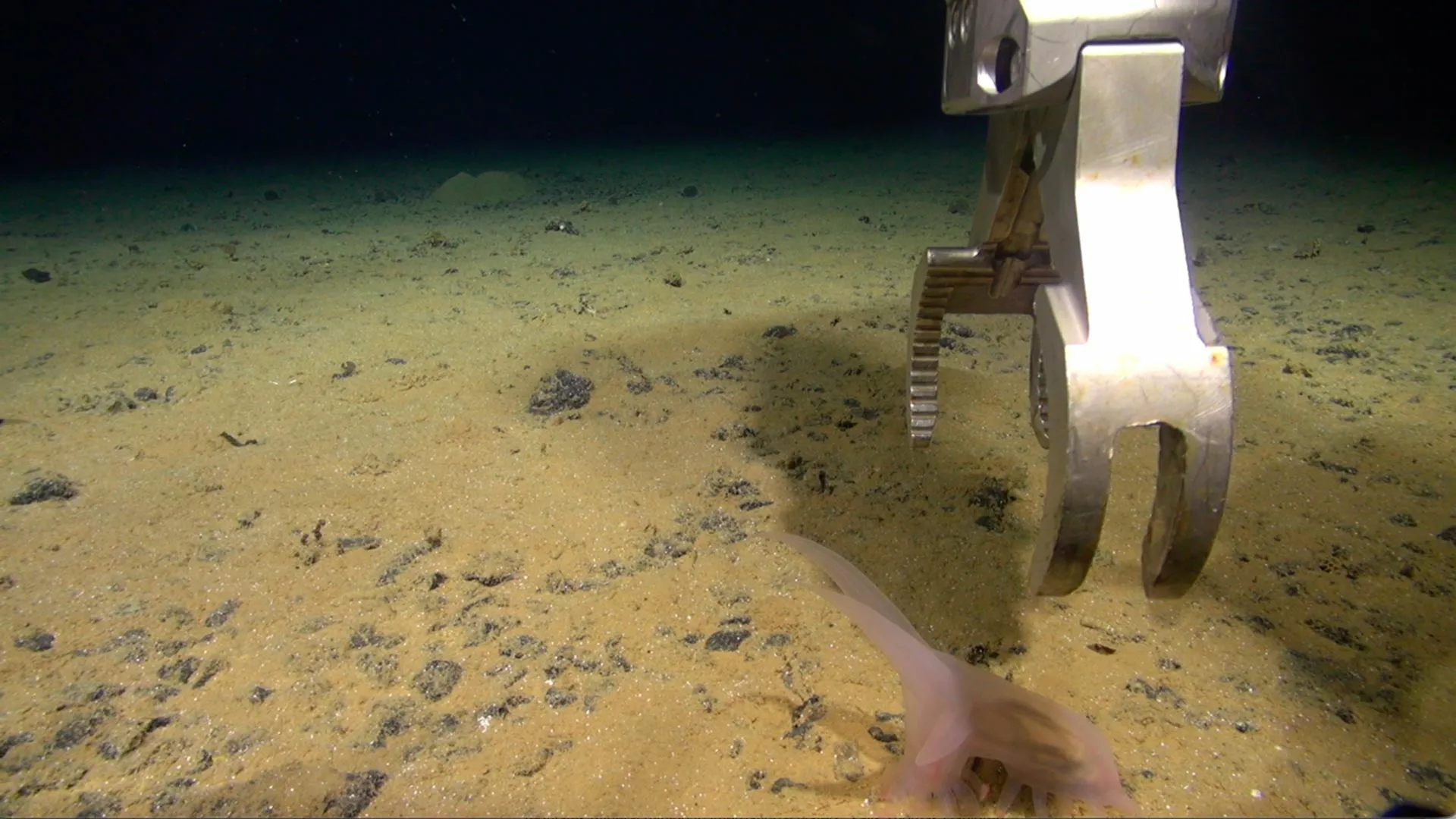
The global demand for critical metals is rising quickly, prompting many countries to explore the possibility of extracting these valuable resources from the ocean floor. A new international study has revealed that this push toward deep-sea mining may have less overall environmental impact than scientists once feared. At the same time, the research shows clear local damage, with species diversity dropping by about one third along the paths cut by mining equipment.
The study also uncovered a major surprise. Hundreds of previously unknown species were found living nearly 4,000 meters below the ocean’s surface, highlighting just how little is known about these remote environments.
Exploring One of Earth’s Least Known Ecosystems
Marine biologists from multiple countries joined forces in a large research effort to document life on the deep-sea floor of the Pacific Ocean, one of the most unexplored regions on the planet.
The research, published in Nature Ecology and Evolution, was driven in part by growing commercial and geopolitical interest in the area.
“Critical metals are needed for our green transition, and they are in short supply. Several of these metals are found in large quantities on the deep-sea floor, but until now, no one has shown how they can be extracted or what environmental impact this would have,” says marine biologist Thomas Dahlgren, that together with Helena Wiklund, also at the University of Gothenburg, have participated in the research project.
Five Years of Research and 160 Days at Sea
The project followed the International Seabed Authority’s (ISA) guidelines for baseline studies and environmental impact assessments (see fact box).
Over five years, researchers cataloged marine life and tested mining impacts in the Clarion-Clipperton Zone, a vast region of the Pacific Ocean located between Mexico and Hawaii. The results showed that areas directly disturbed by mining equipment experienced a 37 percent decline in animal numbers and a 32 percent reduction in species diversity.
“The research required 160 days at sea and five years of work. Our study will be important for the International Seabed Authority (ISA), which regulates mineral mining in international waters,” says Thomas Dahlgren.
Life at 4,000 Meters Below the Surface
The study area lies 4,000 meters beneath the ocean surface, where sunlight never reaches and food is extremely limited. In this environment, the sediment layer grows at a rate of just one thousandth of a millimeter per year.
To put the scarcity of life into perspective, a single seafloor sample from the North Sea can contain up to 20,000 animals. A similar sample from the deep Pacific seabed contains roughly the same number of species, but only about 200 individual animals.
Researchers collected 4,350 animals larger than 0.3 mm living in and on the seabed. From these samples, 788 species were identified. Most belonged to groups such as marine bristle worms, crustaceans, and mollusks, including snails and mussels.
The team also identified a new solitaire coral, that are described in another study.
Unknown Species Ranges and Long-Term Risks
“I have been working in the Clarion-Clipperton Zone for over 13 years, and this is by far the largest study that has been conducted. In Gothenburg, we led the identification of marine polychaete worms. Since most species have not been described previously, molecular (DNA) data was crucial in facilitating studies of biodiversity and ecology on the seabed,” says Thomas Dahlgren.
As the inventory progressed, scientists noticed that deep-sea communities changed naturally over time, likely in response to shifts in how much food reached the ocean floor. However, researchers still do not know how widely these species are distributed across the Pacific’s deep-sea regions.
“It is now important to try to predict the risk of biodiversity loss as a result of mining. This requires us to investigate the biodiversity of the 30 percent of the Clarion-Clipperton Zone that has been protected. At present, we have virtually no idea what lives there,” says Adrian Glover, senior author from the Natural History Museum of London.