
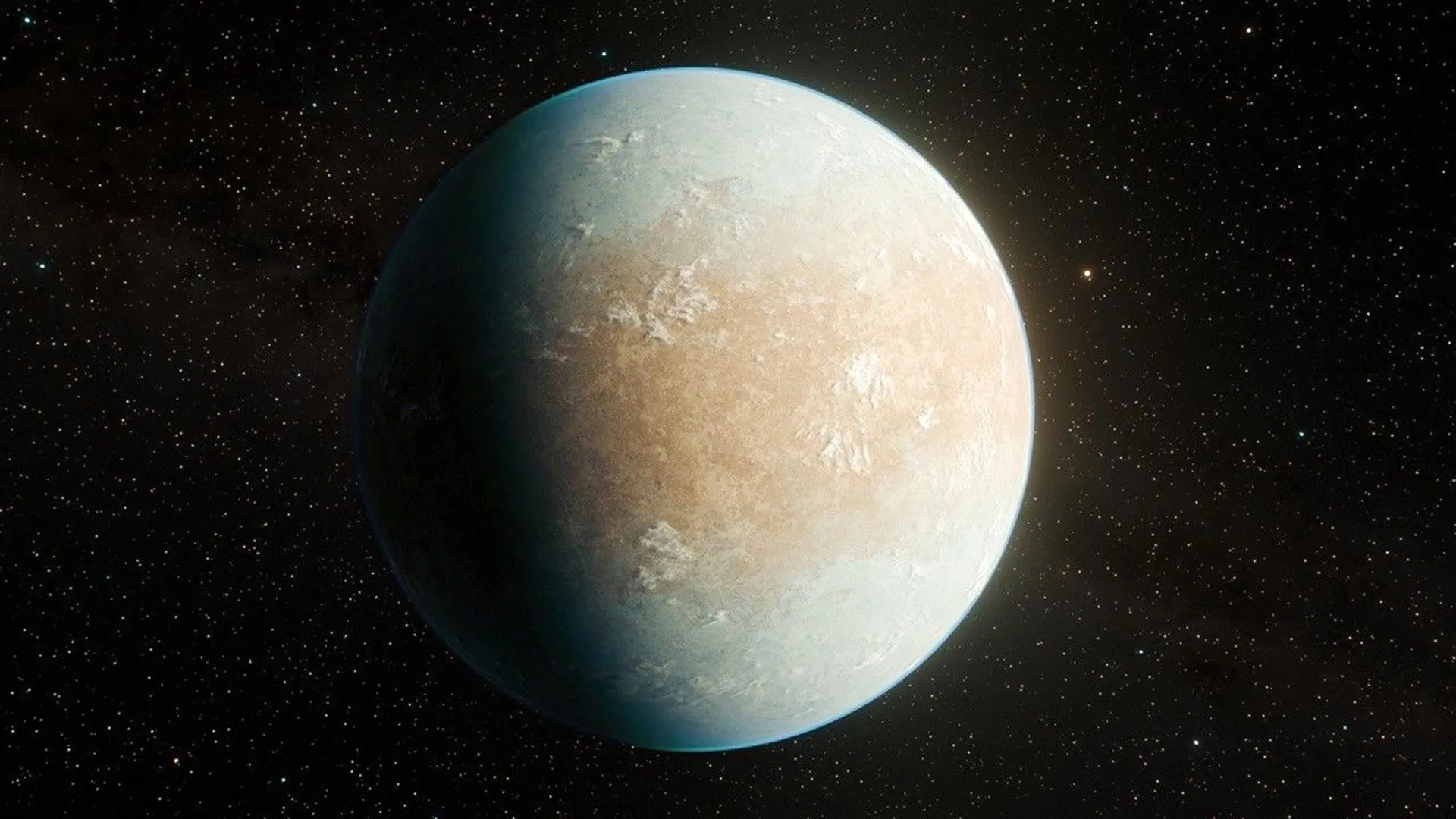
Astronomers have identified a possible Earth-like planet called HD 137010 b that may share many similarities with our world. However, there is one striking difference. It could be even colder than the permanently frozen surface of Mars.
The discovery comes from continued analysis of data collected by NASA’s Kepler Space Telescope, which ended its mission in 2018. Researchers reviewing that archive have uncovered evidence of a rocky planet slightly larger than Earth orbiting a Sun-like star about 146 light-years away.
Earth-Like Orbit Near the Habitable Zone
HD 137010 b is currently classified as a “candidate,” meaning it still needs additional observations to confirm its existence. Early calculations suggest it completes one orbit roughly every year, placing it at a distance from its star similar to Earth’s orbit around the Sun.
The planet also appears to lie near the outer boundary of its star’s “habitable zone,” the region where temperatures could allow liquid water to exist on a planet’s surface if the atmosphere is suitable. Planets beyond our solar system are known as “exoplanets.” If confirmed, this world could become the first Earth-size exoplanet in a yearlong orbit that passes in front of a nearby, bright Sun-like star, making it an especially valuable target for follow-up research.
A World That May Be Colder Than Mars
Despite its promising orbit, the planet may receive far less warmth than Earth does. Scientists estimate it gets under one third of the heat and light our planet receives from the Sun. Although its host star belongs to a similar stellar class as our Sun, HD 137010 is cooler and less luminous.
As a result, surface temperatures on HD 137010 b could reach no higher than minus 90 degrees Fahrenheit (minus 68 degrees Celsius). For comparison, Mars averages about minus 85 degrees Fahrenheit (minus 65 degrees Celsius). That means this potential Earth twin could be even colder than the Red Planet.
Why Confirmation Will Be Difficult
To move from “candidate” to “confirmed,” astronomers must detect repeated transits. A transit occurs when a planet crosses in front of its star from our point of view, briefly dimming the starlight in a small eclipse.
In this case, scientists observed only a single “transit” during Kepler’s extended K2 mission. During that event, the planet’s shadow took about 10 hours to cross the star’s face, compared with roughly 13 hours for Earth crossing the Sun as seen from a distant vantage point. Using the duration of that crossing and computer models of the system, researchers estimated the planet’s likely orbital period.
Even though this single detection was unusually precise, confirmation requires seeing the same event happen again at regular intervals. That will not be easy. Because the planet appears to orbit at a distance similar to Earth’s, transits would occur only about once per year. Planets in tighter, shorter orbits pass in front of their stars more frequently, which makes them easier to detect (it’s a big reason why exoplanets with Earth-like orbits are so hard to detect in the first place).
Future confirmation may come from NASA’s TESS (the Transiting Exoplanet Survey Satellite) or from the European Space Agency’s CHEOPS (CHaracterising ExOPlanets Satellite). If not, astronomers may need to wait for more advanced space telescopes to gather additional evidence.
Could a Thick Atmosphere Make It Warmer?
Although the planet may be extremely cold, researchers say it is still possible that HD 137010 b could support milder conditions. Climate modeling suggests that with a denser atmosphere rich in carbon dioxide, the planet might trap enough heat to allow liquid water to exist.
Based on atmospheric simulations, the team estimates a 40% chance that the planet lies within the “conservative” habitable zone and a 51% chance that it falls within the broader “optimistic” habitable zone. At the same time, there is roughly a 50-50 chance that it actually orbits beyond the habitable zone altogether.
The findings were published in The Astrophysical Journal Letters on Jan. 27, 2026, in a paper titled “A Cool Earth-sized Planet Candidate Transiting a Tenth Magnitude K-dwarf From K2.” The international research team was led by astrophysics Ph.D. student Alexander Venner of the University of Southern Queensland, Toowoomba, Australia, who is now a postdoctoral researcher at the Max Planck Institute for Astronomy, Heidelberg, Germany.