
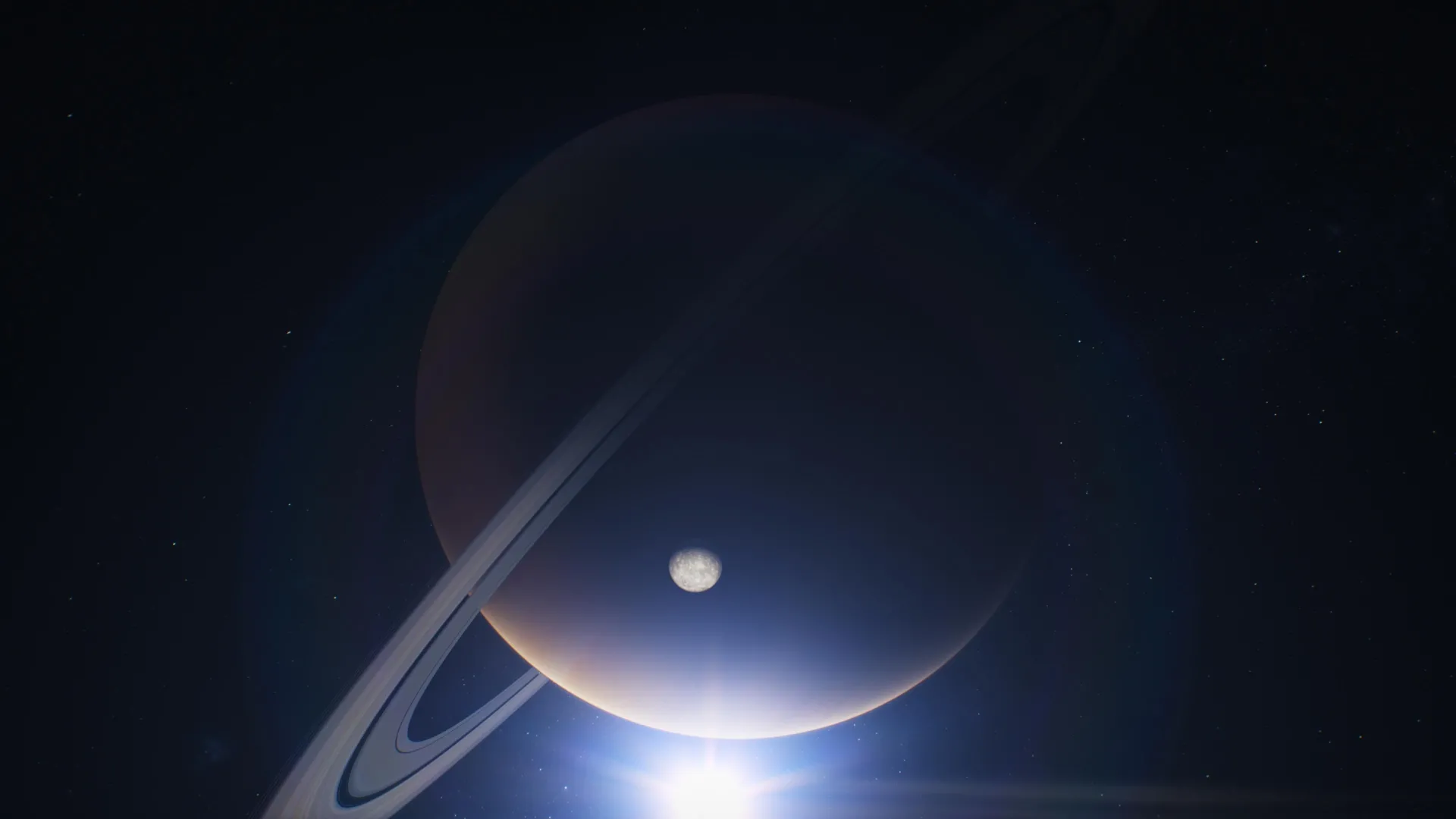
New research suggests that Saturn’s brilliant rings and its largest moon, Titan, may share a violent past shaped by collisions between moons. Although NASA’s Cassini spacecraft transformed our understanding of Saturn during its 13 year mission, it also uncovered new puzzles, including the surprisingly young age of Saturn’s rings and Titan’s shifting orbit. A new study led by SETI Institute scientist Matija Ćuk proposes that these mysteries are connected and that Titan itself may have formed when two earlier moons merged.
Toward the end of its mission, Cassini measured how mass is distributed inside Saturn. That internal structure controls the planet’s slow wobble in space, known as precession. For many years, researchers believed Saturn’s precession matched Neptune’s, allowing their gravitational interactions to gradually tilt Saturn and make its rings more visible from Earth.
However, Cassini’s final measurements revealed that Saturn’s mass is more concentrated toward its center than scientists had expected. This subtle difference changes Saturn’s precession rate so that it no longer aligns with Neptune’s. To account for the mismatch, researchers at MIT and UC Berkeley proposed that Saturn once had an additional moon. According to their idea, that moon was flung away after a close encounter with Titan and later broke apart, creating the rings.
Hyperion’s Orbit Offers a Clue
The SETI Institute team tested whether such an extra moon could have moved close enough to Saturn to form the rings. Computer simulations showed that the most likely outcome was not ring formation directly, but a collision between the extra moon and Titan.
An important clue comes from Hyperion, Saturn’s small, irregularly shaped moon that tumbles chaotically in space. Hyperion’s orbit is locked with Titan’s.
“Hyperion, the smallest among Saturn’s major moons provided us the most important clue about the history of the system,” said Ćuk. “In simulations where the extra moon became unstable, Hyperion was often lost and survived only in rare cases. We recognized that the Titan-Hyperion lock is relatively young, only a few hundred million years old. This dates to about the same period when the extra moon disappeared. Perhaps Hyperion did not survive this upheaval but resulted from it. If the extra moon merged with Titan, it would likely produce fragments near Titan’s orbit. That is exactly where Hyperion would have formed.”
In other words, Hyperion may not have simply survived past chaos. It may have formed from debris created when Titan merged with another moon.
A Collision Between Proto Moons
The new model proposes that Titan formed when two earlier moons combined. One was a large body called “Proto-Titan,” nearly as massive as Titan today. The other was a smaller companion referred to as “Proto-Hyperion.”
Such a merger could explain why Titan has relatively few impact craters. A massive collision would have resurfaced the moon, erasing much of its earlier crater record. Titan’s current orbit, which is slightly elongated but gradually becoming more circular, also hints at a relatively recent disturbance consistent with a past merger.
Before the collision, Proto-Titan may have resembled Jupiter’s moon Callisto, heavily cratered and lacking an atmosphere. The team also found that before it disappeared, Proto-Hyperion could have tilted the orbit of Saturn’s distant moon Iapetus, potentially solving another longstanding mystery about the Saturn system.
How Titan’s Merger May Have Created Saturn’s Rings
If Titan formed from a moon merger, the question remains: where did Saturn’s rings come from?
More than a decade ago, members of the SETI Institute team suggested that the rings formed from debris created when medium sized moons closer to Saturn collided. Later simulations by researchers at the University of Edinburgh and NASA Ames Research Center supported this idea. Those studies showed that most of the debris from such impacts would eventually clump back together into moons, but some material would be scattered inward and remain as rings.
Previously, scientists believed the Sun may have triggered the instability that caused those inner moon collisions. The new research suggests a different chain of events. Titan’s merger may have set off the process.
Titan’s slightly elongated orbit can disturb inner moons when their orbital periods become simple fractions of Titan’s. This configuration, known as orbital resonance, strengthens gravitational interactions. Although such alignments are unlikely at any given moment, Titan’s outward migration sometimes creates these resonances.
When that happens, smaller moons can be pushed into more stretched out orbits, increasing the chances that they collide with neighboring moons. The timing of this second round of destruction is uncertain, but it must have occurred after Titan’s merger. That sequence fits with estimates that Saturn’s rings are about 100 million years old.
Dragonfly Mission Could Test the Theory
NASA’s Dragonfly mission, scheduled to arrive at Titan in 2034, could provide crucial evidence. The nuclear powered octocopter will study Titan’s surface geology and chemistry in detail. If Dragonfly finds signs of large scale resurfacing or other clues tied to a massive collision about half a billion years ago, it would support the idea that Titan was shaped by a dramatic moon merger.
The study has been accepted for publication in the Planetary Science Journal, and the preprint is available on arXiv.