
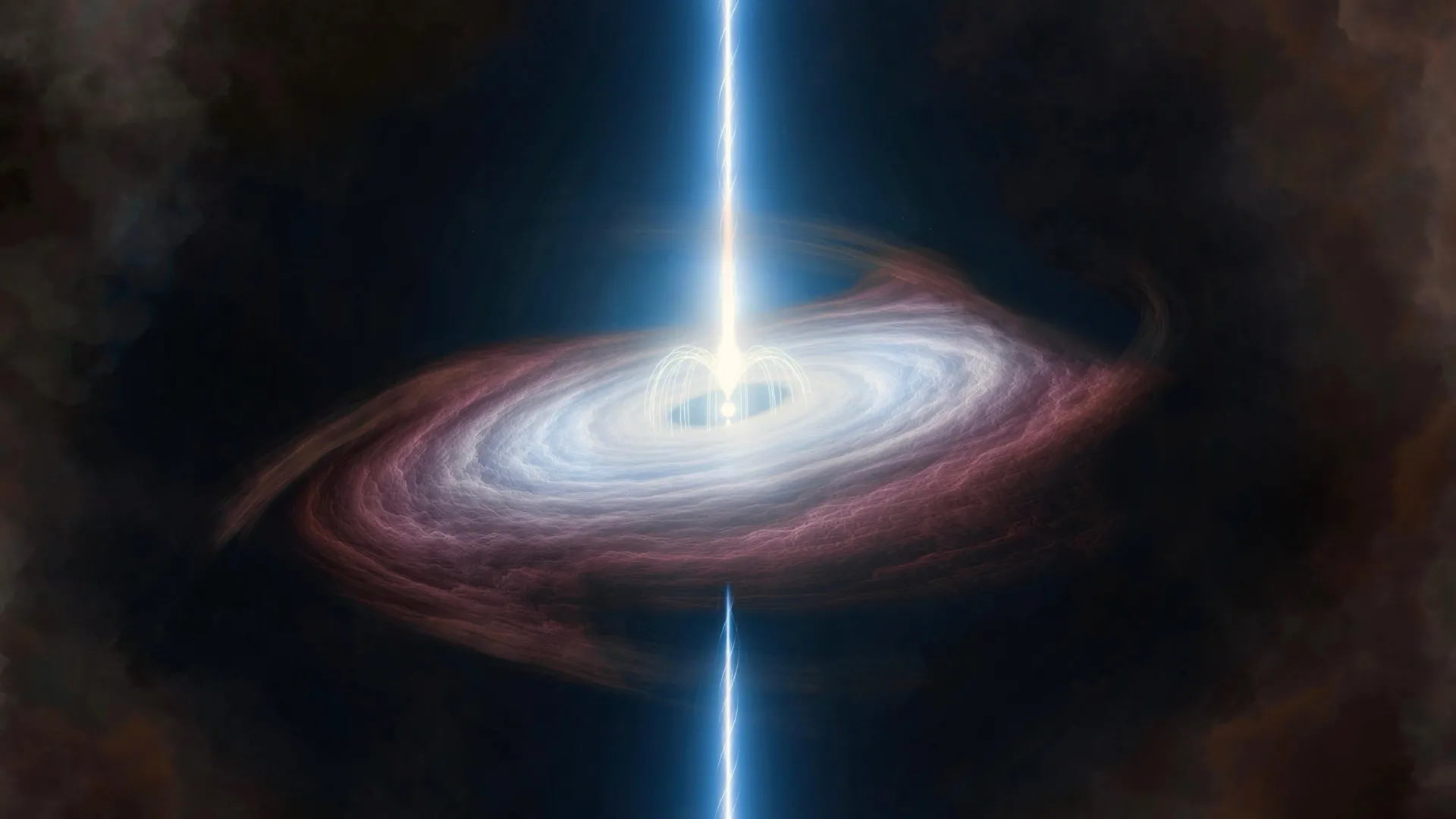
Astronomers have, for the first time, observed the birth of a magnetar, an extremely magnetic, rapidly spinning type of neutron star. The breakthrough confirms that these exotic objects can power some of the brightest stellar explosions ever seen.
The discovery also validates a theory first proposed 16 years ago by a UC Berkeley physicist and reveals a newly recognized feature of certain exploding stars: a distinctive “chirp” in their light that can only be explained using Einstein’s theory of general relativity. The research was published in the journal Nature.
The Mystery Behind the Brightest Supernovae
Superluminous supernovae are among the most spectacular explosions in the universe, shining 10 or more times brighter than ordinary supernovae. Since astronomers first identified them in the early 2000s, they have struggled to explain why these explosions remain intensely bright long after a massive star’s iron core collapses and blasts its outer layers into space.
Back in 2010, UC Berkeley theoretical astrophysicist Dan Kasen proposed that the answer was a newborn magnetar. His theory, coauthored with Lars Bildsten and independently suggested by Stanford Woosley of UC Santa Cruz, argued that when an enormous star reaches the end of its life, its core can collapse into an incredibly dense neutron star instead of becoming a black hole.
If that original star possessed a powerful magnetic field, the collapse would dramatically amplify it, producing a magnetar with a magnetic field 100 to 1,000 times stronger than that of a typical pulsar. Although both pulsars and magnetars measure only about 10 miles across, young magnetars can spin more than 1,000 times every second.
As they rotate, their powerful magnetic fields accelerate charged particles that slam into the expanding debris from the supernova, injecting extra energy that keeps the explosion shining much longer than expected. Magnetars are also believed to generate mysterious fast radio bursts.
A “Chirping” Supernova Reveals the Truth
Graduate student Joseph Farah of UC Santa Barbara and Las Cumbres Observatory (LCO) found the strongest evidence yet for this theory after studying a supernova discovered in 2024, known as SN 2024afav. Farah, who will join Kasen’s research group at UC Berkeley this fall as a Miller Postdoctoral Fellow, and his colleagues concluded that unusual bumps in the supernova’s light curve provide direct evidence that a magnetar formed during the explosion.
“What’s really exciting is that this is definitive evidence for a magnetar forming as the result of a superluminous supernova core collapse,” said Alex Filippenko, a UC Berkeley distinguished professor of astronomy, coauthor of the study, and one of Farah’s future mentors.
“The basis of Dan Kasen and Stan Woosley’s model is that all you need is the energy of the magnetar deep within and a good fraction of it will get absorbed, and that’ll explain why the thing is superluminous. What had not been demonstrated was that a magnetar did in fact form in the middle of the supernova, and that’s what Joseph’s paper shows.”
Kasen said researchers had long suspected a hidden magnetar was powering these extraordinary explosions.
“For years the magnetar idea has felt almost like a theorist’s magic trick — hiding a powerful engine behind layers of supernova debris. It was a natural explanation for the extraordinary brightness of these explosions, but we couldn’t see it directly,” he said. “The chirp in this supernova signal is like that engine pulling back the curtain and revealing that it’s really there.”
Tracking a Billion-Light-Year-Distant Explosion
After SN 2024afav was discovered in December 2024, Las Cumbres Observatory, a worldwide network of 27 telescopes, monitored the explosion for more than 200 days. The supernova occurred roughly one billion light-years from Earth.
Farah and UCSB astronomer Andy Howell noticed something unusual after the supernova reached peak brightness about 50 days after the explosion. Instead of fading smoothly, as most supernovae do, its brightness rose and fell repeatedly. The intervals between these fluctuations became progressively shorter, creating four distinct bumps in the light curve.
Farah compared the pattern to the rising pitch of a bird’s chirp.
Earlier superluminous supernovae had occasionally shown one or two bumps, often explained as shock waves colliding with shells of gas surrounding the dying star. But no previous event displayed four.
Einstein’s General Relativity Explains the Signal
Farah’s model suggests that some of the material blasted outward by the explosion later fell back toward the newborn magnetar, forming an accretion disk.
Because this disk was likely tilted relative to the magnetar’s spin, Einstein’s theory predicts that the rapidly spinning neutron star would drag the surrounding fabric of space-time with it, producing a phenomenon called Lense-Thirring precession. This effect causes the tilted disk to wobble.
As the wobbling disk periodically blocks and reflects light from the magnetar, the system behaves like a flashing cosmic lighthouse. Over time, the disk spirals inward, causing the wobble to speed up. That makes the light pulses arrive more rapidly, producing the distinctive “chirp” detected by astronomers.
“We tested several ideas, including purely Newtonian effects and precession driven by the magnetar’s magnetic fields, but only Lense-Thirring precession matched the timing perfectly,” Farah said. “It is the first time general relativity has been needed to describe the mechanics of a supernova.”
The team also estimated that the neutron star spins once every 4.2 milliseconds and possesses a magnetic field roughly 300 trillion times stronger than Earth’s, both defining characteristics of a magnetar.
“I think Joseph has found the smoking gun,” Howell said. “He’s tied the bumps into the magnetar model and explained everything with the best-tested theory in astrophysics — general relativity. It is incredibly elegant.”
Filippenko added, “To see a clear effect of Einstein’s general theory of relativity is always exciting, but seeing it for the first time in a supernova is especially rewarding.”
More Mysteries Still Remain
The researchers caution that magnetars may not explain every superluminous supernova.
Some may instead brighten when the explosion’s shock wave crashes into surrounding material. Kasen has also suggested that if a collapsing star forms a black hole instead of a magnetar, it could likewise produce an unusually bright supernova. A tilted accretion disk around a black hole could also create bumps in the light curve.
“We don’t know what fraction of Type I superluminous supernovae might be powered by circumstellar material, but it’s definitely a smaller fraction than we previously thought, because this discovery clearly accounts for some of them,” Filippenko said.
Farah expects astronomers to discover many more “chirping” supernovae once the Vera C. Rubin Observatory begins its unprecedented survey of the night sky.
“This is the most exciting thing I have ever had the privilege to be a part of. This is the science I dreamed of as a kid,” Farah said. “It’s the universe telling us out loud and in our face that we don’t fully understand it yet, and challenging us to explain it.”
Howell, Logan Prust, now at the Flatiron Institute in New York, and Yuan Qi Ni of UCSB contributed equally to the research. Filippenko acknowledged financial support from Christopher R. Redlich and many other donors.