
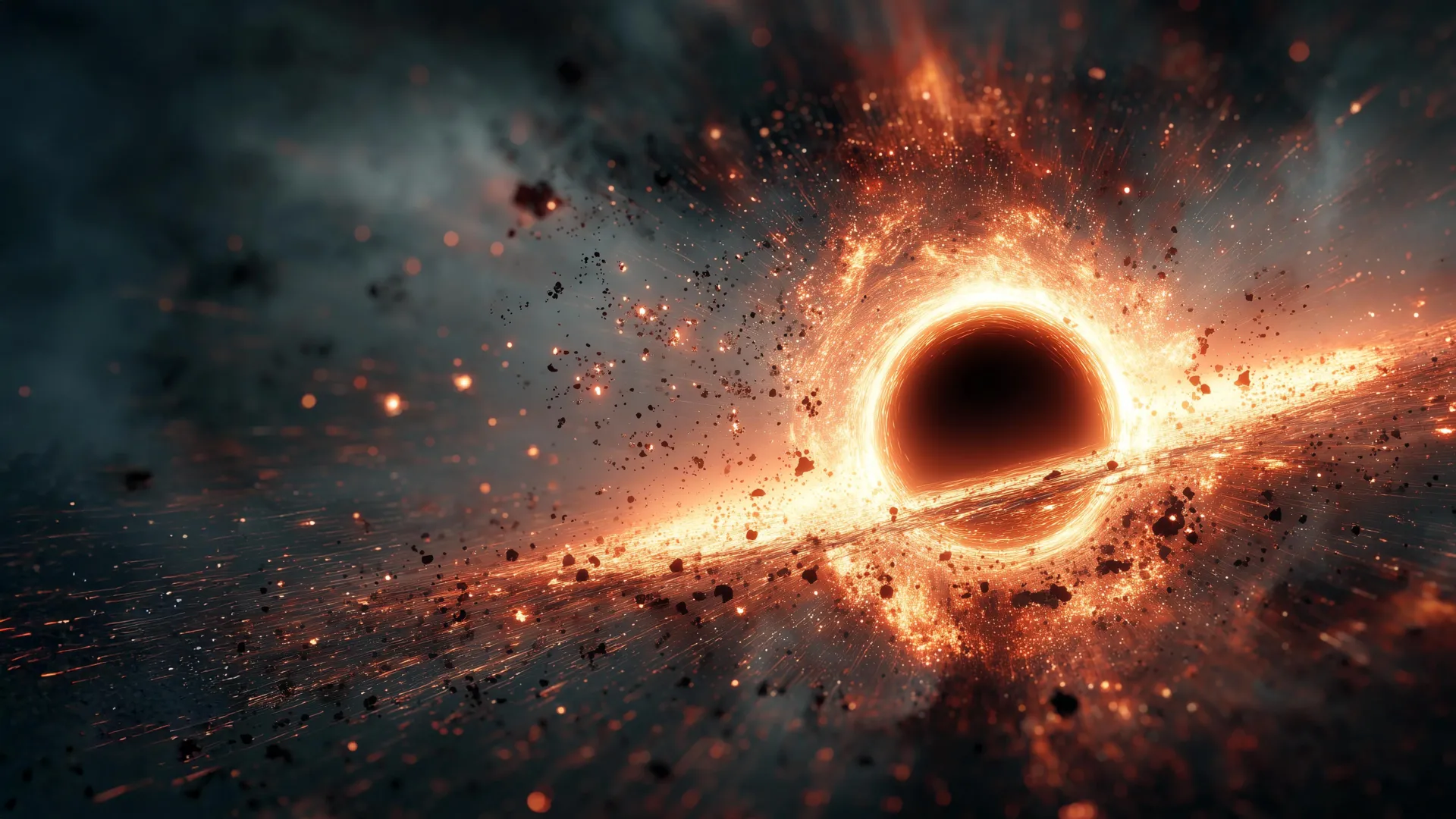
Astronomers have captured one of the clearest views yet of a “reborn” black hole in action, revealing a dramatic outburst that has been compared to a “cosmic volcano” spreading across nearly one million light-years of space.
The discovery centers on the galaxy J1007+3540, where scientists observed a supermassive black hole at its core suddenly restarting powerful jets after remaining inactive for almost 100 million years.
Jets Clash With Extreme Galaxy Cluster Environment
Radio observations show the galaxy caught in a turbulent struggle. Newly reactivated jets from the black hole are pushing outward, only to be distorted and compressed by the intense pressure of the massive galaxy cluster surrounding it.
The findings were published in Monthly Notices of the Royal Astronomical Society and are based on observations from highly sensitive radio instruments. These include the Low Frequency Array (LOFAR) in the Netherlands and India’s upgraded Giant Metrewave Radio Telescope (uGMRT).
Evidence of Repeated Black Hole Eruptions
While most galaxies contain supermassive black holes, only a small fraction produce enormous jets of magnetized plasma that emit radio waves. J1007+3540 stands out because it clearly shows multiple cycles of activity, indicating that its central black hole has switched on and off over long periods.
The images reveal a bright, compact inner jet that signals recent activity. Surrounding it is a larger region of older, fading plasma left behind by earlier eruptions. This older material appears stretched and compressed by the harsh conditions of the surrounding cluster.
“It’s like watching a cosmic volcano erupt again after ages of calm — except this one is big enough to carve out structures stretching nearly a million light-years across space,” said lead researcher Shobha Kumari of Midnapore City College in India.
“This dramatic layering of young jets inside older, exhausted lobes is the signature of an episodic AGN — a galaxy whose central engine keeps turning on and off over cosmic timescales.”
Scientists Identify a Rare Episodic AGN
The study was conducted by Kumari along with Dr. Sabyasachi Pal of Midnapore City College, Dr. Surajit Paul of the Manipal Centre for Natural Sciences in India, and Dr. Marek Jamrozy of Jagiellonian University in Poland.
“J1007+3540 is one of the clearest and most spectacular examples of episodic AGN with jet-cluster interaction, where the surrounding hot gas bends, compresses, and distorts the jets,” Dr. Pal explained.
Extreme Pressure Shapes the Black Hole Jets
J1007+3540 is embedded in a massive cluster filled with extremely hot gas. This creates intense external pressure, far greater than what is typically seen in most radio galaxies. As the jets expand outward, they are forced to bend and twist as they interact with this dense environment.
Images from LOFAR show that the northern lobe of the galaxy is heavily compressed and warped. The data reveal a curved flow of plasma that appears to be pushed sideways by the surrounding gas.
Meanwhile, observations from uGMRT indicate that this compressed region has an ultra-steep radio spectrum. This means the particles there are very old and have lost much of their energy, further highlighting the impact of the cluster’s extreme conditions.
A Galaxy Shaped by Its Surroundings
Another striking feature is a long, faint tail of emission stretching toward the southwest. This structure shows that magnetized plasma is being dragged through the cluster, leaving behind a diffuse trail that has persisted for millions of years.
According to the researchers, this suggests the galaxy is not only generating powerful jets but is also being reshaped by the environment around it.
Insights Into Black Hole Cycles and Galaxy Evolution
Systems like J1007+3540 offer valuable clues about how black holes behave over time. They help scientists understand how often black holes switch between active and quiet states, how jets change as they age, and how surrounding environments can alter the structure of entire galaxies.
The combination of renewed activity, enormous scale, and strong environmental influence makes this galaxy an important example of how galaxies evolve. Rather than growing in a smooth, steady way, the process appears to involve ongoing tension between powerful black hole outbursts and the pressure of the surrounding cosmic environment.
By studying this system, astronomers are gaining insight into:
- How often black holes switch between active and quiet phases
- How old radio plasma interacts with hot cluster gas
- How repeated eruptions reshape a galaxy over time
What Comes Next
The research team plans to carry out even more detailed observations using higher resolution instruments. Their goal is to examine the central region of J1007+3540 more closely and follow how the newly restarted jets move through this complex environment.
Understanding galaxies like J1007+3540 is key to uncovering how black holes influence their surroundings, and how galaxies themselves grow, shut down, and become active again over cosmic time.