
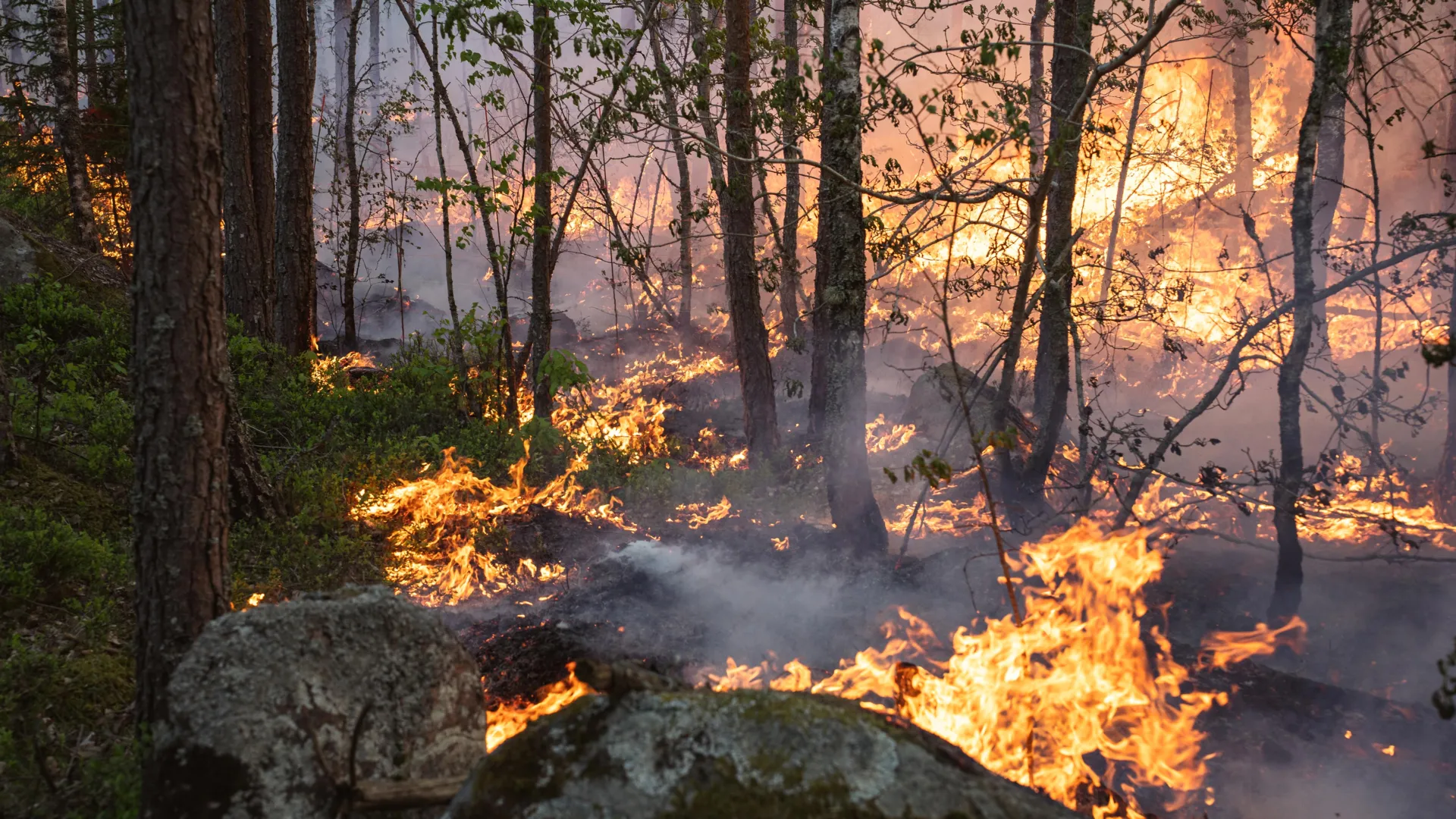
Wildfires sweeping through the vast boreal forests of Alaska, Canada, Scandinavia, and Russia could be having a larger impact on the climate than scientists once believed. A new study led by researchers at UC Berkeley suggests these northern fires may release far more carbon into the atmosphere than current estimates indicate.
The reason is that these fires do not only burn trees. In many boreal regions, flames can spread downward into thick layers of carbon rich soil beneath the forest floor. These soils, known as peat, contain partially decomposed plant material that has accumulated over hundreds or even thousands of years. Because the cold, wet conditions of the far north slow the breakdown of organic matter, these landscapes store enormous amounts of carbon underground.
Satellite Data May Miss Underground Peat Fires
According to the study, many widely used models that estimate wildfire carbon emissions fail to fully capture this underground burning. Most of these models rely heavily on satellite observations of visible flames and are based largely on fires that occur at lower latitudes. As a result, they may overlook slower, less visible fires that smolder deep within peat and organic soils.
“Many of the fires that matter most for the climate don’t look dramatic from space,” said study lead author Johan Eckdahl, a postdoctoral scholar in Berkeley’s Energy and Resources Group. “Peatlands and organic soils can smolder for weeks to years, releasing enormous amounts of ancient carbon.”
Reconstructing Emissions From Swedish Wildfires
The research, published in the journal Science Advances, analyzed 324 wildfires that burned across Sweden in 2018. Eckdahl and his colleagues combined detailed national forest records with direct field measurements to reconstruct the amount of carbon released by each fire.
Using these data, the team created a detailed map of wildfire emissions. Their analysis showed that local conditions such as climate, vegetation, and soil characteristics strongly influence how much carbon is stored in forests and how much is released during a wildfire.
Major Differences From Global Fire Models
When the researchers compared their reconstructed emissions with six widely used global wildfire models, they discovered significant discrepancies. In some places, the models overestimated carbon emissions. In other areas, especially where fires burned deep into soil layers, emissions were dramatically underestimated.
For instance, the models predicted higher emissions in the county of Gävleborg, where intense fires burned through dry forests and were clearly visible from satellites.
However, the situation was very different in neighboring Dalarna County. There, lower intensity fires burned quietly into thick layers of organic soil and were less noticeable from space. In that region, the models underestimated carbon emissions by as much as 14 times.
“Sweden is a very large country, but it’s quite small compared to Siberia and Canada,” Eckdahl said. “We may be severely underestimating the impact of the recent extreme fire seasons in these regions.”
Field Measurements Reveal Soil Carbon Loss
To measure how much carbon wildfires release from soil, the research team collected data from 50 locations affected by fires in 2018. Nineteen sites experienced high intensity fires, while 31 had lower intensity burns.
At each site, the researchers measured the thickness of the organic rich soil layer — which can vary from a few inches to many feet — and collected soil samples. By comparing carbon levels in burned soil with samples from nearby unburned forests, the team calculated how much carbon had been emitted.
“Once you’re out there, it’s a simple task — just dig some holes — but the hard part is getting to the sites,” Eckdahl said. “Sweden has a good network of forest roads, but in Siberia, I hear it’s a real trek, which is one reason why we’re severely missing measurements from that region.”
Expanding Research to Fire Prone U.S. Forests
Eckdahl is now working with colleagues at UC Berkeley and other institutions as part of the Western Fire & Forest Collaborative to apply similar research methods in forests across the Western United States.
Although forests in the western U.S. generally do not contain the same thick peat soils found in northern boreal regions, several other factors still influence wildfire emissions. These include regional climate patterns, the types of trees and vegetation present, and soil conditions. Eckdahl plans to study the role of soil microbes such as bacteria and fungi and how they contribute to forest recovery after wildfire.
“Forests in the Lower 48 and those far up north may look very different, but they share the common currency of carbon,” said Eckdahl. “By improving our understanding of how this element flows between the land and the atmosphere, we can better anticipate the impact of future fire regimes in a warming world and design smarter strategies to reduce climate risks on society.”
Lars Nieradzik of Lund University and Louise Rütting of the Brandenburg University of Technology are co authors of the paper.