
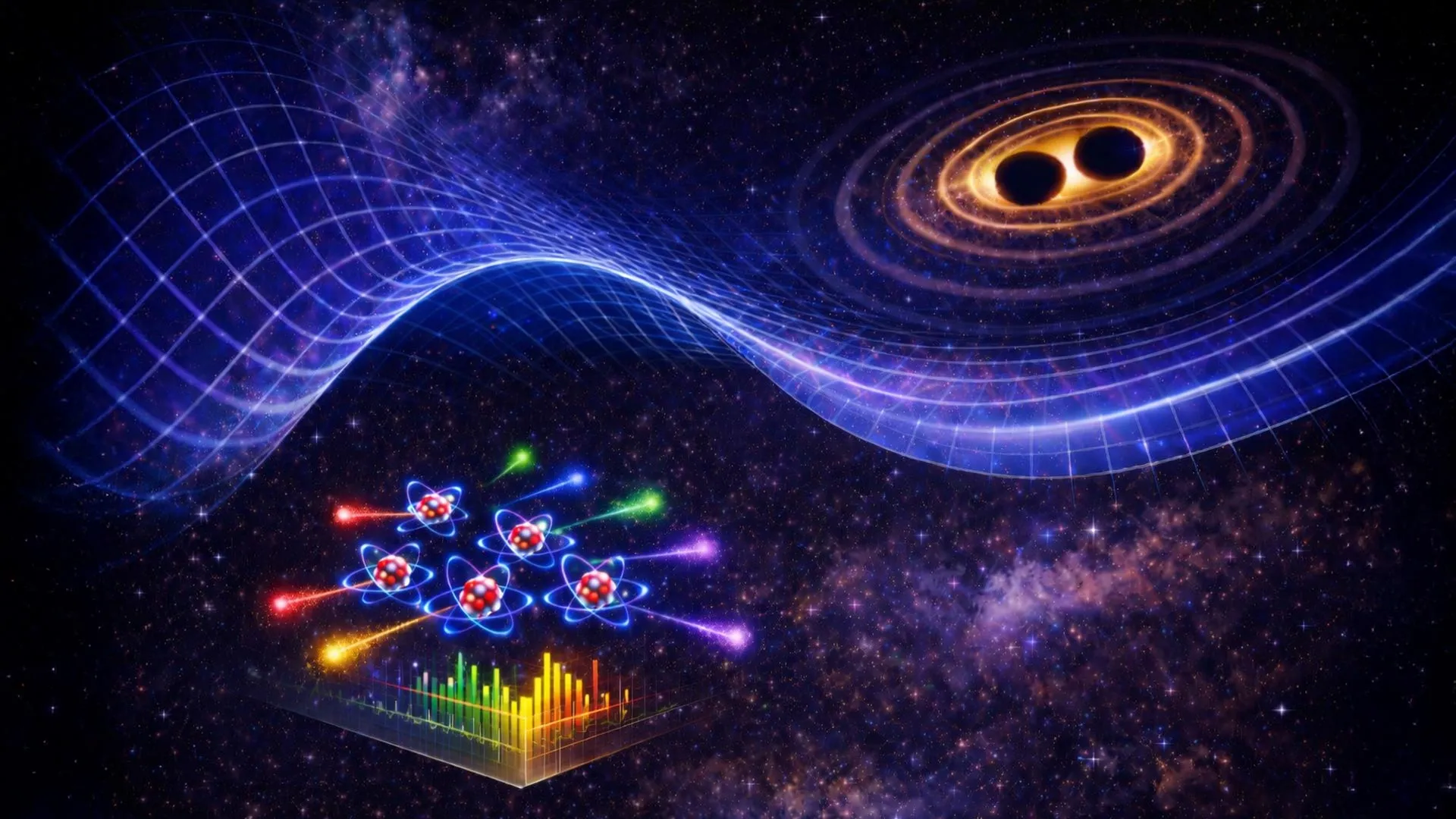
Gravitational waves are tiny ripples in spacetime created by powerful cosmic events such as colliding black holes. Until now, scientists have detected them by measuring extremely small changes in distance using huge instruments that stretch for kilometers. A new theoretical study, accepted for publication in Physical Review Letters, suggests a very different strategy. Researchers from Stockholm University, Nordita, and the University of Tübingen propose looking at how these waves subtly alter the light emitted by atoms. While the idea is promising, it has not yet been tested experimentally.
Atoms that absorb energy do not stay excited for long. They quickly return to a lower energy state by releasing light at a specific frequency, a process known as spontaneous emission. This behavior comes from the atom’s interaction with the quantum electromagnetic field.
“Gravitational waves modulate the quantum field, which in turn affects spontaneous emission,” said Jerzy Paczos, a PhD student at Stockholm University. “This modulation can shift the frequencies of emitted photons compared with the no-wave case.”
Hidden Signals in Directional Light
According to the researchers, gravitational waves would not change how often atoms emit light. Instead, they would subtly alter the frequency of the emitted photons depending on the direction in which they travel. Because the total emission rate stays the same, this effect has gone unnoticed until now.
The result would be a distinct directional pattern in the light’s spectrum. This pattern could carry information about the gravitational wave’s direction and polarization, offering a way to separate real signals from background noise.
Cold Atoms and Future Detectors
Detecting low-frequency gravitational waves is a major goal for future space missions. The team points out that systems based on atomic clocks, which rely on very precise optical transitions, could be especially useful. These systems allow for long interaction times, making cold-atom setups a strong candidate for testing the idea.
A Compact Alternative to Giant Instruments
The researchers compare atoms to a steady musical tone that normally sounds the same in every direction. A passing gravitational wave, however, would subtly change how that tone is heard depending on direction.
“Our findings may open a route toward compact gravitational-wave sensing, where the relevant atomic ensemble is millimeter-scale,” said Navdeep Arya, a postdoctoral researcher at Stockholm University. “A thorough noise analysis is necessary to assess practical feasibility, but our first estimates are promising.”
If confirmed, this approach could eventually lead to much smaller and more accessible detectors, offering a new way to observe some of the universe’s most dramatic events.