
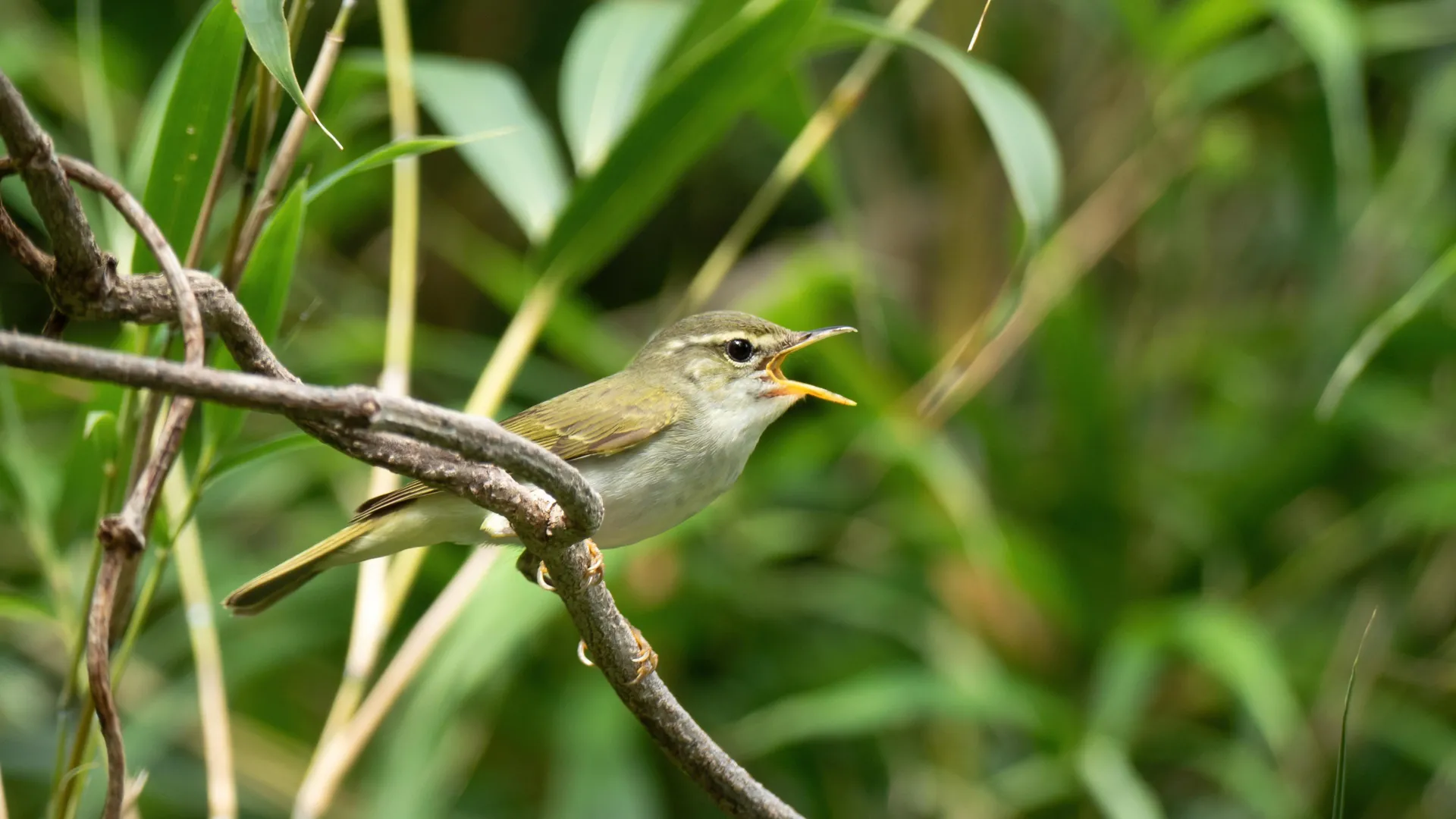
Scientists have identified a previously unrecognized bird species in Japan after genetic research revealed that what was thought to be a single species is actually two.
The discovery involves the Ijima’s Leaf Warbler, a rare migratory bird found only on two island groups in Japan. While new bird species are described every year, this case stands out because the birds look nearly identical. Instead, DNA evidence provided the strongest proof that they belong to separate species.
“This shows how important it is to use genetic methods to reveal hidden biodiversity at a time of global biodiversity crisis. These methods can help provide more complete knowledge on which to base future nature conservation efforts,” says Per Alström at Uppsala University, one of the researchers who have discovered the new species Tokara Leaf Warbler.
DNA Reveals a Hidden Species
The Ijima’s Leaf Warbler (Phylloscopus ijimae) lives on the Izu Islands south of Tokyo and on the Tokara Islands, located about 1,000 km farther to the south-west.
Researchers first found evidence a decade ago that birds from the two island groups were genetically different. After analyzing DNA sequences, they launched extensive investigations that included fieldwork on the islands, studies of museum specimens, and additional genetic research.
Whole genome analyses ultimately showed that the Tokara Islands population differs significantly from the birds living on the Izu Islands. Detailed comparisons of the birds’ songs supported the genetic findings.
As a result, researchers from Uppsala University, the University of Gothenburg, and two Japanese institutions have officially described the Tokara Leaf Warbler (Phylloscopus tokaraensis) as a new species.
The finding is particularly notable because Japan has not seen a newly described bird species since 1982, when scientists first described the Okinawa Rail (Gallirallus okinawae).
“The new species is a little cryptic and tricky to define. In terms of appearance, it doesn’t differ from the Ijima’s Leaf Warbler. It is DNA analyses and differences in song that show that this is a separate species,” Alström says.
Small Populations Raise Conservation Concerns
Both species occupy small island habitats, which means their populations are limited in size. The Tokara Islands cover a combined area of just over 100 square kilometres spread across twelve islands, making the total land area smaller than that of Fårö (an island off the coast of Gotland).
Scientists found that both species have very low genetic diversity. This could make them more vulnerable to environmental change, habitat pressures, and disease. However, there are also indications that the populations may have recovered to some degree after earlier declines.
Protecting Two Rare Island Birds
The Ijima’s Leaf Warbler is already classified as Vulnerable by the International Union for Conservation of Nature and is protected in Japan as a “Natural Monument.”
Because the newly recognized Tokara Leaf Warbler appears to be at least as rare as the Ijima’s Leaf Warbler, the researchers recommend that both species receive Vulnerable status. They also say continued monitoring will be important for detecting future changes in population size and ensuring the long-term survival of these rare island birds.