
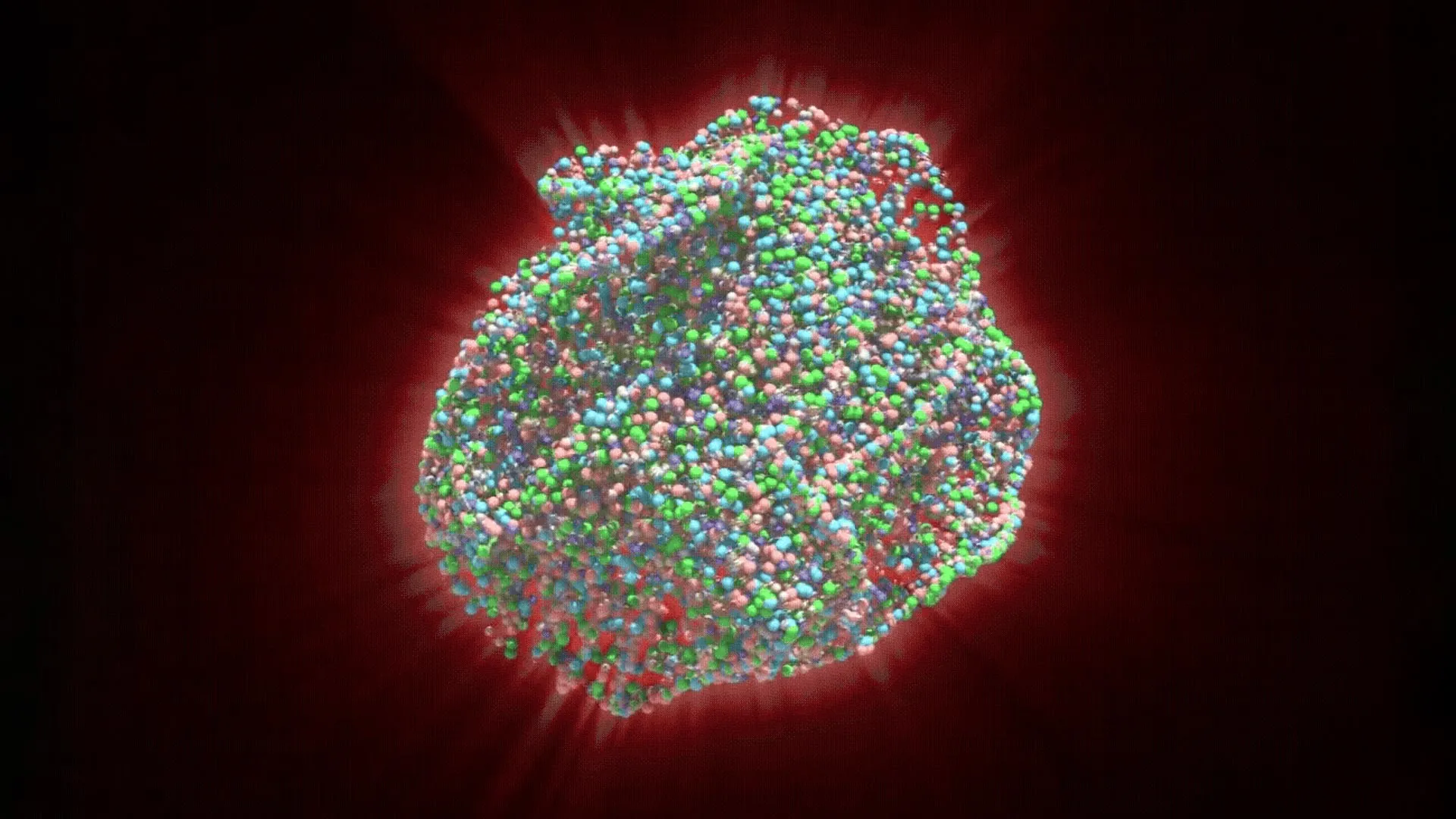
The findings come one year after the first-ever oxygen collisions at the Large Hadron Collider (LHC). All four of the collider’s major research collaborations, ALICE, ATLAS, CMS and LHCb, have now reported signs that this primordial form of matter can emerge when oxygen and neon nuclei collide.
The findings come one year after the first-ever oxygen collisions at the Large Hadron Collider (LHC). All four of the collider’s major research collaborations, ALICE, ATLAS, CMS and LHCb, have now reported signs that this primordial form of matter can emerge when oxygen and neon nuclei collide.
The results challenge a long-standing assumption about the enormous forces needed to create such an extreme substance. They also offer scientists a new way to investigate the conditions that prevailed during the universe’s earliest moments.
Recreating the Extreme Matter of the Early Universe
Quark–gluon plasma (QGP) is an unusual state of matter that appears under tremendous pressure and heat. At temperatures exceeding 100,000 times those at the Sun’s center, particles such as protons and neutrons can no longer maintain their normal structure. Instead, they break apart into quarks and the gluons that ordinarily bind them together.
Physicists believe that this was the state of matter throughout the universe during the first millionths of a second after the Big Bang. Nearly 14 billion years later, researchers can briefly recreate these extraordinary conditions by smashing atomic nuclei together at extremely high energies inside the LHC.
For decades, scientists believed that generating this plasma required collisions involving very heavy atomic nuclei, particularly lead. Lead nuclei are more than 200 times heavier than the protons typically used in LHC experiments, making them capable of producing the intense conditions thought necessary for QGP to form.
However, recent discoveries have increasingly called that assumption into question.
Earlier this year, the ALICE collaboration, which specializes in studying quark–gluon plasma, identified another indication of QGP formation in proton–proton and proton–lead collisions. The previous year, LHC researchers had also reported the first hints of this plasma emerging from oxygen–oxygen collisions.
Now, more detailed investigations have revealed multiple signs that QGP can form in collisions involving both oxygen and neon nuclei, providing stronger evidence that the conditions required to create this primordial matter are not limited to heavy atomic collisions.
Scientists Detect Evidence of Energy Loss in Extreme Collisions
One of the clearest ways to identify quark–gluon plasma is to examine what happens when energetic quarks and gluons travel through it.
As these particles move through the extremely hot and dense material, they lose some of their energy. Scientists call this process parton energy loss, and it provides an important clue that QGP has formed.
The ATLAS collaboration clearly detected this effect by studying pairs of particle jets generated during oxygen–oxygen and neon–neon collisions. These jets are concentrated streams of particles produced when energetic quarks and gluons emerge from a collision.
Researchers observed differences in energy between the paired jets, indicating that some of the particles had lost energy while traveling through the surrounding material.
The effect was especially pronounced during more direct, head-on (central) collisions. Such impacts are expected to create a larger volume of plasma, giving particles more material to travel through and causing greater energy loss.
Preliminary ATLAS results provide additional support for this interpretation. By examining charged particles that recoil in the opposite direction from photons, researchers found a similar relationship between energy loss and how centrally the nuclei collided.
Multiple CERN Experiments Confirm the Pattern
The ALICE, CMS, and LHCb collaborations searched for the same underlying process using a different approach. Rather than focusing primarily on the energy of particle jets, they examined how the plasma appears to reduce the production of certain energetic particles.
CMS found that charged-particle production was suppressed in both oxygen–oxygen and neon–neon collisions compared with proton–proton collisions. This reduction is consistent with particles losing energy inside quark–gluon plasma and provides further evidence that the exotic material can form in collisions involving lighter nuclei.
LHCb reported another important clue in a separate study. The collaboration investigated particles containing a charm quark and a lighter quark, comparing how strongly their production was suppressed in oxygen and neon collisions.
The suppression was more pronounced in the heavier neon collisions. That is precisely the kind of behavior scientists would expect if larger collisions produce greater volumes of plasma, causing particles to lose more energy as they pass through it.
However, reduced particle production does not necessarily prove that energy loss is responsible. Other physical processes could potentially produce similar effects.
To investigate this possibility, ALICE compared the production of neutral pions, another type of subatomic particle, in oxygen–oxygen and proton–oxygen collisions.
The comparison provided unambiguous evidence of parton energy loss in oxygen–oxygen collisions, strengthening the case that even relatively small nuclear collisions can generate conditions associated with quark–gluon plasma.
More Clues Emerge From Exotic Subatomic Particles
Researchers also looked for another distinctive signature of QGP involving particles made from a heavy quark and its corresponding antiquark.
These pairs can briefly bind together following high-energy collisions. Some are more tightly bound than others, making them differently susceptible to disruption by the surrounding plasma.
By examining which bound states are suppressed and by how much, physicists can gather additional evidence about whether QGP is present.
The CMS collaboration found evidence of this varying suppression in particles called upsilon mesons, which consist of a bottom quark paired with its antiquark. The researchers identified the effect by comparing oxygen–oxygen and neon–neon collisions.
LHCb also reported preliminary evidence of similar behavior, this time using data from proton–oxygen and oxygen–oxygen collisions.
Together, these observations add another piece to the growing body of evidence that primordial plasma can emerge in nuclear collisions much smaller than those traditionally used to study it.
Unexpected Particle Patterns Offer Another Hint
The ALICE collaboration has identified yet another possible signature of quark–gluon plasma, this time involving the directions in which particles travel after a collision.
In preliminary findings, researchers observed that particles containing three quarks (baryons) showed a stronger preference for certain directions than particles composed of two quarks (mesons) during oxygen–oxygen collisions.
This behavior is known as anisotropic flow. Rather than spreading evenly in every direction, particles emerge in patterns influenced by the conditions inside the material created during the collision.
The leading explanation involves the formation of QGP. When particles with intermediate momenta emerge from this plasma, they can inherit collective motion from the quarks that make them up.
Because baryons contain three quarks while mesons contain only two, baryons can inherit more of this flow, producing the difference observed in the experiment.
This distinctive pattern provides another potential indication that the extreme matter of the early universe is being recreated in oxygen collisions.
A New Window Into the Universe’s First Moments
Scientists are continuing to analyze data from collisions involving lighter atomic nuclei, searching for additional evidence of how quark–gluon plasma forms and behaves.
The findings are reshaping the understanding of the conditions needed to produce one of the most extreme states of matter known to physics. What once appeared to require collisions between massive nuclei can now be investigated through much smaller systems, giving researchers new opportunities to explore the behavior of matter under extraordinary conditions.
Meanwhile, CERN is upgrading the Large Hadron Collider into the more powerful High-Luminosity LHC. The enhanced accelerator will allow scientists to collect substantially more collision data and investigate the properties of quark–gluon plasma in greater detail.
With each new discovery, researchers are gaining a clearer picture of the remarkable state of matter that dominated the universe during its first fleeting moments after the Big Bang.