
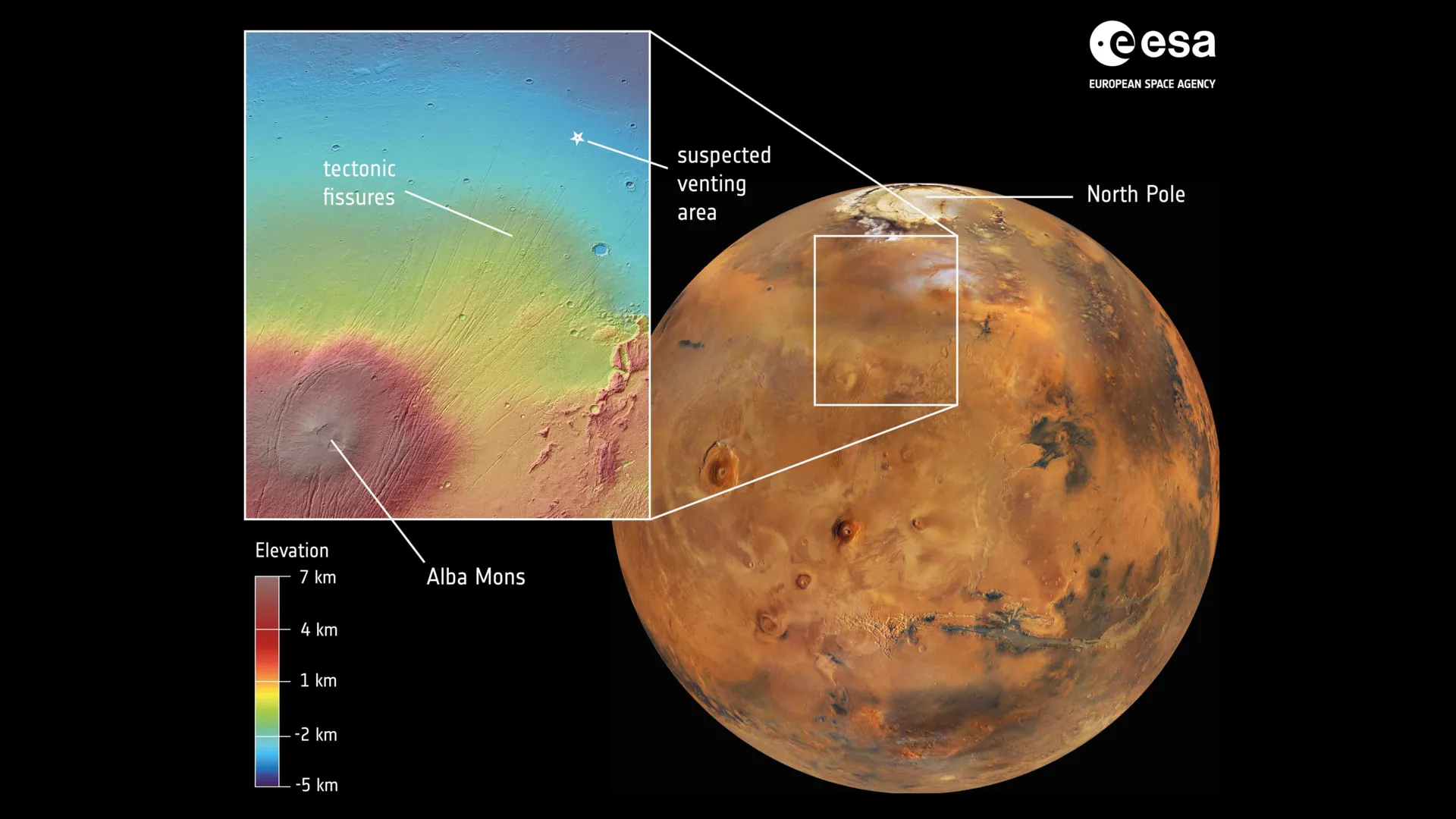
Mars may not be as geologically inactive as it appears. New evidence from mysterious gas emissions near an enormous Martian volcano suggests that heat and volcanic processes could still be present deep beneath the planet’s surface.
Researchers have identified unusual concentrations of hydrogen chloride gas above fractures in the Alba Mons volcanic region. The findings suggest that gases from the planet’s interior may be escaping through cracks in the surface, potentially revealing volcanic activity that has remained hidden until now.
An international team led by Alexander Trokhimovskiy believes the gas could originate from hot magma underground. If confirmed, this would indicate that Mars still has dormant volcanic systems capable of releasing gases to the surface.
The European Space Agency’s ExoMars Trace Gas Orbiter (TGO) first detected hydrogen chloride in the Martian atmosphere in findings reported in 2021. On Earth, hydrogen chloride is frequently released through openings connected to magma, raising the possibility that similar processes could be occurring on Mars.
“Our findings suggest that Mars has retained enough internal heat to support volcanic activity until recently, and possibly still does,” says Daniel Mège, Professor at the Space Research Centre of the Polish Academy of Sciences and co-lead author of the study published in Science Advances.
Mysterious Gas Emissions Defy Mars’ Seasonal Pattern
The researchers noticed something unusual during early summer in the Martian northern hemisphere. Hydrogen chloride concentrations were unexpectedly elevated in a particular region, even though the gas normally becomes scarce at that time of year.
Hydrogen chloride levels on Mars generally follow a seasonal cycle. They typically peak during northern winter before declining to very low levels in summer. Scientists believe much of this behavior is associated with the planet’s dust and water cycles.
However, the observations revealed a striking exception. Elevated hydrogen chloride repeatedly appeared in early summer over volcanic fractures on the slopes of Alba Mons. The unusual timing and consistent location suggested that something beyond ordinary atmospheric chemistry might be responsible.
Is Mars Still Volcanically Active?
Mars is home to the largest volcanoes in the Solar System, but scientists still do not know whether volcanic processes remain active beneath their surfaces.
Images taken from orbit indicate that some Martian volcanoes experienced eruptions within the past few million years. Instruments on the surface have also recorded marsquakes, demonstrating that the planet continues to experience seismic activity.
Together, these observations suggest that Mars may retain some of its geological energy. However, scientists have never directly observed a new volcanic eruption or fresh lava flow on the planet, leaving the question of present-day volcanism unresolved.
Fresh Cracks Reveal Clues to Hidden Volcanic Heat
To investigate the unusual gas concentrations, the research team combined atmospheric measurements with detailed observations of the Martian surface.
The Atmospheric Chemistry Suite aboard TGO uses infrared spectrometers to identify gases in the atmosphere. These instruments detected hydrogen chloride concentrated in a relatively small area shortly after the disappearance of winter frost.
Researchers then examined the same region using the orbiter’s CaSSIS camera. The images revealed narrow fractures that appeared relatively fresh, with some extending hundreds of meters across the surface. Unusual changes in surface color were also visible around the cracks.
“The Trace Gas Orbiter was able to find the smoking gun. It was like looking for a needle in a haystack. It’s truly amazing that it spotted a handful of molecules from a perhaps intermittent source, whilst moving continuously along its orbit to monitor the whole Martian atmosphere,” explains Daniel.
One possible explanation is that gases originating from magma deep underground travel upward through these fractures. On Earth, comparable volcanic openings are known as fumaroles.
The researchers propose that extremely cold Martian winters, when temperatures can fall to -120°C, allow ice to seal the fractures and temporarily prevent gases from escaping. As temperatures rise in early summer, the ice sublimates, changing directly into vapor and potentially opening pathways for underground gases to reach the atmosphere.
The discoloration observed around the fractures could also be significant. It may result from minerals or other substances deposited by escaping gases, similar to the deposits commonly found around fumaroles (volcanic gas vents) on Earth.
A Possible Magma Chamber Beneath Mars
Although the connection between the gas emissions and volcanic fractures appeared promising, the researchers needed to rule out other explanations.
“Looking at the spatial distribution of the seeping, it became instantly obvious to me that there was something volcanic behind it, but it had to be demonstrated,” concedes Daniel.
The team carefully evaluated the chemical reactions that could produce hydrogen chloride in the Martian atmosphere, including processes unrelated to volcanism.
“A huge part of the work consisted of examining all the possible chemical processes going on in the Martian atmosphere. We needed to be rigorous, critical and creative to explain the presence of hydrogen chloride. The data were complex, but also excellent brain food,” adds Daniel.
After examining the atmospheric and geological evidence together, the researchers proposed that the gas could be escaping from a dormant magma chamber beneath Alba Mons. Such a chamber would form part of an underground volcanic system that could continue releasing gases even without producing visible eruptions.
Hidden Volcanic Activity Could Help Mars Support Life
The implications may extend beyond understanding the planet’s geological history. Volcanic gases could also provide clues about how Mars evolved and whether it ever supported environments suitable for life.
In the distant past, gases released from magma, including hydrogen chloride, may have helped create a denser atmosphere and warmer conditions. Those conditions could have allowed liquid water to remain across large portions of the Martian surface.
Volcanic activity might also create habitable environments underground. If rising magma or lava comes into contact with groundwater, the interaction can produce warm hydrothermal systems. Such environments could provide both chemical energy and protection from the harsh conditions on the surface.
“Looking for Martian life in the seeping fissures of the Alba Mons region would make a lot of sense. If hydrothermal systems are active, they could contain the ingredients and energy needed for microorganisms to develop, and shield microorganisms from the hostile and changing environment above the surface,” ponders Daniel.
Although the findings do not establish that Mars is currently erupting or that life exists beneath its surface, they offer an intriguing new reason to investigate the volcanic fractures around Alba Mons.
“These findings may prove to be TGO’s greatest success yet,” highlights Colin Wilson, ESA’s project scientist for the ExoMars Trace Gas Orbiter.