
Most galaxies blaze with billions of stars, lighting up the universe across vast distances. But a small and unusual group barely glows at all. These are low-surface-brightness galaxies, systems so faint they are difficult to detect and so sparse in stars that dark matter makes up most of their mass.
One of these hidden objects, known as CDG-2, could rank among the most dark matter dominated galaxies ever identified. (Dark matter is an invisible form of matter that does not reflect, emit, or absorb light.) The discovery was reported in The Astrophysical Journal Letters.
How Astronomers Found CDG-2
Spotting galaxies this dim is extremely challenging. David Li of the University of Toronto, Canada, and his colleagues relied on advanced statistical analysis to search for clues. Instead of looking directly for faint starlight, they searched for tight groupings of globular clusters, which are dense, spherical collections of stars that typically orbit galaxies. These clusters can act as markers, hinting that a faint galaxy may be hiding nearby.
Using this approach, the team identified 10 previously confirmed low-surface-brightness galaxies along with two additional dark galaxy candidates.
Confirming the Galaxy With Hubble, Euclid, and Subaru
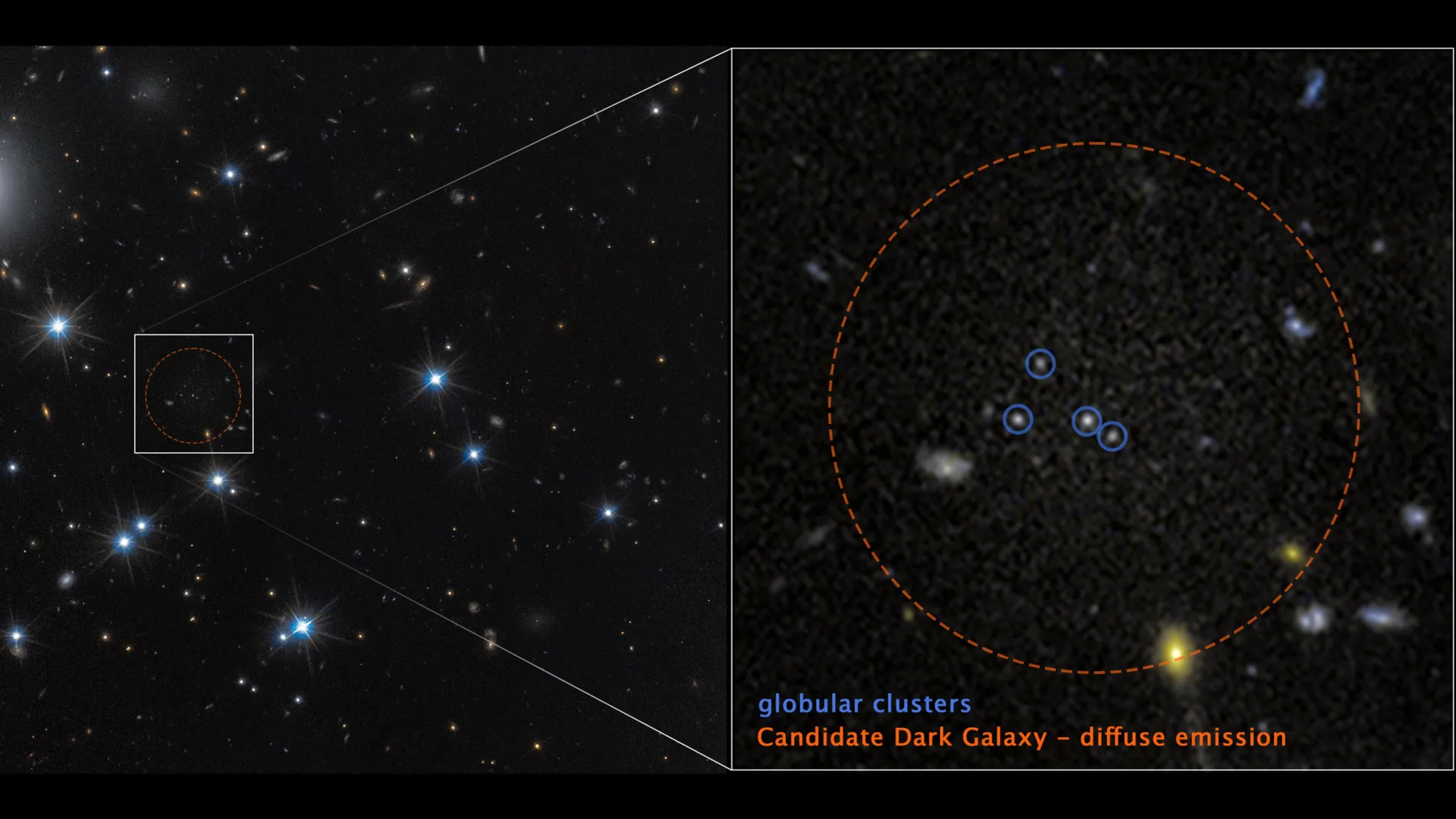
To verify one of the candidates, astronomers turned to three powerful observatories: NASA’s Hubble Space Telescope, ESA’s (European Space Agency) Euclid space observatory, and the ground-based Subaru Telescope in Hawaii. High resolution images from Hubble revealed four closely packed globular clusters inside the Perseus galaxy cluster, located 300 million light-years from Earth.
Further analysis combining data from Hubble, Euclid, and Subaru uncovered a faint, diffuse glow surrounding the clusters. That subtle halo of light provided strong evidence that an underlying galaxy was present.
“This is the first galaxy detected solely through its globular cluster population,” said Li. “Under conservative assumptions, the four clusters represent the entire globular cluster population of CDG-2.”
A Galaxy Made Almost Entirely of Dark Matter
Early measurements indicate that CDG-2 shines with the equivalent light of about 6 million Sun-like stars. Remarkably, the four globular clusters account for 16% of all the visible light in the galaxy. Even more striking, about 99% of the galaxy’s total mass, including both visible matter and dark matter, appears to consist of dark matter.
Much of the material normally needed to form stars, primarily hydrogen gas, was likely stripped away by gravitational interactions with other galaxies in the crowded Perseus cluster.
Globular clusters themselves are extremely dense and tightly bound by gravity. Because of this, they are better able to withstand gravitational tidal disruption, making them dependable tracers of faint and ghostly galaxies like CDG-2.
The Future of Dark Matter Galaxy Searches
As large sky surveys continue to expand with missions such as Euclid, NASA’s upcoming Nancy Grace Roman Space Telescope, and the Vera C. Rubin Observatory, researchers are increasingly using machine learning and sophisticated statistical tools to comb through enormous volumes of data.
The Hubble Space Telescope has now operated for more than 30 years and remains a cornerstone of astronomical discovery. It is a joint project between NASA and ESA (European Space Agency). NASA’s Goddard Space Flight Center in Greenbelt, Maryland, oversees the telescope and mission operations, with additional support from Lockheed Martin Space in Denver. The Space Telescope Science Institute in Baltimore, operated by the Association of Universities for Research in Astronomy, manages Hubble’s scientific operations for NASA.