
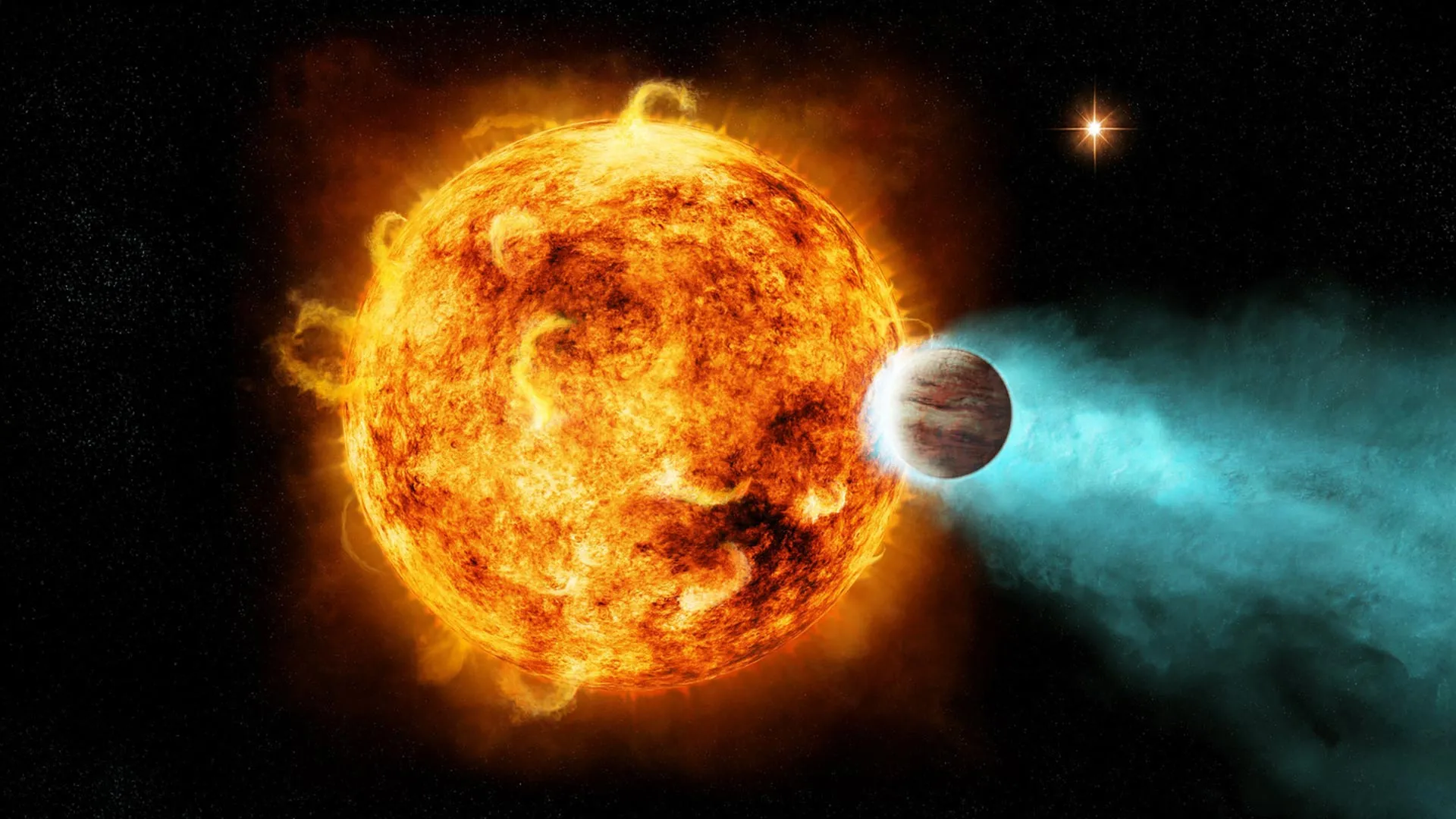
NASA’s Nancy Grace Roman Space Telescope is expected to dramatically expand the search for planets beyond our solar system, known as exoplanets. Scientists estimate the mission could uncover about 100,000 previously unknown worlds, a remarkable increase compared to the nearly 6,300 exoplanets discovered so far through NASA missions and other observatories.
What makes Roman especially exciting is where it will look. Most exoplanet discoveries to date have come from relatively nearby regions of the galaxy. Roman, however, will search largely unexplored areas of the Milky Way, offering a much broader view of planetary systems across our galaxy.
“Our galaxy is home to a variety of different environments, but when it comes to hunting for exoplanets, we’ve really only explored one: our own neighborhood,” said Elisa Quintana, an exoplanet researcher at NASA’s Goddard Space Flight Center in Greenbelt, Maryland. Quintana leads a team focused on building software and simulations to help prepare for Roman’s exoplanet transit observations. “Roman will extend the search far enough to encompass other galactic habitats, which could help us learn how planet formation varies across different regions of the Milky Way.”
Today, most known exoplanets are located within a few thousand light years of Earth. One of Roman’s primary surveys will look far beyond that range, examining stars through the Milky Way’s densely packed central bulge and extending all the way to the far side of the galaxy.
Searching the Milky Way for New Worlds
Roman will continuously monitor stars across a large section of the Milky Way, looking for changes in their brightness.
One technique relies on planetary transits. When a planet passes in front of its star from our perspective, it blocks a small amount of starlight, causing the star to dim temporarily.
The telescope will also use a second technique called microlensing. In these events, the gravity of a foreground star and any accompanying planets magnifies the light of a more distant background star, briefly making it appear brighter.
Each method is sensitive to different kinds of planets.
The transit technique, which is expected to uncover roughly 100,000 worlds, is particularly effective at detecting large, extremely hot planets. These planets block more light from their stars and complete their orbits more frequently, making them easier to spot.
Microlensing, which is expected to reveal more than 1,000 worlds, excels at finding planets farther from their stars, including systems that resemble our own solar system. It can detect planets as small as Earth and Mars, both within habitable zones and at greater distances from their stars. Many of these worlds are extremely difficult, or even impossible, to find using other detection methods.
Together, these complementary approaches will allow scientists to investigate how planets form throughout the galaxy, including in the region where our own solar system may have originated.
Clues to Earth’s Origins
Today, our solar system lies about 27,000 light years from the center of the Milky Way. Researchers believe it likely formed roughly 10,000 light years closer to the galactic center before gradually moving outward to its current location.
Evidence for this idea comes largely from the Sun’s chemical composition.
Astronomers use the term heavy elements to describe all elements other than hydrogen and helium, which were produced shortly after the universe formed. Heavier elements are created inside stars and become more abundant over time as successive generations of stars live and die.
Stars located in the galaxy’s outer regions generally contain fewer heavy elements. By contrast, stars in the galactic bulge are older and tend to be richer in elements such as silicon, oxygen, and magnesium.
These chemical differences may influence the types of planets that form around stars. Some systems could produce larger planets, rockier worlds, or perhaps more planets overall. In some cases, stellar composition may even affect whether planets form at all.
Astronomers have already found evidence that such relationships exist among nearby stars.
“Stars with more heavy elements tend to host more planets, especially giant ones,” said Robby Wilson, a postdoctoral fellow at NASA Goddard, who led a study about Roman’s expected transiting planet yield.
By examining entirely different populations of stars and planets across the Milky Way, Roman could greatly expand these studies and help reveal how common planetary systems like our own really are.
“Roman will be especially powerful because it will observe hundreds of millions of distant stars, letting scientists compare faraway planet populations to those found nearby,” said Wilson. “All of that data will give us a lot to comb through, so we’re prepping by creating synthetic data, detecting simulated planets, and using machine learning to filter out false positives. That way we’ll be ready to go right away when real data comes pouring in.”
All data collected by Roman will be publicly available, allowing researchers and citizen scientists alike to participate in the search for new worlds.
Studying Alien Atmospheres and Weather
Roman could also provide atmospheric information for thousands of the transiting planets it discovers.
“Roman won’t analyze atmospheres in the same in-depth way as missions like NASA’s James Webb Space Telescope, but it will gather different information on a much larger scale,” Wilson said.
While the James Webb Space Telescope focuses on detailed chemical analyses of individual planets, Roman will examine broader temperature and climate patterns across thousands of worlds. This large statistical dataset could identify important trends and help guide future observations by Webb and other observatories.
One area of focus will be “hot Jupiters,” giant planets roughly the size of Jupiter that orbit extremely close to their stars. Since Jupiter is about 11 times wider than Earth, these worlds are enormous and often complete an orbit in just a few days. Their high temperatures allow them to emit detectable infrared radiation.
Roman’s infrared instruments will be able to observe these glowing planets and study how their brightness changes over time.
When a hot Jupiter passes in front of its star, astronomers see one dip in brightness. A second, smaller dip occurs when the planet moves behind the star and its light is temporarily blocked.
“That secondary dip tells us how bright, and therefore how hot, the planet is,” said Wilson. “By tracking how the planet’s brightness changes over its orbit, Roman can also see differences between the day side and night side, and even detect shifts in where the hottest region is on the planet. That tells us about atmospheric winds and heat circulation.”
A New Era for Exoplanet Discovery
NASA’s Kepler mission transformed exoplanet science by monitoring roughly 100,000 stars and demonstrating that planets are extraordinarily common throughout the Milky Way.
“NASA’s now-retired Kepler mission’s survey of 100,000 stars revolutionized the field of exoplanets over a decade ago, and taught us that planets are even more common than stars in our galaxy,” said Jorge Martínez-Palomera, an astronomer at NASA Goddard who is helping prepare for Roman’s exoplanet data.
Roman is expected to take that legacy much further. Its galactic bulge survey alone will observe approximately 100 million stars while exploring regions of the Milky Way that remain largely uncharted.
“Roman’s galactic bulge survey will observe around 100 million stars and probe underexplored areas of our galaxy, which will provide a foundational dataset that will likewise revolutionize what we know about other worlds and our place in the Universe.”