
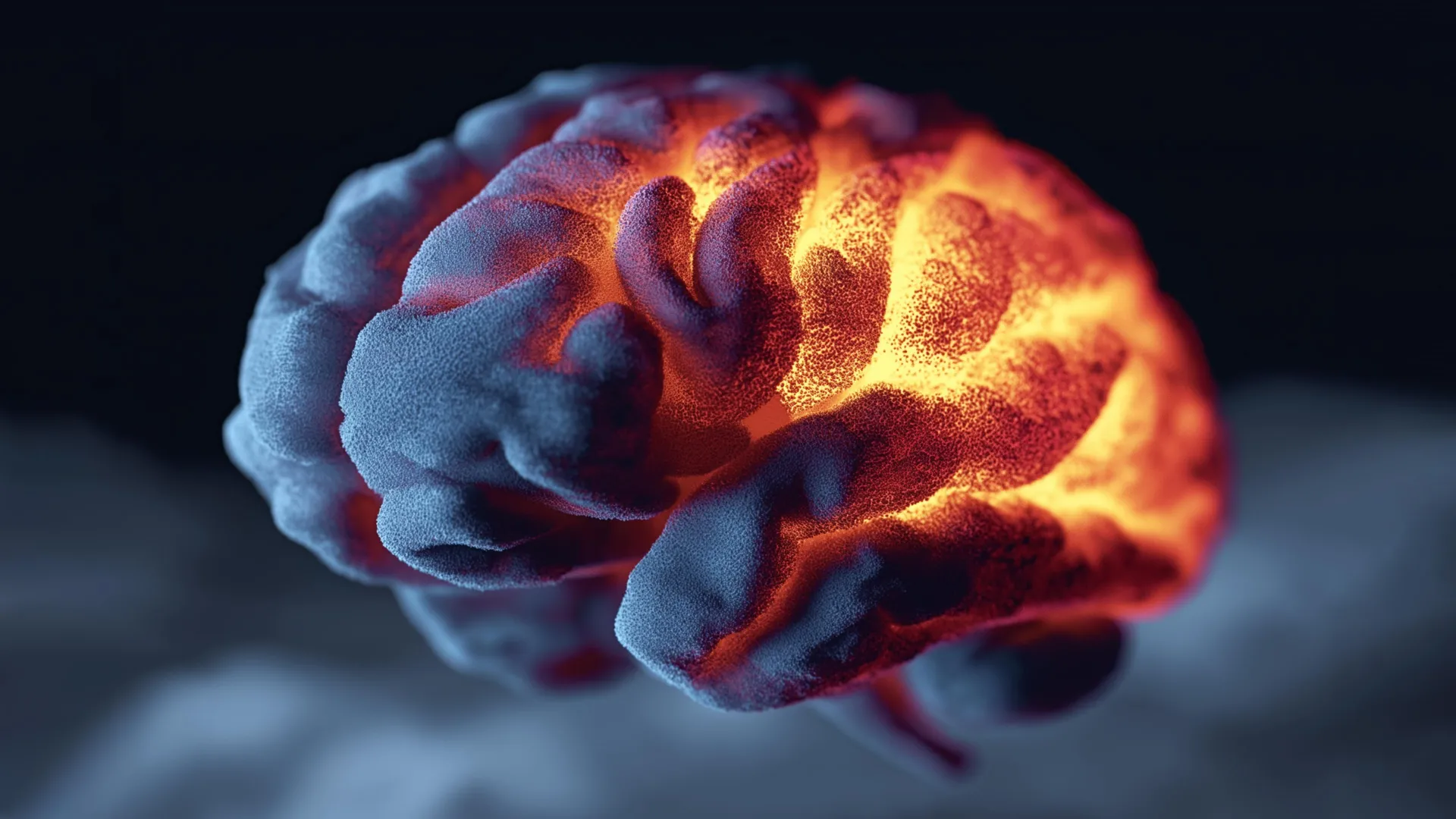
Researchers have uncovered a promising new treatment target for a severe autoimmune brain disorder. The finding could help drive the development of more precise therapies for a condition caused by the immune system attacking a critical brain receptor known as the NMDA receptor. It may also open the door to a future blood test that could detect signs of the disease earlier and allow patients to begin treatment sooner.
The research was conducted at Oregon Health & Science University and published in the journal Science Advances.
The Disease Behind “Brain on Fire”
Many people recognize this disorder from the bestselling memoir and the 2016 film “Brain on Fire.” Although widely publicized, the condition is rare, affecting roughly 1 in 1 million people each year, most often adults in their 20s and 30s.
The illness occurs when the immune system mistakenly attacks NMDA receptors in the brain. These receptors play an essential role in memory and thinking. The attack is driven in part by anti-NMDA receptor autoantibodies. Patients can experience dramatic personality changes, profound memory loss, seizures, and in severe cases, death.
Pinpointing the Antibody Binding Sites
In the new study, scientists identified specific locations on a subunit of the NMDA receptor where these harmful antibodies attach. Blocking these precise sites could potentially slow or even reverse the progression of the disease.
Lead author Junhoe Kim, Ph.D., a postdoctoral fellow at the OHSU Vollum Institute, analyzed anti-NMDA receptor autoantibodies taken from a specially engineered mouse model of the disease. He then compared those findings with detailed images of the same types of antibodies collected from people diagnosed with the disorder.
The binding locations observed in mice closely matched those seen in human patients.
“We have really solid evidence because the autoantibody binding sites that Junhoe identified overlap with those from people,” said senior author Eric Gouaux, Ph.D., senior scientist in the Vollum and an investigator with the Howard Hughes Medical Institute. “We’re focused now on this area as literally a hot spot for the interaction that underpins at least one component of the disease.”
Kim explained that earlier research had narrowed down the general region where antibodies might attach.
“From previous studies, people knew where the antibodies might bind,” he said. “But we collected the entire native autoimmune antibody panel from a mouse model with the disease, and we elucidated where specifically they bind onto the receptor.”
Near-Atomic Imaging Reveals a Critical Hot Spot
The team used advanced near-atomic imaging at the Pacific Northwest Cryo-EM Center on OHSU’s South Waterfront campus. The facility is one of three national centers dedicated to this state-of-the-art imaging technology. It is jointly operated by OHSU and the Pacific Northwest National Laboratory and supported by the National Institutes of Health.
Their analysis showed that nearly all of the antibodies concentrated on a single region of the receptor.
“Nearly all of the antibodies bound to a single domain of the receptor that happens to be the part of the receptor that’s simplest to target,” Gouaux said. “It’s a super exciting result, actually.”
Toward More Precise Treatments
According to co-author Gary Westbrook, M.D., a neurologist and senior scientist at the Vollum Institute, the discovery could help pharmaceutical companies design drugs that specifically block the damaging antibody interactions. Current treatments rely largely on immunosuppression, which does not work for everyone and can leave patients vulnerable to relapse.
“More specific approaches are definitely needed,” he said.
In addition to Kim, Gouaux, and Westbrook, the research team included Farzad Jalali-Yazdi, Ph.D., and Brian Jones, Ph.D., of OHSU.
The study was supported by the National Research Foundation of Korea, award RS202400334731; the National Institute of Mental Health and the National Institute of Neurological Disorders and Stroke, both part of the National Institutes of Health, under award numbers F32MH115595, R01NS117371 and R01NS038631; the Howard Hughes Medical Institute; and Jennifer and Bernard LaCroute. The content is solely the responsibility of the authors and does not necessarily represent the official views of the NIH.
All animal research at OHSU undergoes review and approval by the university’s Institutional Animal Care and Use Committee (IACUC). The IACUC ensures the welfare of animal subjects and the safety of research personnel. It also evaluates all proposed animal studies to confirm their scientific merit and justify the use of live animals.