
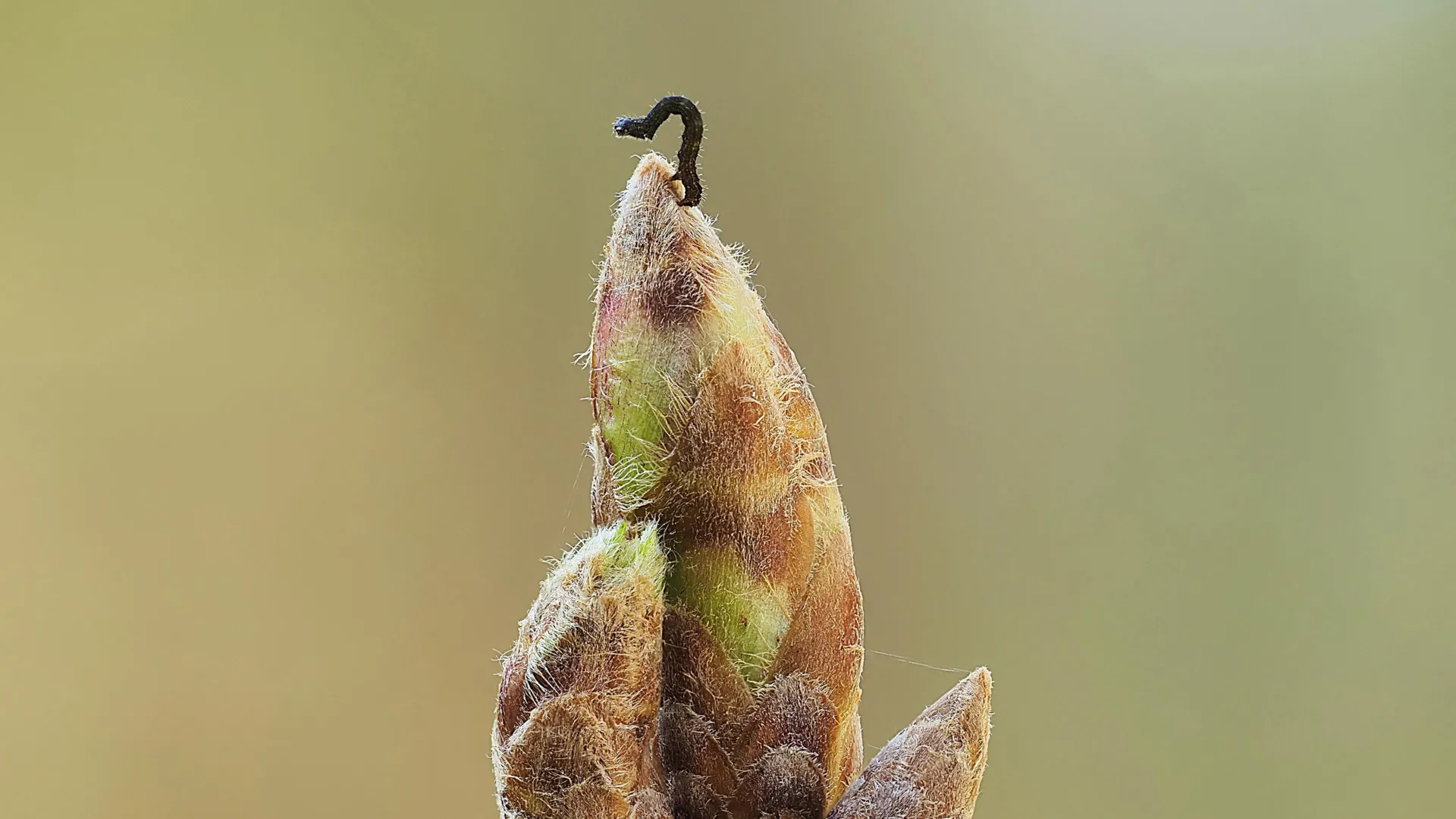
In spring forests, timing is everything. Many insects, especially caterpillars, hatch just as tree leaves are young, tender, and full of nutrients. This perfect alignment gives them immediate access to food, allowing them to begin feeding right away.
But oak trees have a surprising response when caterpillars become too abundant. If a tree experiences heavy infestation in one year, it shifts its schedule the next spring by delaying leaf emergence by about three days. For caterpillars, this small delay has big consequences. When they hatch, the leaves they depend on are still sealed inside buds, leaving them with nothing to eat.
This simple adjustment proves remarkably effective. A delay of just a few days sharply lowers caterpillar survival and cuts feeding damage to the trees by about 55 percent. These findings were reported by an international research team in the journal Nature Ecology & Evolution.
Trees Actively Respond to Insect Threats
“The delaying tactic is more effective for the oak than a chemical defense, such as bitter tannins in the leaves,” says Dr. Soumen Mallick, a postdoc at the University of Würzburg’s Biocentre and lead author of the study. Producing more tannins would require a large energy investment from the tree, making timing a more efficient defense.
“This discovery fundamentally changes our previous understanding of the onset of spring in the forest,” says the Würzburg researcher. Instead of simply responding to temperature and weather, trees can also adjust their timing based on biological threats like insect outbreaks.
Satellite Data Reveals Forest-Wide Patterns
To uncover these patterns, the researchers combined ecological studies with advanced remote sensing technology. In the past, scientists relied on detailed ground observations of individual trees. In this case, the team monitored a much larger area, covering 2,400 square kilometers in Northern Bavaria, using Sentinel-1 radar satellites.
These satellites are particularly useful because they can capture accurate data on tree canopies even through dense cloud cover. Over five years, from 2017 to 2021, the researchers collected 137,500 observations. The data had a resolution of 10×10 meters per pixel, roughly matching the size of a single tree crown. In total, 27,500 pixels across 60 forest sites were analyzed.
The year 2019 offered a key opportunity to observe this process in action, as a major gypsy moth outbreak hit the region. “The radar sensors recorded exactly which trees were stripped bare and how they reacted in the following year,” says Professor Jörg Müller, University of Würzburg (Germany) Chair of Conservation Biology and Forest Ecology and co-senior author of the study.
Forest Timing Reflects an Evolutionary Tug of War
The results help explain why forests do not always turn green as early as rising temperatures might suggest. This insight is important for conservation efforts, since many existing models focus mainly on environmental factors like temperature while overlooking interactions between plants and insects.
Trees are caught in a balancing act. Warmer conditions linked to climate change encourage earlier leaf growth, while pressure from insects pushes trees to delay it. One advantage of this strategy is its flexibility. Trees only delay leafing after actual infestations, which prevents insects from adapting to the change over time.
“This dynamic interplay is an example of the forest’s high resilience and adaptability in a changing world,” says Professor Andreas Prinzing, University of Rennes (France), the other co-senior author of the study. Future research aims to explore these mechanisms in even greater detail.
Participating Research Institutions
In addition to researchers from the University of Würzburg, scientists from the following institutions were involved in this study:
- University of Göttingen
- Thünen Institute (Federal Research Centre for Rural Areas, Forestry and Fisheries), Braunschweig
- Adam Mickiewicz University Poznań (Poland)
- Technical University of Munich
- University of Lorraine (France)
- Czech University of Life Sciences Prague (Czech Republic)
- Julius Kühn Institute (Federal Research Institute for Cultivated Plants), Dossenheim
- Bavarian Forest National Park
- Centre National de la Recherche Scientifique, University of Rennes (France)