
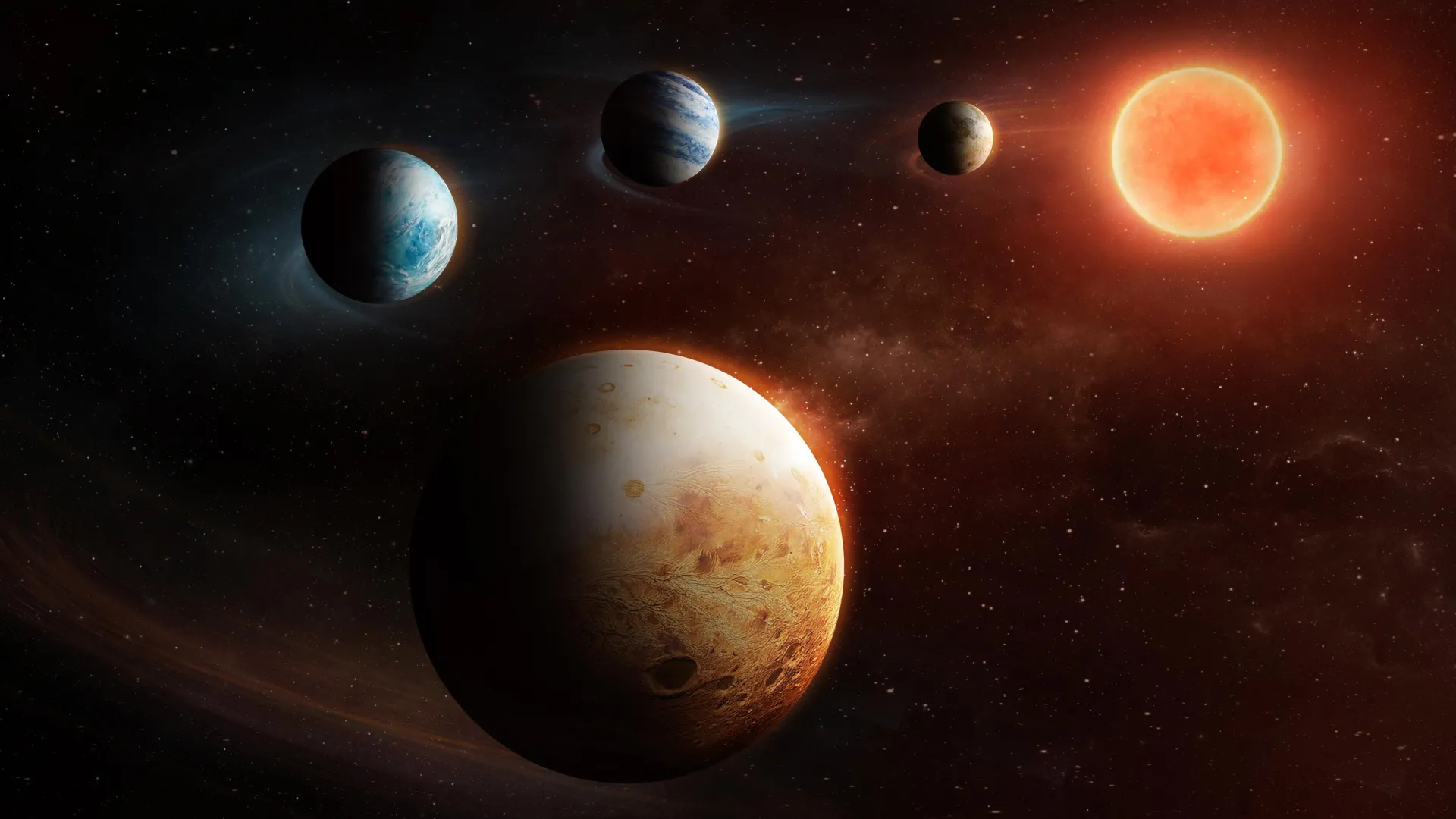
Children often learn the order of the planets in our Solar System using quirky memory phrases like “My Very Educated Mother Just Served Us Nachos.” These sayings help recall Mercury, Venus, Earth, Mars, Jupiter, Saturn, Uranus, and Neptune.
In our Solar System, the planets fall into two broad groups. The inner planets closest to the Sun, from Mercury through Mars, are rocky worlds. Farther out are the giant gaseous planets, from Jupiter to Neptune.
Astronomers have long believed this arrangement reflects a common pattern throughout the Universe. According to leading theories of planet formation, rocky planets form near their star while gas giants develop farther away where cooler conditions allow thick atmospheres to build up. Observations of many planetary systems have generally supported this idea.
But a newly studied star system called LHS 1903 may challenge that understanding.
A Strange Planetary System Around LHS 1903
LHS 1903 is a small, cool red dwarf star known as an M-dwarf. It is dimmer and cooler than our Sun. Researchers led by Thomas Wilson from the University of Warwick in the United Kingdom combined observations from several space and ground-based telescopes to examine planets orbiting the star.
The team identified three planets at first. The closest planet appeared rocky, while the next two seemed gaseous. That arrangement matched what scientists expected to see.
Then researchers analyzed data from the European Space Agency’s CHaracterising ExOPlanet Satellite (Cheops) and uncovered something unexpected. A fourth planet orbiting farther from the star appeared to be rocky as well.
“That makes this an inside-out system, with a planet order of rocky-gaseous-gaseous-and then rocky again. Rocky planets don’t usually form so far away from their home star,” says Thomas.
Current models suggest rocky planets form near stars because intense radiation strips away gas surrounding developing planetary cores. Farther away, cooler temperatures allow gas to accumulate into thick atmospheres, creating giant gaseous planets.
ESA Cheops project scientist Maximilian Günther says the discovery highlights how much scientists still do not understand about planetary origins.
“Much about how planets form and evolve is still a mystery. Finding clues like this one for solving this puzzle is precisely what Cheops set out to do.”
Scientists Test Possible Explanations
Researchers did not immediately conclude that existing planet formation theories were wrong. Instead, they explored whether other events could explain the unusual system.
One possibility was that the outer rocky planet had once possessed a thick atmosphere that was later blasted away by a collision with a massive asteroid, comet, or another large object. Another idea was that the planets may have changed positions over time.
Using simulations and calculations of the planets’ orbital behavior, the team ruled out those explanations.
Their investigation instead pointed toward a more unusual possibility. The planets around LHS 1903 may not have formed simultaneously. Instead, they may have developed one after another.
Under standard theories, planets form within giant discs of gas and dust called protoplanetary discs. Multiple planetary embryos emerge at roughly the same time and gradually evolve over millions of years into full planets.
But in this system, researchers believe the star may have produced its planets sequentially rather than all at once. Scientists proposed this idea, known as inside-out planet formation, about a decade ago, but evidence supporting it has been limited until now.
A Rocky Planet Born Late
The discovery becomes even more intriguing because the outer rocky planet may have formed under very different conditions than its neighboring worlds.
“By the time this outer planet formed, the system may have already run out of gas, which is considered vital for planet formation. Yet here is a small, rocky world, defying expectations. It seems that we have found first evidence for a planet which formed in what we call a gas-depleted environment,” says Thomas.
The unusual rocky planet could represent a rare cosmic oddity, or it might reveal a broader trend astronomers have not yet recognized. Either way, scientists say the system cannot easily be explained using current theories alone.
Rethinking Planet Formation
“Historically, our planet formation theories are based on what we see and know about our Solar System,” Isabel Rebollido who is currently a Research Fellow at ESA points out. “As we are seeing more and more different exoplanet systems, we are starting to revisit these theories.”
As telescopes become more powerful, astronomers continue discovering increasingly unusual planetary systems across the galaxy. These strange worlds are forcing researchers to reconsider assumptions about how planets form and evolve.
The findings may also reshape how scientists view our own Solar System. Rather than representing a universal blueprint, its orderly structure could be just one example among many wildly different planetary arrangements in the cosmos.