
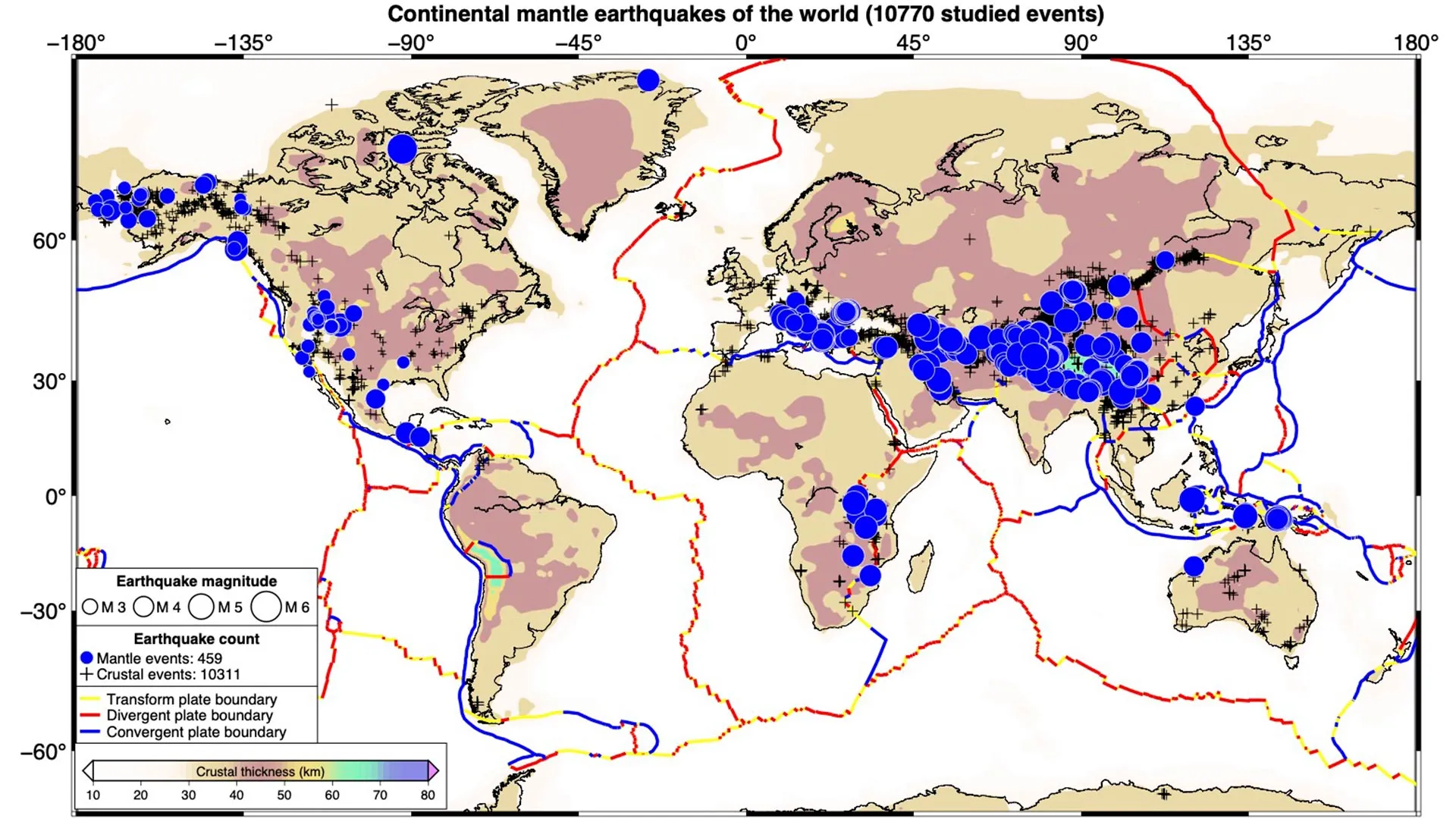
Researchers at Stanford University have produced the first worldwide map of an unusual type of earthquake that occurs deep in Earth’s mantle rather than in the crust. The mantle lies between the planet’s thin outer crust and its molten core. By charting these rare events, scientists hope to better understand how mantle earthquakes work and what they can reveal about how all earthquakes begin.
The findings, published Feb. 5 in Science, show that continental mantle earthquakes happen across the globe but tend to cluster in specific regions. Significant groupings appear beneath the Himalayas in southern Asia and near the Bering Strait between Asia and North America, south of the Arctic Circle. Studying these deep tremors could provide new clues about the crust mantle boundary and the behavior of the upper mantle, which generates volcanic magma and helps drive tectonic plate motion.
“Until this study, we haven’t had a clear global perspective on how many continental mantle earthquakes are really happening and where,” said lead study author Shiqi (Axel) Wang, a former PhD student in the lab of geophysics professor Simon Klemperer at the Stanford Doerr School of Sustainability. “With this new dataset, we can start to probe at the various ways these rare mantle earthquakes initiate.”
Although these quakes occur too far below the surface to cause significant shaking or damage, they offer valuable insight into how earthquakes form. Understanding their origins may improve knowledge of more common, shallow earthquakes that pose real hazards.
“Although we know the broad strokes that earthquakes generally happen where stress releases at fault lines, why a given earthquake happens where it does and the main mechanisms behind it are not well grasped,” added Klemperer, senior study author. “Mantle earthquakes offer a novel way to explore earthquake origins and the internal structure of Earth beyond ordinary crustal earthquakes.”
What Lies Above and Below the Moho
Earth’s crust is relatively cool and brittle. In contrast, the mantle is a thick layer of warm, dense rock that behaves more like a slow moving solid and extends about 1,800 miles deep, making up most of the planet’s interior. The dividing line between the crust and the mantle is called the Mohorovičić discontinuity, or “the Moho.”
For years, scientists questioned whether the mantle, which is hotter and more ductile than the crust, could generate significant earthquakes at all. Most continental earthquakes begin about 6 to 18 miles below the surface, well above the Moho and within the crust. Subduction zones are an exception. In those regions, heavy oceanic plates slide beneath lighter continental plates, sometimes producing earthquakes hundreds of miles deep. However, seismic instruments have occasionally detected earthquake origins beneath continents and away from subduction zones, in some cases as much as 50 miles below the Moho.
Over the past decade, growing evidence has convinced many researchers that rare earthquakes do originate in the mantle, though they may occur about 100 times less frequently than crustal earthquakes. Even so, confirming them has been difficult because of limited data.
A Breakthrough in Seismic Wave Detection
To reliably tell mantle earthquakes apart from crustal ones, Wang and Klemperer developed a technique that compares two kinds of seismic waves. These waves travel through Earth after an earthquake, spreading vibrations through the planet much like the ringing of a bell.
One type, called Sn or “lid” waves, moves along the top of the mantle in a region known as the lid. The other, called Lg waves, consists of high frequency vibrations that move efficiently through the crust. By measuring the ratio between these two wave types, researchers can determine whether an earthquake started in the crust or in the mantle.
“Our approach is a complete game-changer because now you can actually identify a mantle earthquake purely based on the waveforms of earthquakes,” said Wang.
Hundreds of Rare Deep Earthquakes Identified
The team analyzed data from seismic monitoring stations around the world and factored in information such as crustal thickness. From an initial pool of more than 46,000 earthquakes, they identified 459 continental mantle earthquakes that have occurred since 1990.
The researchers caution that this figure likely underestimates the true number. Expanding seismic networks, especially in remote regions like the Tibetan Plateau north of the Himalayas, would probably reveal more mantle quakes. Klemperer has spent much of his career studying earthquakes in this remote area. His earlier work on unusual deep quakes there helped inspire Wang to pursue the topic.
With a growing catalog of confirmed mantle earthquakes and a dependable way to detect them, the team plans to investigate what triggers these rare events. Some may occur as aftershocks caused by seismic waves traveling outward from crustal earthquakes. Others could be linked to heat driven convection within the mantle as it recycles subducted slabs of Earth’s crust.
Looking ahead, the researchers expect that continued study will shed new light on the planet’s inner workings.
“Continental mantle earthquakes might be part of an inherently interconnected earthquake cycle, both from the crust and also the upper mantle,” said Wang. “We want to understand how these layers of our world function as a whole system.”
This research was supported by the National Science Foundation.