
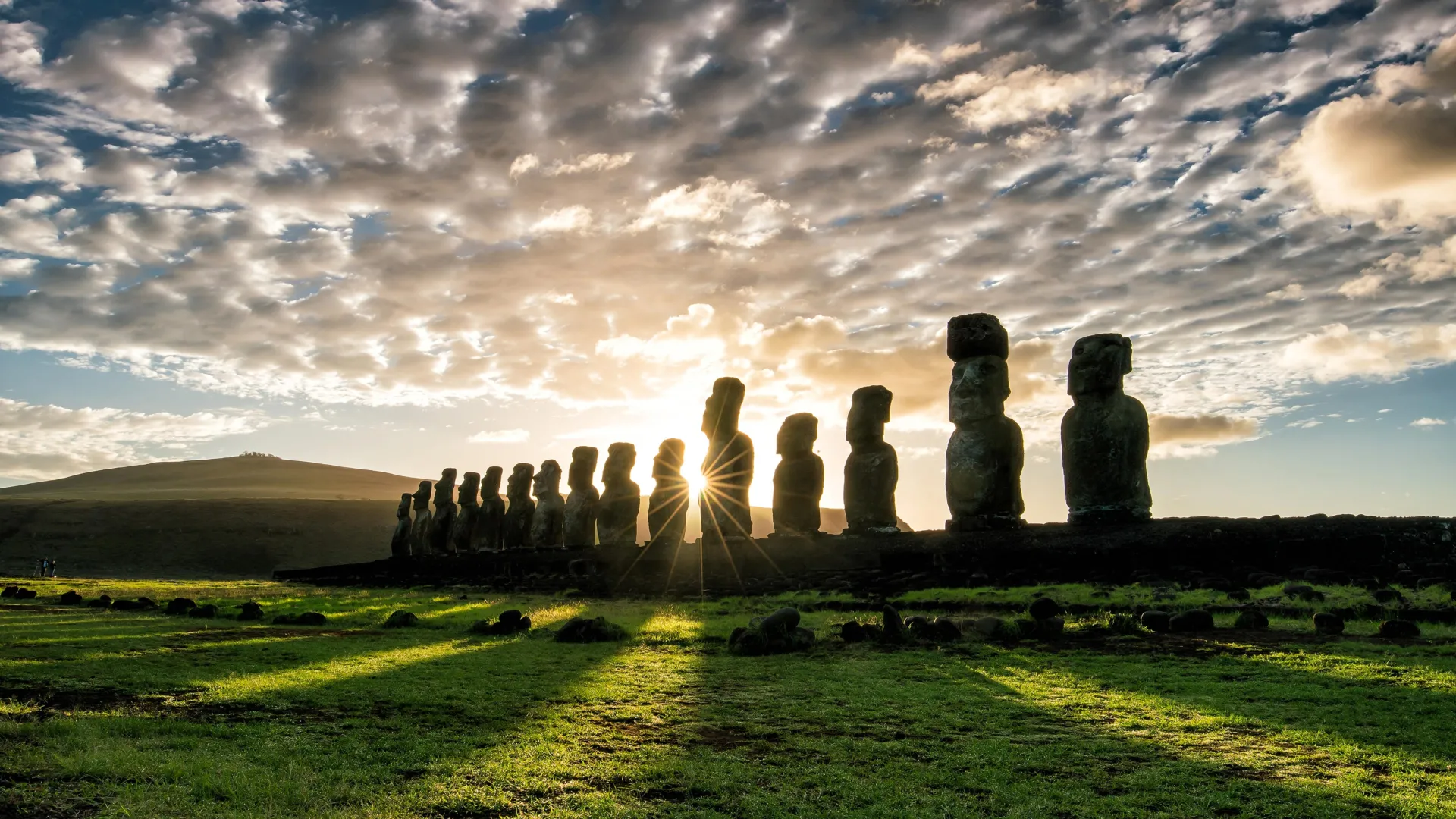
New research from the Lamont-Doherty Earth Observatory provides the strongest evidence so far that a prolonged drought reshaped life on Rapa Nui (Easter Island) starting around the year 1550. To uncover this history, scientists extracted sediment cores from two of the island’s limited freshwater sites: Rano Aroi, a wetland high in elevation, and Rano Kao, a crater lake. These sediments preserve natural chemical signals that record past environmental conditions.
By studying the hydrogen isotope makeup of plant leaf waxes preserved in the sediments, the researchers reconstructed rainfall patterns stretching back 800 years. Their results show that annual rainfall dropped sharply in the mid-16th century and stayed low for more than 100 years. Rather than pointing to a sudden societal breakdown, the findings suggest that Rapanui communities adapted and persisted despite severe and lasting climate stress. Lead author Redmond Stein explained how the team traced this hidden climate history and why it matters for understanding the relationship between environment and culture.
Reading Ancient Rainfall in Lake Sediments
Lakes and wetlands slowly accumulate layers of sediment over centuries, locking in clues about the climate at the time each layer formed. Earlier studies on Rapa Nui relied on indicators such as pollen, plant remains, elemental chemistry, and how quickly sediments built up to infer past environmental changes. While these methods are useful, they can be influenced by several factors at once, including temperature, rainfall, and human land use.
Leaf waxes offer a more direct signal. On Rapa Nui, these waxes appear to reflect local rainfall and dryness more clearly than other indicators. By examining their chemical makeup — the balance between “heavy” and “light” hydrogen in the waxes mirrors the hydrogen composition of rainwater absorbed by plants — the team was able to estimate the severity of drought conditions. This approach allowed researchers to calculate the scale of the 16th century drought on Rapa Nui for the first time.
How Severe Was the Drought and What Changed?
The analysis indicates that rainfall declined by about 600-800mm (24-31 inches) per year compared with the previous three centuries. This extended dry period overlaps with notable cultural changes on the island. During this time, construction of ceremonial “ahu” platforms slowed, Rano Kao became a key ritual center, and a new social system known as “Tangata Manu” emerged. Under this system, leadership could be earned through athletic competition rather than inherited through family lines connected to the moai statues.
Archeologists continue to debate the exact timing and causes of these shifts, and it remains difficult to link specific events directly to climate change. Still, the evidence shows that the island’s social and geographic organization looked very different after the drought began than it had before.
Rethinking the “Ecocide” Story
For decades, Rapa Nui has often been cited as an example of self-inflicted environmental collapse. The so-called ecocide narrative argues that deforestation led to conflict and population decline before Europeans arrived in the 18th century, turning the island into a cautionary tale about overconsumption. While it is true that Rapa Nui experienced widespread deforestation, many studies now question whether this led to societal collapse. There is little evidence for a sharp drop in population before European contact.
This new study adds climate context to that debate. Evidence suggests that island residents were already coping with worsening drought conditions from the 16th century onward, a serious challenge on an island with scarce freshwater. The researchers are not arguing that climate alone drove social change or that deforestation played no role. Instead, they emphasize that shifts in rainfall likely shaped how people responded to environmental pressures. The precise effects remain uncertain — for example, reduced rainfall may have increased soil erosion, limited drinking water, forced people to seek new water sources, or hindered plant growth. Taken together, the findings show that Rapa Nui’s history is far more complex than the ecocide narrative suggests.
Lessons for a Changing Climate
One clear takeaway from Rapa Nui’s past is human resilience. However, the researchers stress that modern discussions about climate change should prioritize the voices of people living on Rapa Nui and other Pacific islands today. These communities are already experiencing climate impacts firsthand, and their knowledge is more directly relevant to present challenges than lessons drawn from ancient history. The goal of this research is not to create a new warning story for the modern world, but to replace an oversimplified one.
What Comes Next for the Research
The team is now working with a much longer leaf wax isotope record from Rano Aroi that spans roughly 50,000 years. This extended timeline could reveal how atmospheric circulation in the southeast Pacific has responded to climate shifts over tens of thousands of years. Rapa Nui sits deep in this remote region, more than 3,000 kilometers from the coast of Chile and over 1,500 kilometers from the nearest inhabited island.
Because it is the only significant source of land-based sediment in the area, Rapa Nui offers a rare window into past atmospheric behavior. Scientists still have limited understanding of what controls weather patterns in the southeast Pacific, and current climate models do not capture them well. The new record could provide valuable insight into how regional climate systems have changed over long periods of time.