
Every summer, lawns fill with colorful “silly sprinklers,” whose looping and twisting tubes send water spraying in unusual patterns. Their designs may look playful, but researchers have now used these backyard devices to investigate a serious and decades-old question in physics.
The mystery is known as Feynman’s Sprinkler Problem. It asks what happens when a sprinkler operates in reverse, pulling water into its arms instead of forcing water outward. By building and testing sprinklers with a variety of shapes, a team of mathematicians has now produced a clear experimental answer. Their results also offer broader insight into how moving fluids push, twist, and rotate physical structures.
“This work provides the experimental answer for Feynman’s Sprinkler Problem by showing, across several sprinkler types, how the angular momentum of water flows drives sprinklers’ rotation,” explains Leif Ristroph, an associate professor at New York University’s Courant Institute School of Mathematics, Computing, and Data Science and the senior author of the paper, which appears in the journal Proceedings of the National Academy of Sciences.
Why the Sprinkler Problem Matters
The researchers say the findings are useful for more than settling a famous scientific puzzle. Understanding how objects react to moving fluids could help engineers improve machines that capture or convert energy from flowing liquids.
“Our findings provide a firmer understanding of how components respond to fluid flows — knowledge that can guide future engineering and technological advances for devices, such as turbines, that convert these flows into energy,” notes Brennan Sprinkle, an assistant professor at Colorado School of Mines and one of the paper’s co-authors.
The team began studying Feynman’s Sprinkler Problem in work published in 2024. The question became widely known during the 1980s after physicist Richard Feynman described his own unsuccessful attempts to investigate it experimentally.
That earlier research showed that a reverse sprinkler turns about 50 times more slowly than an ordinary sprinkler, even though both rely on closely related physical mechanisms.
A conventional sprinkler behaves somewhat like a rotating rocket. Water shoots from the arms, producing forces that make the device spin. A reverse sprinkler works more like an “inside-out rocket,” because water jets travel inward and enter the central chamber where the arms connect.
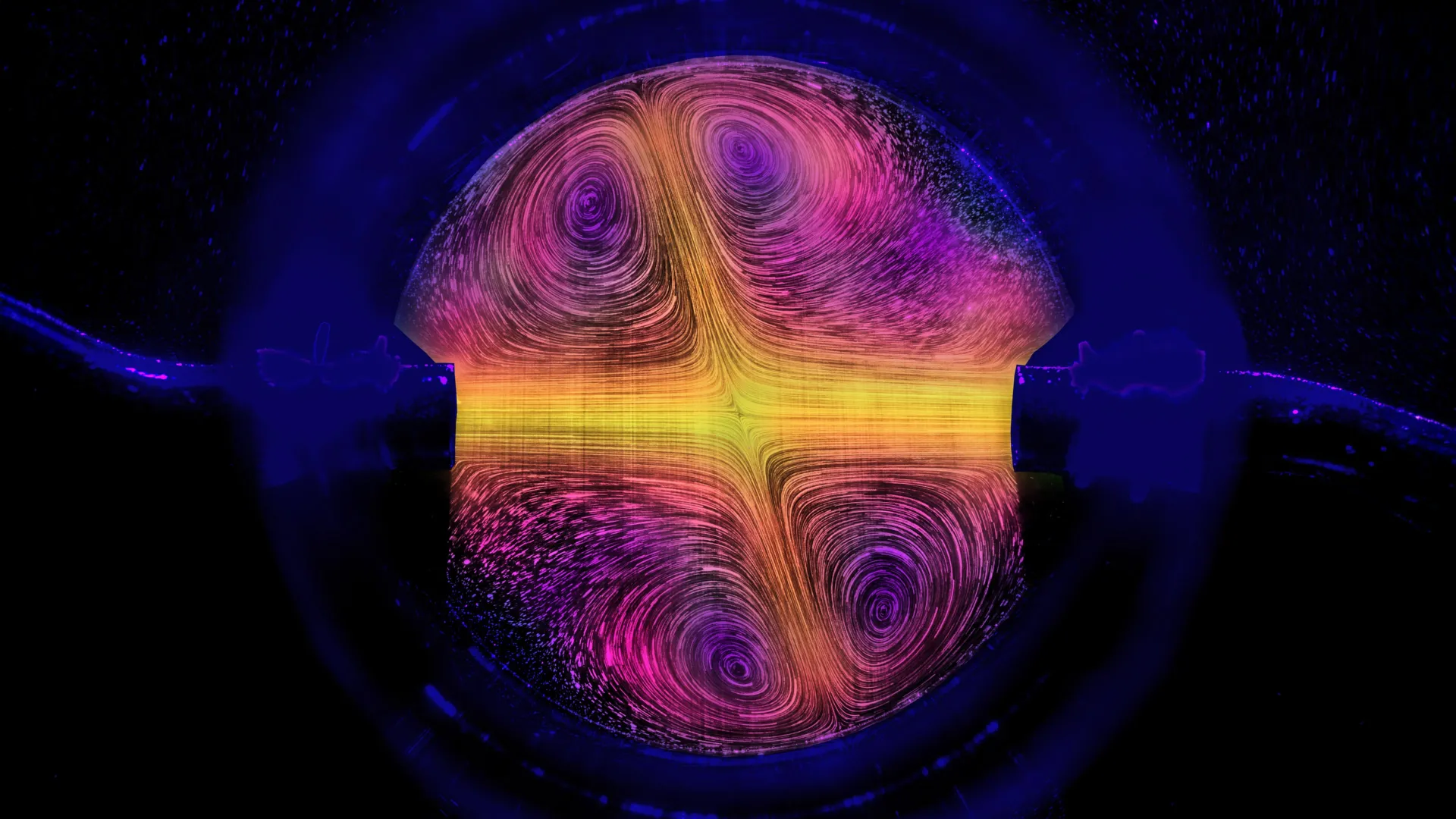
Inside that chamber, the two incoming jets collide. However, they do not strike one another perfectly head on. This slight misalignment creates forces that cause the sprinkler to rotate in the reverse direction.
Ristroph, Sprinkle, and their colleagues described this explanation as the momentum flux theory, which focuses on the way swirling water carries momentum through the sprinkler.
Testing Sprinklers With Twists and Loops
The 2024 experiments focused only on standard sprinklers with S-shaped arms. That left open the possibility that sprinklers with more complicated forms, including the curved and looping tubes found in silly sprinklers, might behave differently.
The earlier study also had not fully ruled out other major explanations for the sprinkler’s motion.
For the new research, the team built a collection of silly sprinklers with different contours. Each device was tested in two configurations. In forward mode, water sprayed outward as it would from an ordinary lawn sprinkler. In reverse mode, water was drawn into the sprinkler.
The unusual shapes allowed the researchers to examine several features at once. They recorded how the sprinklers rotated, observed the water moving both inside and outside the devices, and measured the torque or twisting force produced when the sprinklers were prevented from turning.
Competing Physics Theories Put to the Test
The scientists compared their momentum flux theory with two other explanations that have been proposed over the years.
The first dates to the 1880s and was introduced by physicist Ernst Mach. It suggests that the fluid rotates in one direction while the sprinkler turns in the opposite direction. However, Mach’s explanation could not account for the reverse rotations and torques measured during the new experiments.
A second theory, associated with Feynman and later researchers, focuses on water flowing near the outer ends of the sprinkler arms. The new tests showed that neither the outside sections of the arms nor the water moving around them affected the sprinkler’s motion or torque.
The results instead strongly supported the momentum flux theory. The researchers expanded the theory and found that it accurately described both forward and reverse operation across every sprinkler shape they tested.
The experiments also revealed that changing the shape of the arms can alter and control the water jets. That ability may prove useful when designing practical fluid-based devices.
“By showing that momentum flux is the answer to Feynman’s Sprinkler Problem, our findings address a long-standing open problem in flow physics and provide useful knowledge about how these devices work and their effectiveness,” concludes Ristroph.
The paper’s other authors were NYU graduate students Jesse Smith and Mingxuan Zuo, as well as Will Kuhlke, an NYU undergraduate.
The work was supported by grants from the National Science Foundation (DMS-2407787 and DMS-2407788).