
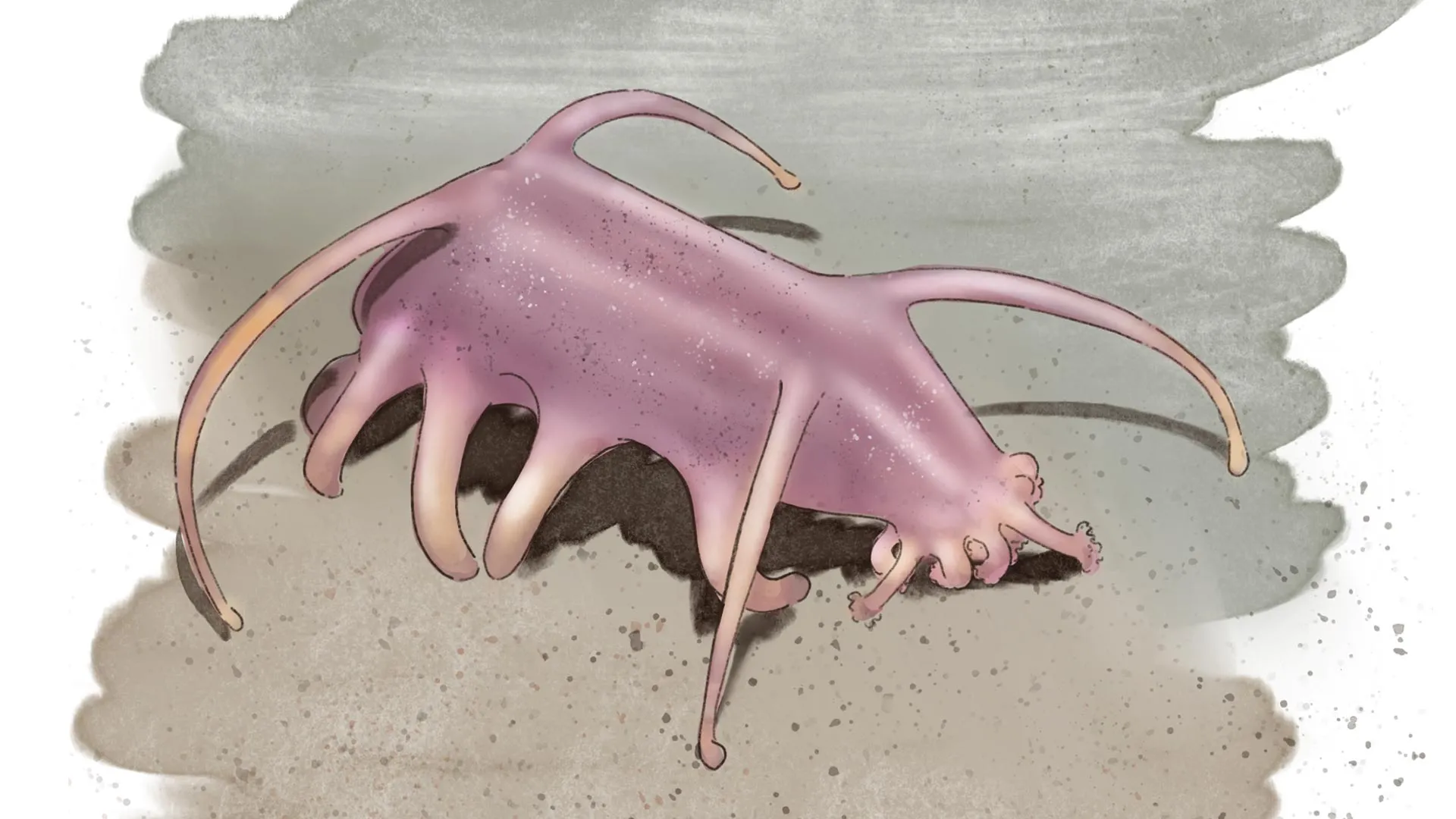
Deep beneath the ocean’s surface, strange, translucent creatures known as sea pigs crawl across the seafloor. Now, researchers at the University of Tokyo have discovered that these unusual animals are hiding something even stranger beneath their “skin.” Living within their body walls is a previously unknown bacterium with an extraordinarily small genome and a surprising collection of genes responsible for producing enormous proteins.
The researchers identified the bacterium, which they named Candidatus Abyssoplasma scotoplanesicola, and used fluorescence imaging to pinpoint its location inside sea pig tissues. Genetic analysis revealed that its genome contains just 649,000 DNA bases, yet more than a quarter of its genetic material is devoted to producing groups of proteins associated with the bacterial surface. Some of these “giant” proteins contain more than 5,000 amino acids and may help the bacteria interact with their hosts or form clusters (clustering into groups). The discovery offers new insights into how bacteria adapt to living in close association with other organisms and which biological functions they retain as they become increasingly dependent on their hosts.
Meet the Strange Sea Pigs of the Deep Ocean
Sea lions, seahorses, and sea cows may be familiar marine animals, but sea pigs are considerably less well known. These small, gelatinous creatures are actually a type of sea cucumber that inhabits the deep ocean. Using numerous tube-shaped feet, they slowly travel across the seafloor, gathering decaying organic material and delivering it to their mouths with specialized tentacles.
Despite their unusual appearance, sea pigs perform important work in the deep-sea ecosystem. By consuming dead organic matter, they help recycle nutrients that support other marine life. Their soft, seemingly vulnerable bodies also provide an unexpected benefit to other animals. Young king crabs have been observed using sea pigs as shelter from predators.
Many aspects of sea pig biology, however, remain mysterious. Researchers still do not know how long these animals live or precisely why they have long, waving projections resembling antennae on their heads. Another important unanswered question concerns the bacteria that inhabit the layers beneath their outer surfaces.
Sea pigs belong to a group of marine invertebrates called echinoderms (marine invertebrates including sea cucumbers and sea stars). Like other members of this group, they can harbor bacteria beneath their outer body covering. Scientists are particularly interested in understanding how these microorganisms interact with their hosts and how such relationships evolved. This research is also ecologically important because sea cucumbers make up more than 90% of the biomass of large seafloor animals in some deep-ocean environments.
“Taxonomic and genomic information about these body-wall inhabiting bacteria is scarce, and very few studies of deep-sea species have linked this information to the bacteria’s location within host tissues,” said Yu Yoshida, a Ph.D. student at the University of Tokyo’s Graduate School of Frontier Sciences and a lead author of the study.
Scientists Discover a Dominant Bacterium Beneath Sea Pig Skin
To investigate these hidden microorganisms, researchers from several Japanese institutions, including the University of Tokyo, examined eight sea pigs collected during deep-sea research expeditions.
The team extracted DNA from different tissues to identify the bacteria present throughout the animals’ bodies. They also reconstructed the genomes of the most abundant bacterial groups, allowing them to investigate their genetic characteristics. Finally, they used fluorescence imaging, a technique that makes selected biological structures visible through fluorescent signals, to determine precisely where the bacteria lived within the sea pig tissues.
The results revealed that one particular bacterium was remarkably abundant in the animals’ body walls.
“What we found was that in body-wall samples from the three sea pig species, one bacterium accounted for more than 70% of bacterial 16S rRNA gene sequences (a genetic marker used in identifying bacteria), so it truly dominated the body wall,” explained Yoshida.
Further investigation showed that this dominant bacterium belongs to a broader group of microorganisms known to live in close association with marine invertebrates. However, its genetic characteristics differ substantially from those of previously identified members of that group.
Because of these differences, the researchers have proposed recognizing Candidatus Abyssoplasma scotoplanesicola as a new bacterial genus and species.
A Tiny Genome Packed With Giant Proteins
One of the most surprising findings emerged when the scientists examined the bacterium’s DNA. Its genome was exceptionally compact, containing only 649,000 bases, the chemical units that make up genetic material.
By comparison, the genome of Escherichia coli, a widely studied bacterium commonly found in the intestines of humans and other animals, is roughly seven times larger.
“The complete genome was very small, only 649,000 bases. By comparison, the E. coli genome is approximately seven times larger. However, we were more surprised by the composition. Genes for some of the energy-generating pathways (used for breaking down nutrients and generating energy) which are commonly found in bacteria were not detected,” explained Yoshida.
The absence of genes involved in certain energy-producing processes suggests that the bacterium may have lost some of the biological machinery that many other bacteria use to survive independently.
Yet even more remarkable was how much of its limited genetic material was devoted to proteins associated with its surface.
“Meanwhile, genes for encoding surface-associated protein groups (that is, DNA with the blueprints for building specific proteins on cell surfaces) accounted for 27.6% of the entire genome. This included genes for proteins exceeding 5,000 amino acids. As bacterial proteins average about 300 amino acids in length, 5,000 is exceptionally long. This offers us important clues as to which functions are retained in bacteria which live in close association with their host.”
Proteins are built from chains of amino acids, and their structures help determine the jobs they perform. The unusually large proteins identified in this bacterium could be involved in interactions with sea pig tissues or in helping bacterial cells stick together. Their exact functions remain unknown.
The discovery suggests that, as the bacterium evolved to depend more heavily on its host, it may have retained certain specialized capabilities while losing genes needed for other essential processes.
What Do Sea Pigs Gain From These Mysterious Bacteria?
The bacterium’s unusually reduced genome offers an important clue about its lifestyle. Researchers believe Candidatus Abyssoplasma scotoplanesicola relies extensively on its sea pig host to obtain substances it cannot adequately produce for itself.
These include amino acids, which are necessary for building proteins, along with nucleic acid precursors, lipids, and mineral nutrients. Nucleic acid precursors are the molecular building blocks used to make DNA and RNA, while lipids are important components of cell membranes and other cellular structures.
Because the bacterium lacks some of the genes needed to produce or process essential compounds independently, living within the sea pig’s tissues may provide access to resources required for its survival.
What remains unclear is whether the relationship also benefits the sea pig. One possibility is that the bacteria help defend their hosts against pathogens, potentially offering protection from disease-causing microorganisms. However, the researchers emphasize that this potential benefit has not yet been demonstrated.
Understanding why this particular bacterium becomes so abundant in sea pig body walls is another major question. Scientists also hope to determine what its unusually large surface proteins do, how it competes with other microorganisms, and whether its presence changes the health or biology of its host.
“We would really like to understand how this bacterium could become so dominant in the body wall, the functions of the giant surface proteins, what competition it faces from other bacteria, and of course the effects on the host,” said Yoshida. “More broadly, further investigation could provide fundamental insights into how bacteria colonize hosts and adopt a host-dependent lifestyle.”
The findings highlight how much remains to be discovered about life in the deep ocean. By investigating the microscopic organisms living within these unusual animals, scientists hope to better understand the evolutionary processes that allow bacteria to form intimate, long-lasting relationships with their hosts.
Funding: This work was supported by JSPS KAKENHI Grant Number JP22H00557 (to S.Y.) and JST SPRING, Grant Number JPMJSP2108 (to Y.Y.)