
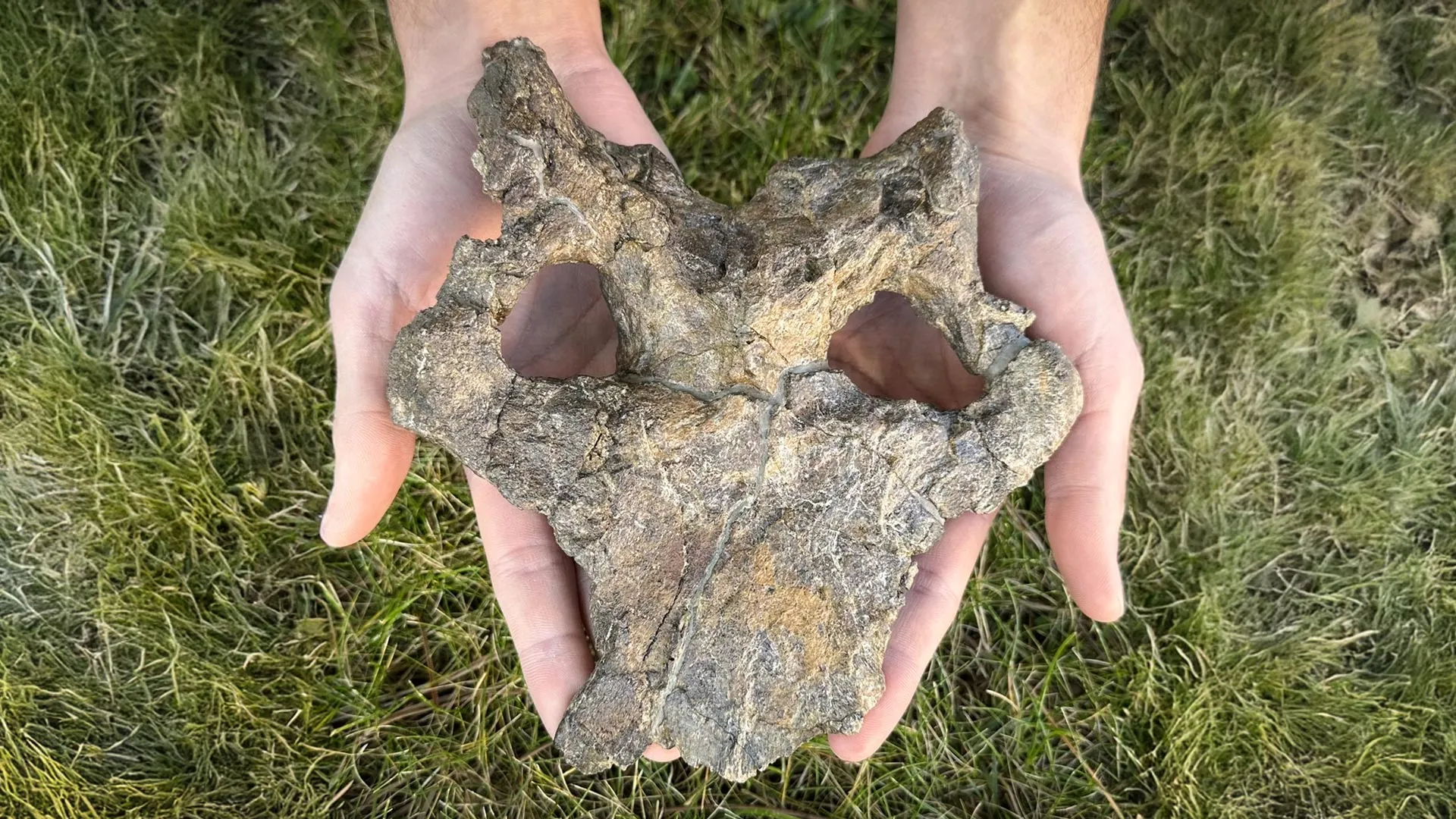
Paleontologists from the Fundación Conjunto Paleontológico de Teruel-Dinópolis have published new findings in the scientific journal Vertebrate Zoology describing an extraordinary stegosaur skull discovered in Riodeva (Teruel, Spain). The fossil, which comes from a plated dinosaur that lived about 150 million years ago, is also helping researchers propose a new explanation for how stegosaurs evolved and spread across the world.
Stegosaurs were plant-eating dinosaurs that walked on four legs and are best known for the rows of plates and spikes running from their necks to their tails. The newly studied fossil was uncovered during excavations led by Fundación Dinópolis at the “Están de Colón” site within the Villar del Arzobispo Formation, which dates back to the Late Jurassic period.
Researchers identified the specimen as Dacentrurus armatus, one of Europe’s most iconic stegosaurs. The fossil is considered the best-preserved stegosaur skull ever discovered in Europe, a remarkable achievement because dinosaur skulls are extremely delicate and rarely survive intact over millions of years.
Sergio Sánchez Fenollosa, researcher at Fundación Dinópolis and co-author of the study, said: “The detailed study of this exceptional fossil has allowed us to reveal previously unknown aspects of the anatomy of Dacentrurus armatus, the quintessential European stegosaur, which in 2025 marks 150 years since its first description. Dinosaurian skulls are rarely preserved due to the extreme fragility of their bones. This discovery is key to understanding how stegosaurian skulls evolved.
“Furthermore, alongside the anatomical study, we have also proposed a new hypothesis that redefines the evolutionary relationships of stegosaurs worldwide. As a result of this work, we have formalized the definition of a new group called Neostegosauria.”
New Dinosaur Evolution Hypothesis
The researchers say Neostegosauria includes medium and large stegosaur species that lived across several continents during different periods of the Jurassic and Early Cretaceous. According to the study, members of this group inhabited areas that are now Africa and Europe during the Middle and Late Jurassic, North America during the Late Jurassic, and Asia during the Late Jurassic and Early Cretaceous.
The team believes this new classification could reshape how scientists understand the evolutionary history and global distribution of plated dinosaurs.
Fossil Site Still Producing Important Discoveries
Alberto Cobos, managing director of Fundación Dinópolis and co-author of the research, emphasized the broader importance of the discovery: “This dual achievement-both the study of an exceptional fossil and the proposal of a new evolutionary hypothesis-positions this research as a global reference in stegosaurian studies.
“This fossil site from Riodeva continues to be a subject of research and still holds numerous relevant fossils, including more postcranial elements from the same adult specimen and, notably, juvenile individuals, a particularly rare combination in this type of dinosaurs. These discoveries continue to exponentially increase the paleontological heritage of the province of Teruel, making it one of the iconic regions for understanding the evolution of life on Earth.”
Scientists say the Riodeva fossil site continues to yield valuable material, including additional bones from the same adult dinosaur and rare juvenile remains. Discoveries like these are helping establish Teruel as one of the world’s most important locations for studying prehistoric life and dinosaur evolution.
Study Published in Vertebrate Zoology
The research appears in Vertebrate Zoology under the title “New insights into the phylogeny and skull evolution of stegosaurian dinosaurs: An extraordinary cranium from the European Late Jurassic (Dinosauria: Stegosauria).” The paper was authored by paleontologists Sergio Sánchez Fenollosa and Alberto Cobos of Fundación Dinópolis.
The project was supported by Fundación Dinópolis, which is affiliated with the Dept. of Medio Ambiente y Turismo of the Gobierno de Aragón. It also forms part of the activities of Research Group E04-23R FOCONTUR, funded by the Gobierno de Aragón through the Dept. of Empleo, Ciencia y Universidades.
Additional support came from the Unidad de Paleontología de Teruel, funded by the Gobierno de España through the Ministry of Ciencia, Innovación y Universidades. Excavation work at the site also received backing through the project Los yacimientos paleontológicos de la provincia de Teruel como factor de desarrollo territorial (IV), funded jointly by the Gobierno de España and the Gobierno de Aragón through the Teruel Investment Fund via the Dept. of Presidencia, Economía y Justicia.