
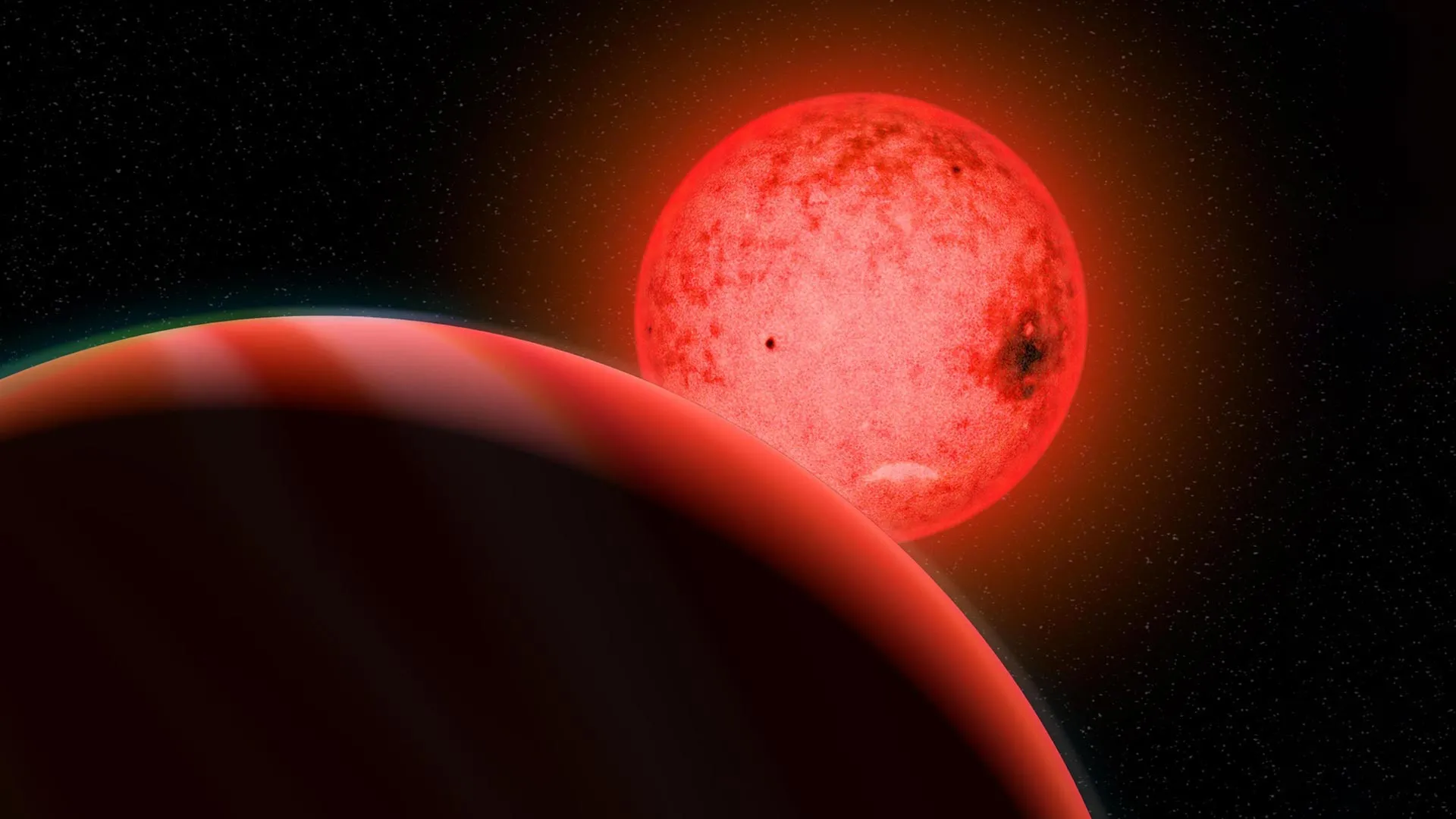
New observations from the James Webb Space Telescope (JWST) are shedding light on a highly unusual exoplanet known as TOI-5205 b, sometimes described as “forbidden.” Scientists found that this giant planet’s atmosphere contains fewer heavy elements than its host star, a surprising result that could reshape how researchers understand the early stages of giant planet formation.
The findings, published in The Astronomical Journal, come from an international team led by Caleb Cañas of NASA’s Goddard Space Flight Center, with contributions from Carnegie Science’s Shubham Kanodia and others.
A Giant Planet Orbiting a Small Star
TOI-5205 b is about the size of Jupiter but orbits a much smaller star, one that is roughly four times Jupiter’s size and only about 40 percent as massive as the Sun. When the planet passes in front of its star in an event known as a “transit,” it blocks about six percent of the star’s light.
During these transits, astronomers used spectrographs to break the starlight into its component colors. This technique allows them to identify the chemical makeup of the planet’s atmosphere and gain insight into how it formed and evolved alongside its host star.
A Puzzle for Planet Formation Theories
Planets typically form within a rotating disk of gas and dust surrounding a young star. While this process is widely accepted, systems like TOI-5205 b challenge existing models. Massive planets orbiting small, cool stars at close distances are difficult to explain using current theories.
To investigate these unusual systems, Kanodia, Cañas, and Jessica Libby-Roberts of the University of Tampa are leading JWST’s largest Cycle 2 exoplanet program, Red Dwarfs and the Seven Giants. This project focuses on rare worlds like TOI-5205 b, often referred to as GEMS (for giant exoplanets around M dwarf stars).
JWST Detects Unexpected Atmospheric Chemistry
TOI-5205 b was first confirmed in 2023, when Kanodia led follow-up observations based on data from NASA’s Transiting Exoplanet Survey Satellite (TESS). Now, researchers have used JWST to examine its atmosphere in detail for the first time.
After observing three transits, the team encountered an unexpected result. The planet’s atmosphere contains significantly fewer heavy elements compared to hydrogen than Jupiter does. Even more surprising, its metallicity is lower than that of its own host star, making it unlike any giant planet studied so far.
The data also revealed the presence of methane (CH4) and hydrogen sulfide (H2S) in the atmosphere.
Heavy Elements May Be Hidden Deep Inside
To better understand these findings, researchers Simon Muller and Ravit Helled at the University of Zurich used advanced models of planetary interiors. Their results suggest that the planet as a whole is about 100 times more metal rich than its atmosphere appears to be.
“We observed much lower metallicity than our models predicted for the planet’s bulk composition, which is calculated from measurements of a planet’s mass and radius. This suggests that its heavy elements migrated inward during formation and now its interior and atmosphere are not mixing,” Kanodia explained. “In summary, these results suggest a very carbon-rich, oxygen-poor planetary atmosphere.”
The GEMS Survey and Future Research
This work is part of the broader GEMS Survey, which aims to study transiting giant planets around M-dwarf stars to better understand their formation, internal structure, and atmospheres. The research team includes Carnegie astronomers Peter Gao, Johanna Teske, and Nicole Wallack, along with former Carnegie postdoctoral fellow Anjali Piette, now at the University of Birmingham.
Additional contributors include researchers from institutions such as Johns Hopkins University’s Applied Physics Laboratory, the Academia Sinica Institute of Astronomy and Astrophysics, Catholic University, the University of Maryland, Caltech, NASA Goddard, the University of St. Andrews, Penn State University, the University of California Irvine, the Tata Institute of Fundamental Research, and the University of Amsterdam.
Correcting for Starspots Improves Accuracy
The team also accounted for interference caused by starspots on the host star. These dark, active regions can distort observations by brightening certain wavelengths and hiding parts of the atmospheric signal.
By correcting for these effects, the researchers improved the accuracy of their measurements. Wallack and Kanodia are now refining this approach in a newer JWST project focused on the same system. Their work could help future studies of planets orbiting active stars produce more reliable results.