
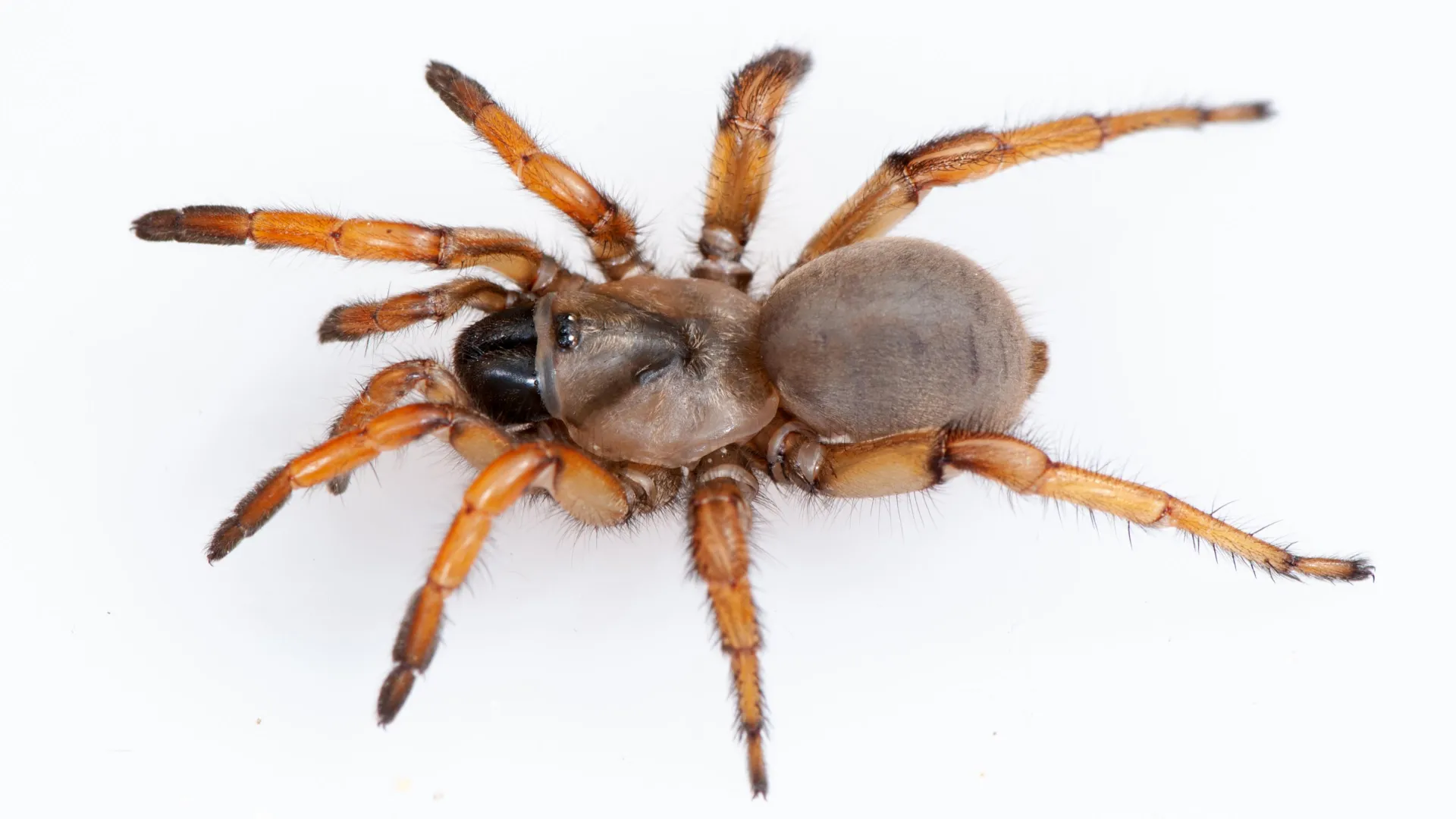
A tiny California spider named after comedian Stephen Colbert is making a big impression on scientists. Although it is only about the size of a quarter, the spider has a genome roughly 50% larger than the human genome.
The species, known as Aptostichus stephencolberti, is a trapdoor spider that lives in California’s coastal dunes. Its unusually large genome seems particularly fitting given Colbert’s famously pompous television persona on the former Comedy Central show “The Colbert Report.”
Many spiders reach their largest size in the fall after spending the summer feeding, making them familiar symbols of Halloween. But this particular spider stands out for something that cannot be seen with the naked eye: the extraordinary amount of DNA packed into its tiny body.
“At 4.6 gigabases, or 4.6 billion DNA base pairs, it’s not the largest genome among the spiders, but it’s significant,” said corresponding author Jason Bond, a professor in the UC Davis Department of Entomology and Nematology.
According to Bond, this is the first time scientists have sequenced the genome of a spider belonging to this family. The findings were published in the Journal of Heredity.
A Secretive Spider That Hunts From Underground
Visitors to the coastal dunes of Northern California may unknowingly pass close to these spiders without ever spotting one. Most of their lives unfold beneath the sand, where they remain hidden in carefully constructed burrows.
Female trapdoor spiders spend their entire lives underground in tunnels lined with silk. Each burrow has a hinged entrance that blends into its surroundings, allowing the spider to stay concealed while monitoring activity outside.
When an unsuspecting insect or other prey animal approaches, vibrations alert the spider to its presence. At precisely the right moment, the spider bursts through its hidden door to capture its next meal.
Although these spiders are skilled ambush predators, their venom poses no danger to humans. Bond noted that among the more than 50,000 known spider species, only about 30 to 50 have venom known to be toxic to people.
A Spider Genome Bigger Than the Human Genome
The spider’s DNA contains more surprises than its sheer size. Researchers found that its genome includes 52 chromosomes, compared with the 46 chromosomes typically found in human cells, which are organized into 23 pairs.
However, having a larger genome does not necessarily mean having more genes. In this spider, approximately 77% of the genome consists of repetitive DNA sequences that appear many times throughout its genetic material.
The research also highlights an unusual feature of spider chromosomes. Spiders lack the conventional repetitive DNA sequences associated with telomeres, the protective structures at the ends of chromosomes. This difference could help explain why spider chromosomes appear to evolve more rapidly than those of vertebrates.
“It lends itself to broadening our understanding of spider genome composition and consequently how genomes have evolved across the animal Tree of Life,” Bond said.
Why Is the Spider Named After Stephen Colbert?
The story behind the spider’s unusual scientific name dates back to 2008, when Stephen Colbert discovered that Bond had named a trapdoor spider after rock musician Neil Young.
Not wanting to be left out, Colbert turned the situation into a comedy segment. During “Who’s Not Honoring Me Now?” on “The Colbert Report,” he publicly demanded that Bond name a spider in his honor.
Bond agreed, and Aptostichus stephencolberti became Colbert’s namesake in the spider world.
Rising Seas Threaten California’s Trapdoor Spiders
Beyond revealing the spider’s genetic peculiarities, the research could play an important role in protecting the species.
The genome sequencing effort is part of the California Conservation Genomics project, a state-funded initiative designed to build a collection of genomic information that scientists can use to guide conservation decisions.
Trapdoor spiders generally do not venture far from their burrows, making it difficult for populations to move between habitats. Because their coastal dune environments are already separated into isolated areas, researchers hope genetic information will help them identify distinct populations that may need special protection.
“We Californians love our beaches and trapdoor spiders share them with us,” Bond said. “We’re hoping to understand how things like climate change, fire and urbanization might be impacting the genetic diversity of species.”
Aptostichus stephencolberti (the “t” in Colbert is silent) is found only in coastal dunes along a limited stretch of Central California, extending from the San Francisco Bay area to Monterey.
This restricted range makes the species particularly vulnerable to environmental changes. Rising sea levels could eliminate portions of its coastal habitat, while invasive species pose another significant danger.
“They’re going to be incredibly sensitive to sea-level rise, but they’re also very sensitive to invasive species,” Bond said.
Spider Venom Could Hold Clues to New Medicines
The potential benefits of studying this spider’s genome extend beyond conservation and evolutionary biology. Scientists also hope that understanding spider genetics will help them explore the vast range of chemical compounds found in spider venom.
Some substances identified in spider venoms have shown promise as potential painkillers, while others could be useful in developing new ways to control agricultural pests.
With so many spider species still poorly understood at the genetic level, researchers believe their venoms may contain valuable compounds that have yet to be discovered.
“We don’t really know what’s out there in terms of untapped natural product diversity for venoms,” Bond said.
The study’s additional authors include Stephen Richards, Emma Jochim, Lacie Newton, James Starrett, Ruta Sahasrabudhe and Oanh Nguyen of UC Davis; Eric Beraut, Colin Fairbairn, Samuel Sacco, William Seligmann and Merly Escalona of UC Santa Cruz; Robert D. Cooper of Virginia Polytechnic Institute and State University; and H. Bradley Shaffer and Erin Toffelmier of UCLA.
The research received support from the California Conservation Genomics Project, with funding provided to the University of California through the state of California’s State Budget Act of 2019, as well as from the National Science Foundation.