
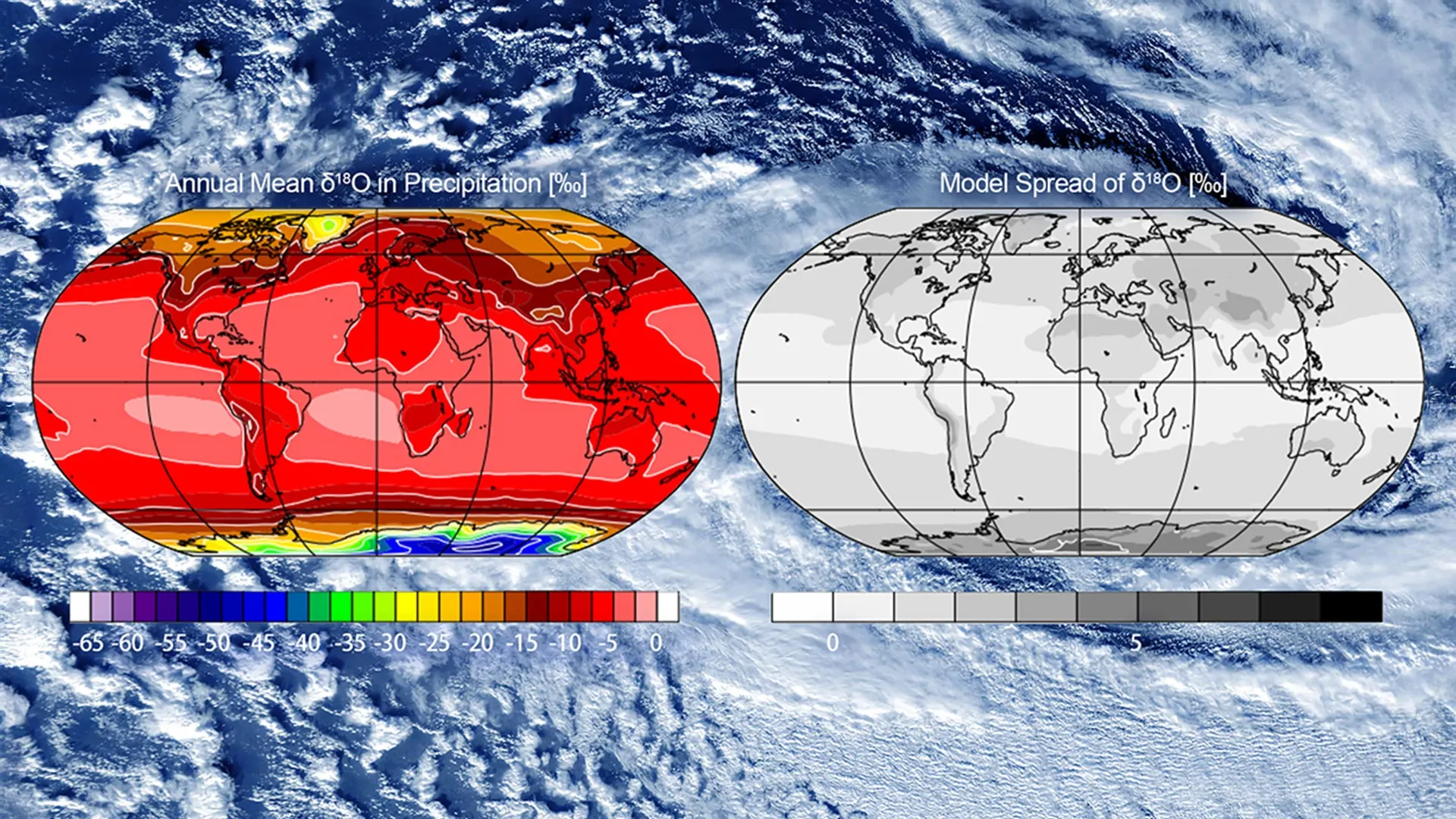
Scientists can now follow the path of a single drop of water across the globe. Water is made of hydrogen and oxygen, and some of these atoms naturally exist in slightly heavier forms called isotopes. As water evaporates, forms clouds, and moves through the atmosphere, the proportion of these isotopes shifts in consistent and measurable ways. Those shifts act like a fingerprint, helping researchers map how water travels on a global scale.
When this isotope data is combined with hydrological models, it becomes a powerful tool. Scientists can use it to better understand extreme weather events such as storms, flooding and droughts, and to improve projections of how climate change may alter future weather patterns.
Improving Climate Models With Isotope Data
Some climate models already account for isotopic processes, but no single model can perfectly capture the complexity of Earth’s water cycle. In a study published by Journal of Geophysical Research: Atmospheres, researchers at the Institute of Industrial Science, The University of Tokyo used a method known as an ensemble, which combines multiple models at the same time. Their ensemble brought together eight isotope-enabled climate models and covered a 45-year period from 1979 to 2023.
Each model was driven by the same wind and sea-surface temperature data. This setup allowed the team to evaluate how individual models handled water cycle physics and to compare the combined ensemble average with real-world climate observations.
Why Water Isotopes Matter for Climate Science
“Changes in water isotopes reflect shifts in moisture transport, convergence, and large-scale atmospheric circulation. Although we know, at a simple level, that isotopes are affected by temperature, precipitation and altitude, the variability of current model simulations makes it difficult to interpret the results,” said Professor Kei Yoshimura, one of the senior authors of the study, who advised on several of the isotope-enabled climate models participating in the project. “We are delighted that our ensemble mean values capture the isotope patterns observed in global precipitation, vapor, snow, and satellite data much more successfully than any of the individual models.”
Links to Global Climate Patterns
Looking at the past 30 years, the ensemble simulations showed an overall rise in atmospheric water vapor linked to increasing global temperatures. The results also revealed strong connections to major interannual climate patterns, including the El Niño-Southern Oscillation, the North Atlantic Oscillation, and the Southern Annular Mode. These large-scale systems influence global water availability over multiple years and affect billions of people worldwide.
“Ensembles offer a nuanced modeling approach that reduces divergence between individual models. This approach allows us to separate the effects of how each model represents water cycle processes from differences arising from individual model structures,” said Dr. Hayoung Bong, alumnus of the Institute of Industrial Science, The University of Tokyo, now at NASA Goddard Institute for Space Studies.
A World-First Climate Modeling Framework
This research represents the first time multiple isotope-enabled climate models have been integrated into a single unified framework. The resulting ensemble closely aligns with observed data, providing a more reliable picture of how water moves through the global climate system.
“Importantly, the research advances our ability to interpret past climate variability and provides a stronger foundation for understanding and predicting how the global water cycle and the weather it shapes will respond to continued global warming,” said Professor Yoshimura.