
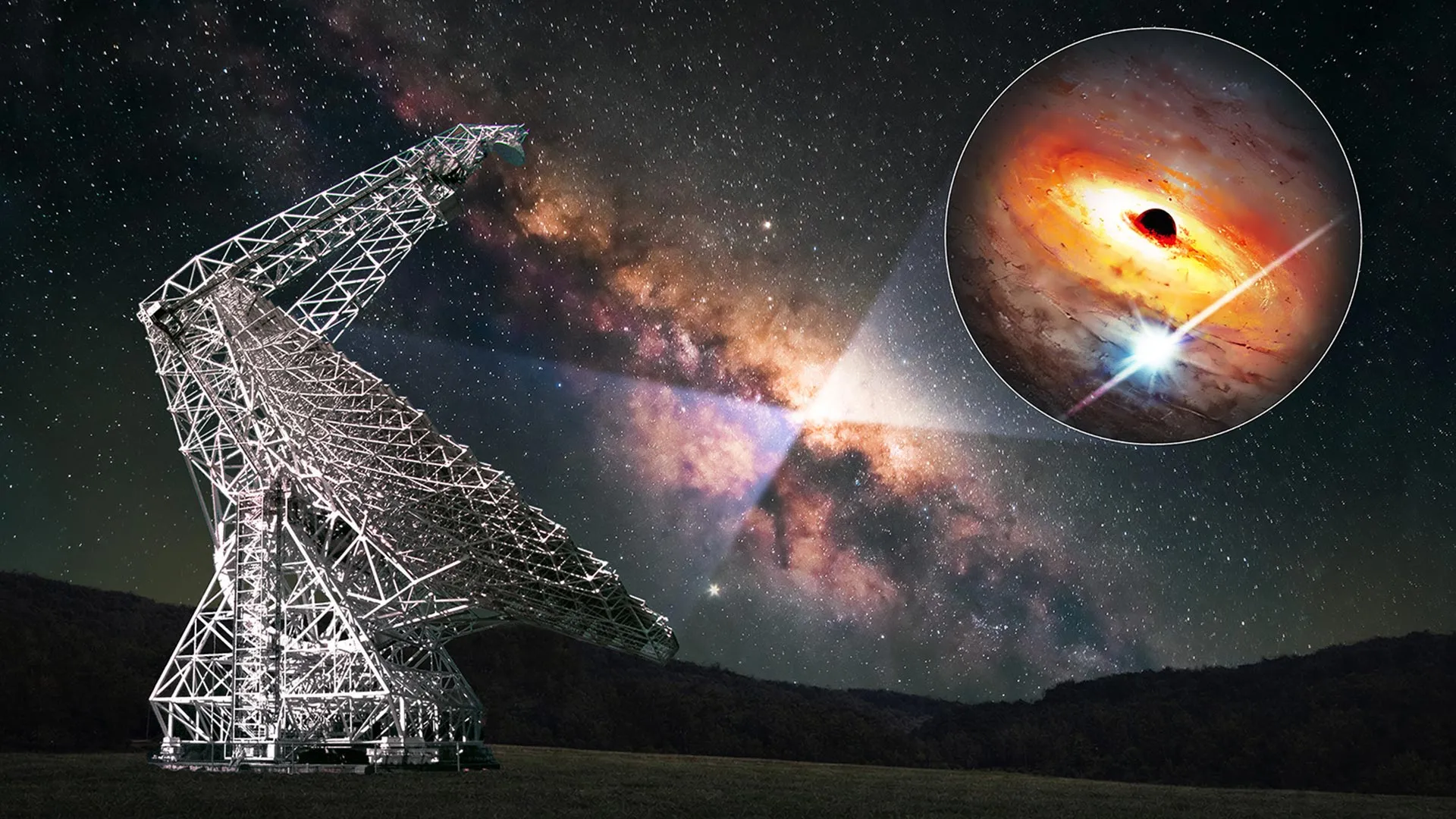
Scientists at Columbia University working with Breakthrough Listen, a research initiative focused on searching for signs of civilizations beyond Earth, have reported new findings from the Breakthrough Listen Galactic Center Survey. This project represents one of the most sensitive radio investigations ever carried out to search for pulsars in the turbulent central region of the Milky Way. The research was led by recent Columbia PhD graduate Karen I. Perez and published in The Astrophysical Journal.
During the survey, researchers identified a promising 8.19-millisecond pulsar (MSP) candidate located close to Sagittarius A*, the supermassive black hole at the center of our galaxy.
A Potential Tool for Testing Einstein’s General Relativity
If astronomers can confirm the object and precisely measure the timing of its pulses, it could create a rare opportunity to test General Relativity under extreme conditions. Tracking a pulsar in this environment would allow scientists to make highly accurate measurements of space-time around a supermassive black hole.
Pulsars are dense remnants of massive stars known as neutron stars. They spin rapidly and generate intense magnetic fields, producing focused beams of radio waves that sweep across space like the beam of a lighthouse.
When undisturbed by outside forces, the radio pulses from a pulsar reach Earth with remarkable consistency. Because of this steady rhythm, pulsars function like highly reliable cosmic clocks. Millisecond pulsars spin especially fast, which makes their timing behavior even more stable and predictable.
How Gravity Can Distort a Pulsar’s Signal
“Any external influence on a pulsar, such as the gravitational pull of a massive object, would introduce anomalies in this steady arrival of pulses, which can be measured and modeled,” said Slavko Bogdanov, a research scientist at the Columbia Astrophysics Laboratory who was a co-author on the study. “In addition, when the pulses travel near a very massive object, they may be deflected and experience time delays due to the warping of space-time, as predicted by Einstein’s General Theory of Relativity.”
Sagittarius A* contains about 4 million times the mass of the Sun, giving it a powerful gravitational reach that strongly affects nearby objects.
Follow Up Observations Underway
Because of the possible scientific significance, researchers are now analyzing additional follow up observations to determine whether the pulsar candidate is genuine.
To encourage broader scientific collaboration, Breakthrough Listen is making the data publicly available. This allows research teams around the world to conduct their own independent analyses and explore related scientific questions.
“We’re looking forward to what follow-up observations might reveal about this pulsar candidate,” Perez said. “If confirmed, it could help us better understand both our own Galaxy, and General Relativity as a whole.”