
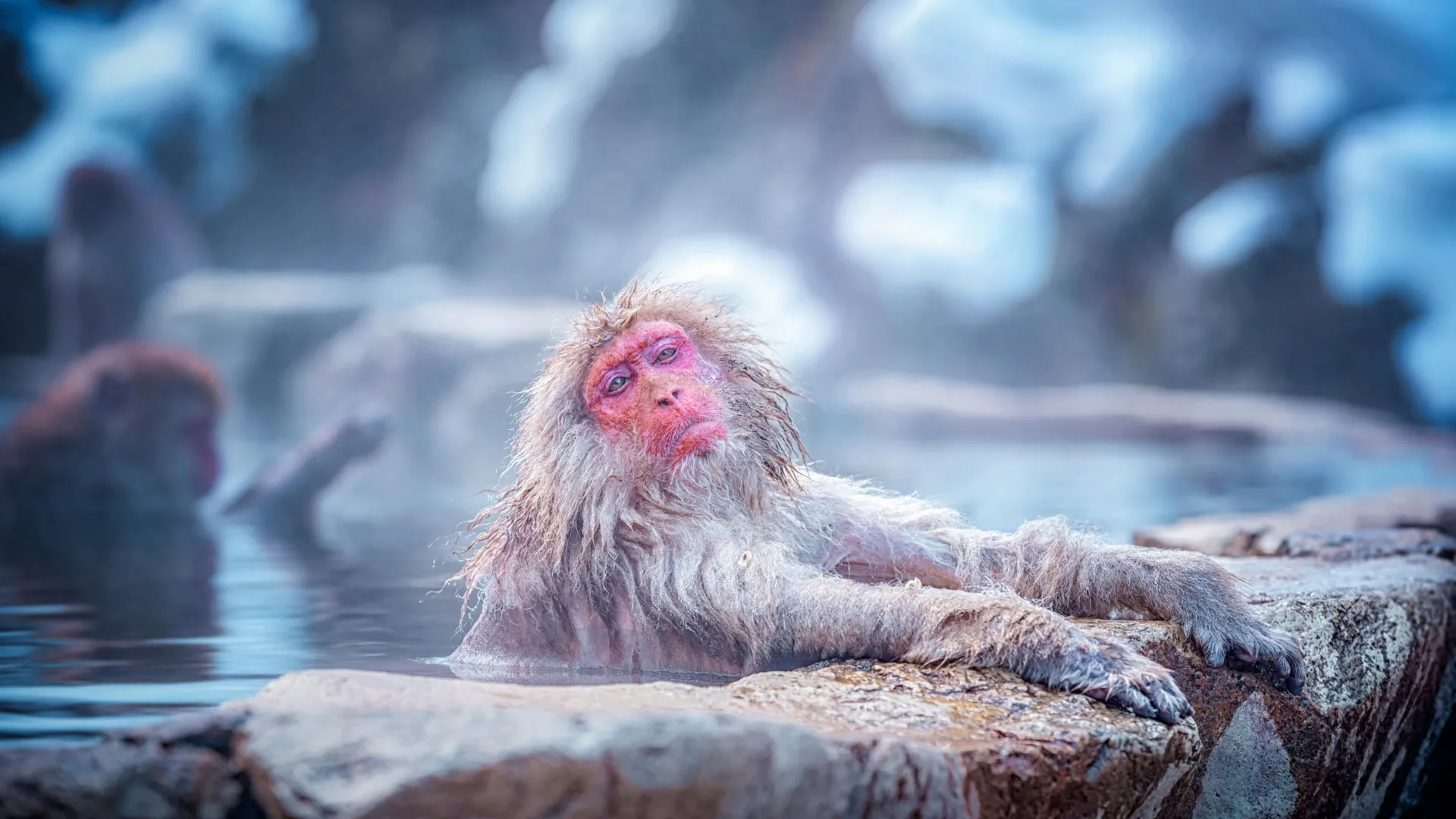
Japanese macaques, better known as snow monkeys, are famous for sitting in steaming hot springs when temperatures drop. While the warm water clearly helps them cope with winter cold, researchers at Kyoto University found that these baths do more than provide heat.
“Hot spring bathing is one of the most unusual behaviors seen in nonhuman primates,” says first author Abdullah Langgeng. His team wondered whether regularly soaking in hot springs might also influence the parasites and microscopic organisms that live on and inside the monkeys.
Studying Parasites and the Gut Microbiome
To find out, the researchers traveled to Jigokudani Snow Monkey Park in Nagano prefecture. Over the course of two winters, they tracked a group of female macaques, comparing those that frequently bathed in hot springs with those that rarely or never did. The scientists combined direct behavioral observations with parasite checks and gut microbiome sequencing. Their goal was to determine whether bathing affects the macaque holobiont, the combined biological system made up of the animal and the microbes and parasites associated with it.
The findings showed that time spent in hot springs subtly changes how the monkeys interact with parasites and gut microbes. Monkeys that soaked in the warm water had different patterns of lice on their bodies and differences in certain gut bacteria. This suggests that immersion in hot water may interfere with lice activity or where they lay their eggs.
Subtle Microbial Shifts Without Higher Infection Risk
The researchers also detected modest differences in the gut microbiome. Overall diversity of gut bacteria was similar between monkeys that bathed and those that did not. However, several bacterial genera were more common in individuals that skipped the hot springs. Importantly, sharing the pools did not appear to raise the risk of intestinal parasites. Bathing macaques showed no increase in parasite infection rates or severity.
Taken together, the results show that behavior can influence the animal holobiont and play a meaningful role in health. The study highlights how complex the relationship between behavior and health can be in wild animals. Bathing changed some interactions between the monkeys and the organisms that live with them, while leaving others unaffected.
“Behavior is often treated as a response to the environment,” says Langgeng, “but our results show that this behavior doesn’t just affect thermoregulation or stress: it also alters how macaques interact with parasites and microbes that live on and inside them.”
What This Means for Animal and Human Health
This research is among the first to connect a natural behavior in a wild primate with changes in both ectoparasites and the gut microbiome. By demonstrating that behavior can selectively shape elements of the holobiont, the findings offer insight into how health related behaviors may have evolved and how microbiomes vary in social animals.
The study also suggests parallels with people. Human habits such as bathing can influence exposure to microbes, and the results challenge the idea that shared water sources automatically increase disease risk, at least under natural conditions.