
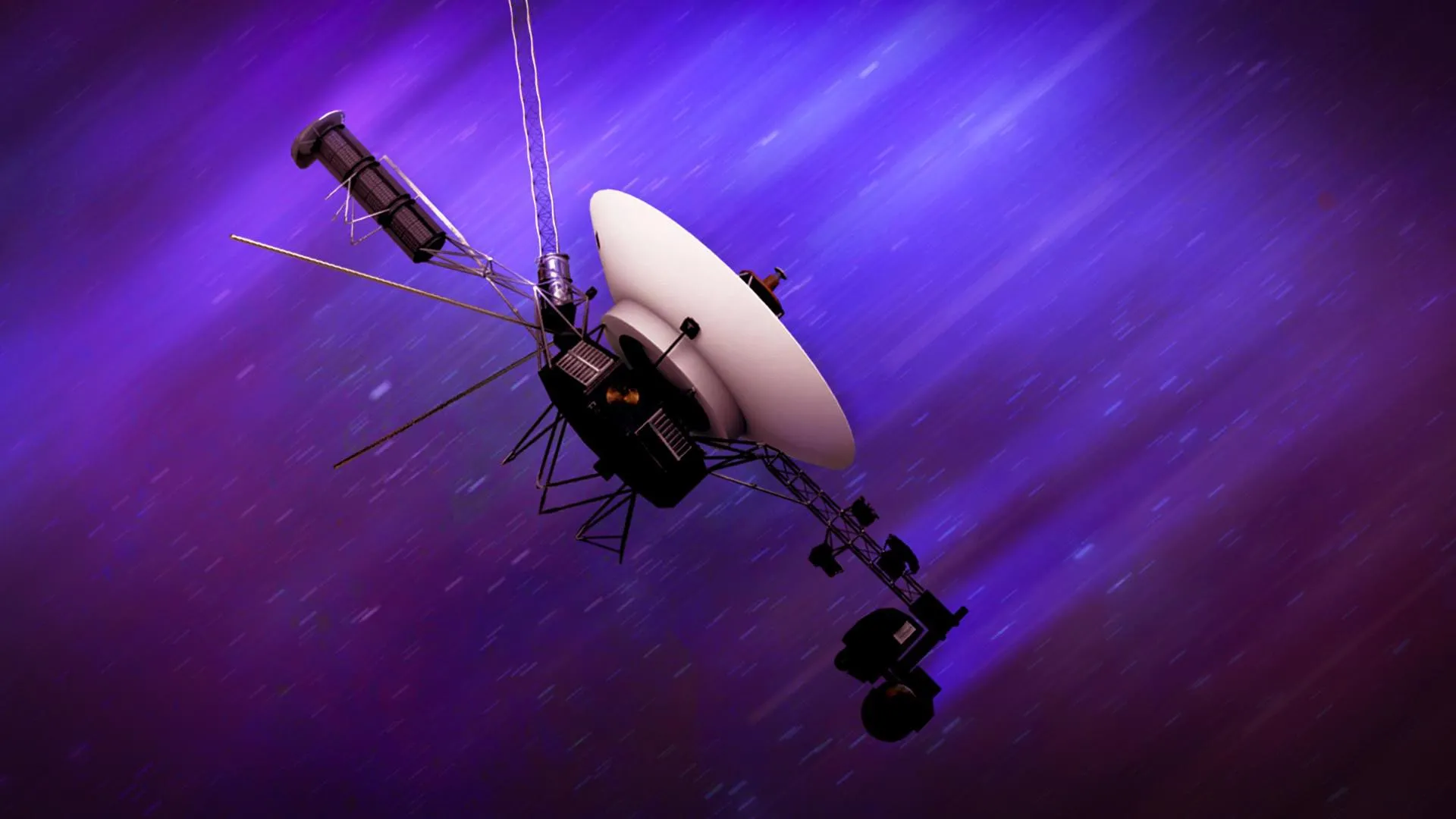
On April 17, engineers at NASA’s Jet Propulsion Laboratory (JPL) in Southern California sent a command to turn off an instrument on Voyager 1 known as the Low-energy Charged Particles experiment, or LECP. The spacecraft, powered by a nuclear energy source, is gradually losing power, and shutting down this instrument is the most effective way to extend the life of humanity’s first mission into interstellar space.
The LECP has operated almost continuously since Voyager 1 launched in 1977, nearly 49 years ago. It studies low-energy charged particles such as ions, electrons, and cosmic rays that come from both our solar system and the wider galaxy. Over the decades, it has delivered valuable insights into the interstellar medium, including detecting pressure waves and changes in particle density beyond the heliosphere. Voyager 1 and Voyager 2 remain the only spacecraft far enough from Earth to collect this kind of data.
Power Supply Shrinks After Decades in Space
Voyager 1, like its twin Voyager 2, is powered by a radioisotope thermoelectric generator that converts heat from decaying plutonium into electricity. Each spacecraft loses about 4 watts of power every year. After nearly 50 years in operation, available power has become extremely limited. Engineers must carefully reduce energy use by shutting off heaters and instruments while also preventing the spacecraft from becoming so cold that its fuel lines freeze.
During a planned roll maneuver on Feb. 27, Voyager 1 experienced an unexpected drop in power. Engineers realized that any further decline could activate the spacecraft’s undervoltage fault protection system. This system would automatically shut down components to protect the probe, requiring a complex recovery process that carries additional risks.
The team decided to act before that could happen.
“While shutting down a science instrument is not anybody’s preference, it is the best option available,” said Kareem Badaruddin, Voyager mission manager at JPL. “Voyager 1 still has two remaining operating science instruments — one that listens to plasma waves and one that measures magnetic fields. They are still working great, sending back data from a region of space no other human-made craft has ever explored. The team remains focused on keeping both Voyagers going for as long as possible.”
Long-Planned Strategy for Instrument Shutdowns
The decision to turn off the LECP was not made suddenly. Years earlier, scientists and engineers developed a step-by-step plan for shutting down systems in a specific order while preserving as much scientific capability as possible. Each Voyager originally carried 10 sets of instruments, and seven have already been turned off. The LECP was next on the list for Voyager 1. The same instrument was shut down on Voyager 2 in March 2025.
Because Voyager 1 is now more than 15 billion miles (25 billion kilometers) from Earth, communication takes time. It takes about 23 hours for commands to reach the spacecraft, and once received, the shutdown process takes roughly three hours and 15 minutes to complete.
One small part of the LECP will continue operating. A motor that rotates the sensor to scan in all directions remains active because it uses very little power (0.5 watts). Keeping it on increases the possibility that the instrument could be restarted in the future if enough power becomes available.
Future Plans to Extend the Voyager Mission
Engineers expect that turning off the LECP will provide Voyager 1 with about one additional year of operation. During this time, the team is preparing a more advanced power-saving strategy known as “the Big Bang.” This approach involves replacing several power-consuming components at once with more efficient alternatives to maintain enough warmth and functionality for continued science operations.
The Big Bang will first be tested on Voyager 2, which has slightly more available power and is closer to Earth, making it a lower-risk candidate. Tests are scheduled for May and June 2026. If successful, the same approach will be applied to Voyager 1 no earlier than July.
If the plan works as hoped, there is even a possibility that Voyager 1’s LECP instrument could be turned back on in the future.