
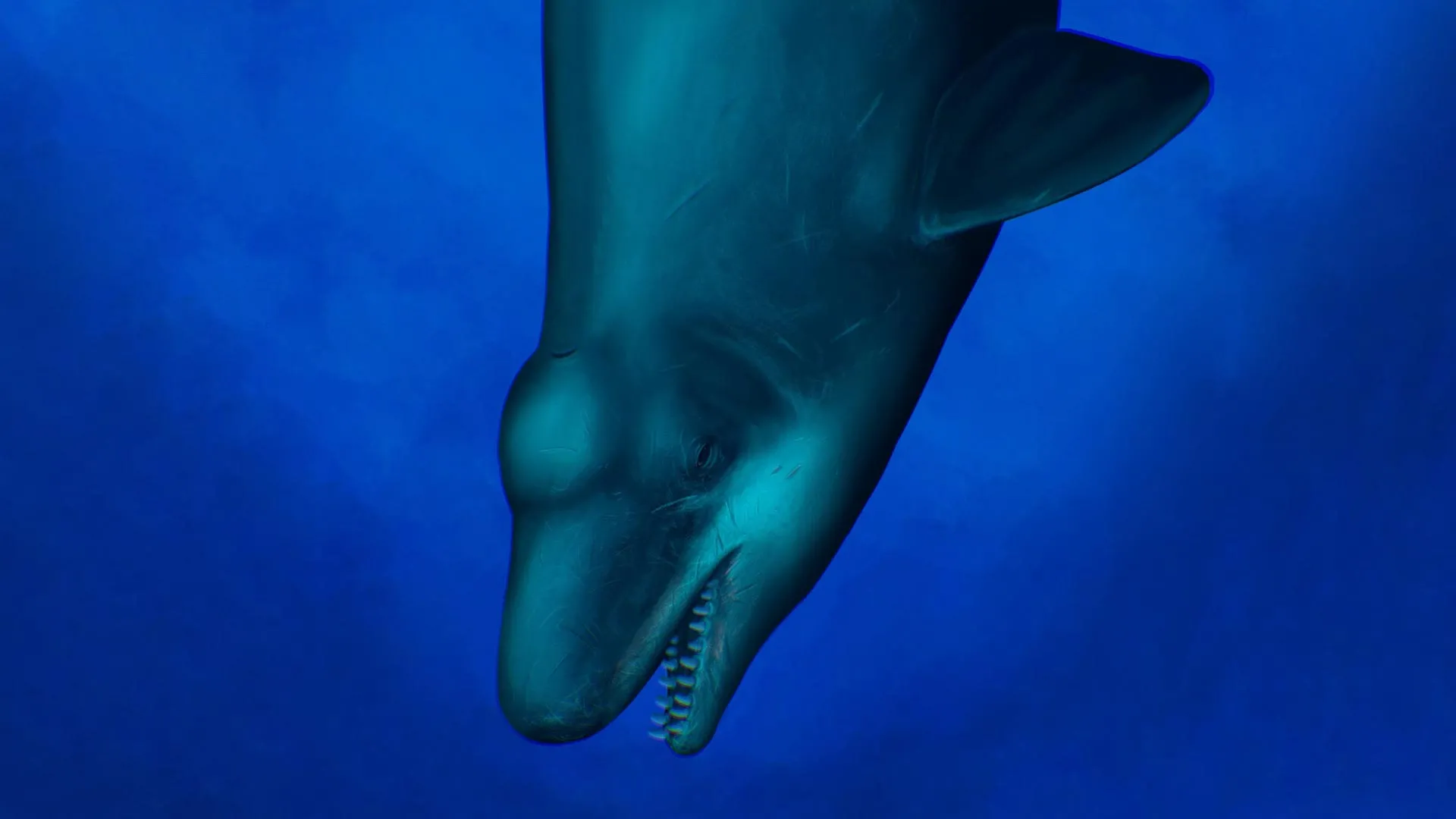
A bizarre prehistoric whale that lived roughly 6 million years ago had a face so crooked that researchers initially suspected its fossilized skull had been distorted after death. Instead, its extraordinary shape was completely natural and may represent the most extreme facial asymmetry ever documented in a mammal.
Sperm whales and pygmy sperm whales are already known for having some of the strangest head shapes among mammals. While most vertebrates have bodies and skulls that are roughly symmetrical on both sides, toothed whales have evolved uneven skull structures to accommodate specialized organs responsible for producing sound and navigating through echolocation.
Now, an international team of scientists has identified an extinct pygmy sperm whale species that took this unusual anatomy to an entirely new level. Named Scaphokogia huachafo, the whale lived during the Late Miocene, between 6.3 and 5.6 million years ago, and measured approximately 2.7 meters in length. Its fossilized skull displays the most extreme facial asymmetry known in any whale or dolphin, and possibly in any mammal.
A Prehistoric Whale With an Extraordinary Skull
“Cranial asymmetry in toothed whales is directly linked to the development of fatty structures in the forehead that are involved in sound production. But in Scaphokogia huachafo, this asymmetry went far beyond the area around the blowhole. Both bony nostrils are shifted entirely to the left side of the skull, while the facial bones differ dramatically in size and position. The skull looks completely crooked,” explains Aldo Benites-Palomino, lead author of the study.
Benites-Palomino investigated the fossil during his doctoral research at the University of Zurich’s Department of Paleontology. He is currently an assistant professor at Friedrich-Alexander-Universität Erlangen-Nürnberg (FAU).
The whale’s extraordinary appearance also inspired its scientific name. The word huachafo comes from Peruvian Spanish and is commonly used to describe something excessively flashy, bizarre, extravagant, or even tacky.
“In Peru, huachafo is an everyday word for anything that is flashy, over-the-top, bizarre, extravagant or difficult to categorize aesthetically,” says Benites-Palomino.
“When we looked at the proportions of this whale – with its face strongly shifted to the left and its oversized, downward-curving snout – it broke every rule of symmetry and elegance seen in living cetaceans. Its anatomy is so extravagant and odd that huachafo seemed the perfect name for it.”
Scientists Initially Suspected the Skull Was Deformed
The remarkable fossil was originally recovered during the mid-1990s from the Pisco Formation in southern Peru. This desert region is famous among paleontologists for its exceptionally preserved fossils of ancient marine animals.
Benites-Palomino first encountered the specimen in 2015 while preparing his Bachelor’s thesis at the Museo de Historia Natural in Lima. Its dramatically uneven shape immediately raised an important question: Was the skull genuinely this crooked when the whale was alive, or had millions of years of geological pressure distorted it?
“The initial suspicion with skulls this distorted is always taphonomy – that the specimen may have been flattened or twisted by sediment pressure over millions of years,” says Benites-Palomino.
“But the sutures are fully closed, and there are no fractures, pathologies or deformations elsewhere on the skull. This was genuine biology, not a result of poor preservation.”
The findings confirmed that the extraordinary asymmetry was part of the whale’s natural anatomy, rather than damage caused by burial, fossilization, or disease.
A Bizarre Adaptation for Hunting Along the Seafloor
The whale’s unusual skull also offers clues about how it survived. Modern sperm whales typically pursue squid in deep ocean waters, but Scaphokogia huachafo appears to have followed a very different hunting strategy. Its anatomy suggests that it was highly adapted to searching for food along the bottom of shallow coastal waters.
One of its most distinctive features was a large, tube-shaped snout strengthened by dense bone and cartilage that had hardened into bone. These heavy structures served as natural ballast, moving the whale’s center of gravity forward and downward.
Its snout also pointed downward at an angle of 31 degrees relative to the rest of its skull. By reconstructing the joint connecting the skull to the first neck vertebra, known as the atlas, scientists determined that Scaphokogia could bend its head downward by as much as 55 degrees.
“The entire cranio-cervical complex is modified to point the snout directly toward the bottom,” explains Gabriel Aguirre-Fernández, co-author of the study and doctoral advisor at the University of Zurich.
“The combination of dense bone, the downward-curving snout and the flexible neck articulation allowed the animal to move directly above the seabed and feed close to the sediment.”
Researchers also believe the whale may have relied on its highly specialized echolocation system to locate prey beneath the soft sediment of coastal environments. Unlike other marine mammals that forage along the ocean floor, Scaphokogia lacked the sensitive facial whiskers or specialized visual adaptations that can help animals find food near the bottom.
Instead, its extraordinarily asymmetrical skull may have supported a sophisticated biological sonar system that allowed it to detect hidden prey.
This unusual feeding strategy represents a specialized way of life that no longer exists among modern marine mammals. As ocean conditions shifted toward the end of the Miocene, the ecological niche occupied by Scaphokogia disappeared, eventually giving way to the marine mammal communities familiar today.
The discovery provides a remarkable glimpse into how far evolution once pushed the anatomy of whales, producing a creature whose dramatically crooked face was not a deformity, but an adaptation to a vanished underwater world.